
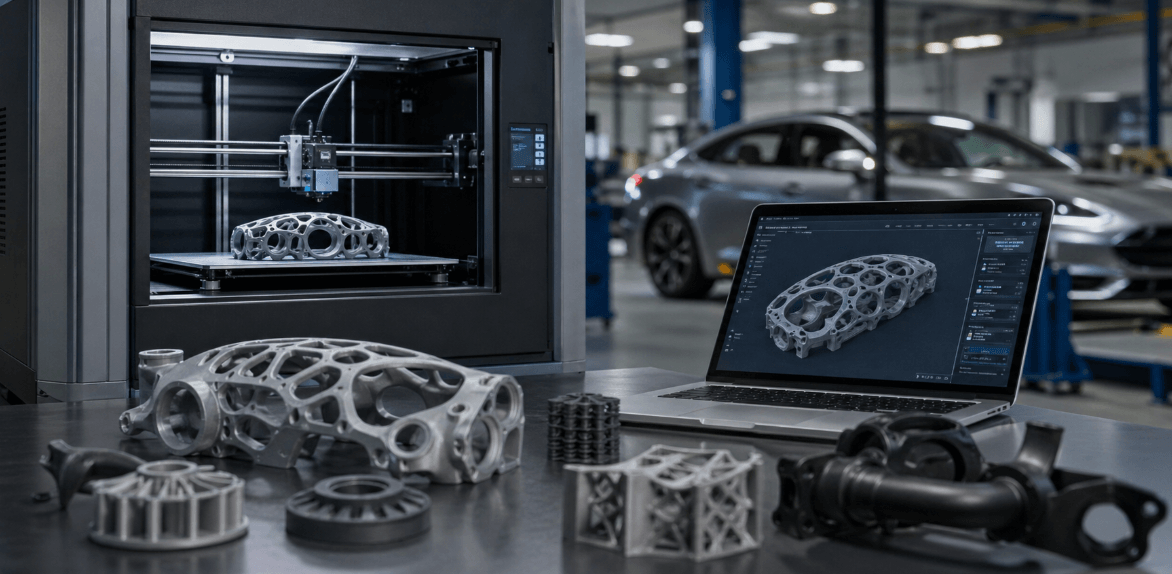

In the automotive industry, 3D printing introduces new capabilities in manufacturing and design. With the advancement of 3D printing technology, making custom parts and solutions for cars has never been easier. Thus, the costs for making a car will drop while productivity will increase. Prototyping will not only take less time but also custom-made components will be produced, which will open up new design possibilities. The introduction of 3D printing has allowed vehicles to be manufactured with distinctively unique and precise characteristics which are on demand.
3D printing is transforming many sectors as well as the designs what were considered impossible just a decade ago. From simple shapes to intricate ones. Not only is it improving efficiency, but it’s also paving the way for a future where cars could become so personalized it would be unprecedented in every detail.
What is 3D Printing?
Additive manufacturing or 3D printing is the process of creating objects by adding material on top of one another layer by layer using a computer control. 3D printing is a process that builds an object up, adding the material rather than cutting the material or shaping the material through other methods. Therefore, it can create complex shapes that may be too complex or far-fetched to produce through conventional means. A 3D printer UAE enables designers and engineers to create impressive parts and realize ambitious concepts.
In automotive applications, it is used to manufacture detailed and performance-oriented parts. 3D printing technology is also changing other industries like healthcare, where customised implants and prosthetics are being manufactured. 3D printing is creating new opportunities for innovation and breaking barriers in product design and manufacturing through customised solutions.
Printing 3D Technologies
Many types of 3D printing technologies are used in the automotive industry. The most favored ones are
FDM (Fused Deposition Modeling).
Fused deposition modeling is one of the most widely used 3D printing methods. It melts thermoplastic filament that is shaped or layered to build up physical objects. In the automotive sector, it’s a valuable method for producing functional prototypes and inexpensive parts. The FDM process is simple but effective since it enables a designer to create 3D models quickly and effectively. A versatile tool, it promotes creativity and efficiency, allowing the development of new products and innovations.
Laser-Driven Powder Melting
SLS involves the utilization of a laser to fuse powdered materials like metal or nylon.
This method works well for making parts that are durable, high performance, and good for small runs. The SLS technique enables complex designs and durable parts possessing an ideal combination of creativity and functionality. It’s particularly helpful in automotive construction for designing custom, high-quality parts. Selective Laser Sintering bonds powder particles layer by layer to make parts which are functional and custom-made.
Stereolithographic Printing
SLA 3D printing harnesses laser technology to solidify liquid resin layer by layer, creating parts with high accuracy and detail. It’s a great solution for creating complicated and precise prototypes. SLA can produce complex parts with intricate detail, this is the reason why engineers use SLA to perfect designs in automotive before mass production.
Advantages of 3D Printing in Automotive
As 3D printing manufacturing technology grows more robust, the automotive industry continues to take full advantage of the capabilities. The continued proliferation of 3D printing will continue to enable companies to cut costs, speed up development, and enhance design possibilities.
Budget Efficiency
3D printing can save a lot of money due to fewer waste materials. The process of this method additively building objects layer by layer, it utilizes only the amount of material necessary rather than cutting. With this system, car manufacturers can produce small quantities of limited series or custom-made parts. Without expensive molds and machines.
Quick Prototyping
With 3D printing, automotive manufacturers can produce prototypes more quickly and at a lower cost something which is crucial in the automotive industry. With the ability for engineers and designers to quickly create car components these days, design changes can be made without delays. New Vehicle Models To Be Introduced Faster Thanks To This Rapid Prototyping Technique
Freedom of Customization of Designs
3D printing’s ability to create complicated, one-of-a-kind designs is possible due to fewer mold and tool constraints than conventional manufacturing techniques. This technology enables car manufacturers to experiment with interesting geometric shapes and light-weight structures which would be difficult or even impossible with traditional methods.
Manufacturers can also create customized parts and features with 3D printing to deliver a more tailored product.
Uses of 3D Printing in Automobile
The automotive industry is already using 3D printing in different ways, such as making prototypes and final parts.
Creating and Experimenting
The automotive industry use 3D printing rapid prototyping often. This system enables engineers to evaluate the design, fit, performance of components prior to mass production. This system speeds up the development & testing phase, ensuring superior quality control & efficient manufacturing.
Manufacturing Extra Components.
From custom automotive parts to rapid manufacturing of something in four-walls, 3D printing is an affordable solution. When a part is unavailable or hard to source, manufacturers can respond by quickly 3D printing it. This capability can substantially enhance the efficiency of vehicle repairs and maintenance.
Personalizing A Car
Three-dimensional printing creates new opportunities to manufacture personalized car parts. The technology allows to produce unique internal furnishings, body components, and special external fittings. This customization improves customer service while providing car owners with the unique look for their auto accessory that they wouldn’t have achieved otherwise.
Limitations and Obstacles.
While 3D printing has several advantages in automotive industry, there are challenges and limitations of 3D printing and this must also be checked.
Material Constraints
Although 3D printing technology is advancing at a rapid pace, there are still limited materials suitable for the automotive industry, namely plastics and composites. Advanced methods like selective laser sintering (SLS) or direct metal laser sintering (DMLS) are needed to produce components from stronger materials like metals and special alloys.
Nevertheless, these processes are not yet widespread. Due to this, continuous development of more durable materials having strong performance properties will be critical to the automotive industry and will see growth as an innovation driver in the future.
Safety and Regulatory Norms
Car makers should check whether the parts made using 3D printing are up to standards and are safe. The auto industry has stringent laws regarding the performance, durability and safety of vehicle components, so that is not an easy task. To qualify for mass manufacturing of automobiles, parts produced by 3D printing must pass stringent testing and certification. It can hinder the introduction of these technologies into production.
Challenges Related to Scalability
3D printing is perfect for prototyping, but making it mass-producible is more complex than it sounds. 3-D printing is slow compared to traditional methods such as injection molding or stamping. These conventional methods create many units at once, while 3-D printing builds an item layer by layer.
To make 3D printing competitive for large-scale production, various areas need to be improved. Increased efficiency must be achieved with faster printing technologies, such as laser filament-based systems. Moreover, the diversity and quality of the products would be improved if the usable materials can be expanded to new polymers, metals, and composites. Cost efficiency is also important. Reducing the cost of equipment and raw materials, as well as improving infrastructure, would help in making 3D printing viable for mass production.
In summary, to scale up and gain widespread acceptance in traditional manufacturing industries, it is critical for 3D printing to address speed, materials and cost.
Future Trends in Automotive 3D Printing
Owing to the continual evolution of 3D printing, several emerging trends are set to revolutionize the automotive industry.
Joining forces with artificial intelligence and automation
Combining artificial intelligence and automation on the 3D printing process can enhance efficiency and accuracy significantly. Artificial Intelligence improves the design and production process by predicting and suggesting problems. Automated 3D printing setups could enhance speed and reduce human error in the workflows.
Sustainable Methods
The auto industry is placing a greater emphasis on sustainability and the potential of 3D printing to lower the carbon footprint. The technological advancement enhances in-efficient production processes which reduces waste and energy usage through addition of the material layer by layer rather than removal. Also, it encourages recycling and other sustainable uses of materials. In addition, 3D printing could create lighter components, potentially boosting fuel efficiency and helping to reduce emissions associated with this process.
Conclusion
The automotive industry stands to benefit immensely as 3D printing continues to disrupt manufacturing in terms of cost, speed and customisation. Despite obstacles concerning material constraints, regulatory frameworks and scalability, the future of 3D printing in the automotive sector appears bright. With the evolution of technology, the potential of 3D printing to change vehicle design, production, and repairs is vast. Also, automotive manufacturers must use 3D printing in response to the market competition.