
In blind head-to-head evaluations, ClickUp’s newly launched Brain2 defeated standalone ChatGPT and Claude every single time. Not 95%. Not 99%. Every time.
The San Diego-based company unveiled Brain2 on Tuesday, pitching it as something fundamentally different from the AI tools already flooding the market.
While OpenAI and Anthropic race to build more powerful models, ClickUp is betting on a different advantage: memory. Not the kind that recalls your last three prompts, but the kind that knows every task your engineering team committed to, every KPI your operations team tracks, and every decision your company made last quarter.
“The model isn’t the moat. What you can do with full context is,” said Zeb Evans, ClickUp’s chief executive and founder. “We’ve spent years building a layer of company intelligence that deeply understands how your team works. Brain2 turns that into answers, decisions, and execution that are uniquely yours.”
The difference showed in testing. Users completing real tasks about their own work chose Brain2 over ChatGPT and Claude 100% of the time, according to ClickUp. The performance gap didn’t stem from superior underlying models—Brain2 actually routes between Claude, GPT, and Gemini depending on the task. Instead, it won by injecting the full context of a company’s decisions, workflows, and institutional knowledge into every query.
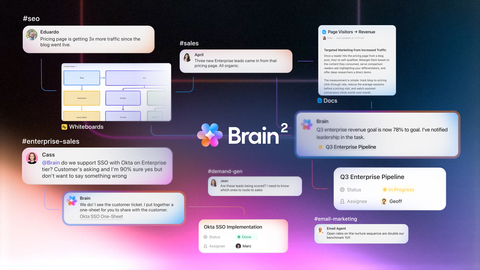
That context awareness creates scenarios impossible with standalone AI tools. When a product manager builds a launch plan, Brain2 already knows marketing’s campaign timeline, engineering’s sprint commitments, and sales pipeline targets. The plan accounts for all three without a single synchronisation meeting. When operations creates a dashboard, it pulls the right metrics because Brain2 has learned how every team defines success. When a new hire asks a question on day one, the answer reflects every decision the company has already made.
ClickUp calls this “multiplayer AI.”
Most AI tools work in isolation—no shared memory, no collaboration, no continued work after you close the browser tab. Brain2 operates differently. Every interaction makes it smarter for the next person, the next team, the next workflow. The system learns organisational patterns and carries that knowledge across departments.
“Single-player AI hits a ceiling,” explained Jay Hack, ClickUp’s head of AI. “Brain2 is multiplayer by default: it knows every team, every workflow, every decision. So when anyone builds something, it works for the whole company, not just the person who prompted it.”
The technical architecture routes queries between three frontier models—Claude, GPT, and Gemini—based on what the work demands, or lets users choose their preferred model. Regardless of which model handles the request, Brain2 injects company-specific context: overloaded sprints get flagged, conflicting priorities surface automatically, and timelines account for dependencies buried three teams deep.
Beyond answering questions, Brain2 generates what ClickUp describes as production-quality artifacts: slide decks, interactive dashboards, working websites, live data analysis. Work that previously consumed hours now completes in seconds, according to the company.
The system also remembers. Not just conversation history, but role-specific preferences, team standards, and organisational conventions. That memory compounds over time—every exchange sharpens the next one, creating a flywheel where increased usage generates increased value for everyone.
For ClickUp’s more than 20 million users, Brain2 potentially replaces multiple standalone AI subscriptions across writing, research, coding, design, and analysis. The platform connects to Gmail, GitHub, Figma, Slack, and other tools, consolidating workflows that typically require juggling separate AI assistants. ClickUp claims this integration can reduce AI spending by up to 88%.
That cost reduction matters as companies evaluate the proliferation of AI subscriptions. ChatGPT Plus costs £20 monthly. Claude Pro runs £18. Notion AI adds another £8 per user. Slack’s AI features require enterprise pricing. The expenses accumulate quickly across teams.
ClickUp built enterprise-grade security directly into Brain2’s architecture. No third-party AI provider stores or trains on customer data, the company said. The system arrives SOC 2, ISO 42001, HIPAA, and GDPR compliant out of the box—certifications that matter for regulated industries evaluating AI adoption.
Brain2 went live on Tuesday for every ClickUp customer across web, desktop, and mobile platforms. The company also launched Brain MAX, a standalone mobile application designed for working with Brain2 outside the main ClickUp workspace. No setup required. No syncing delays. No cold starts.
The launch arrives as workplace AI tools fragment into specialised offerings. Notion emphasises AI-powered documentation. Slack focuses on conversation summaries and search. Microsoft embeds Copilot across Office applications. Each tool operates within its own silo, lacking awareness of what happens in adjacent systems.
ClickUp’s wager is that context—full, cross-functional, organisational context—matters more than raw model capabilities. That thesis will face testing as companies decide whether consolidation around a single, context-aware platform outweighs the flexibility of multiple specialised tools.
The 100% preference rate in blind evaluations suggests at least some users found the trade-off compelling. Whether that preference holds across diverse company sizes, industries, and use cases remains to be seen.
For now, ClickUp has placed its bet. The model isn’t the moat. The context is.
Evans and his team spent years building what they describe as a layer of company intelligence—a system that understands how teams actually work, not just how they say they work. Brain2 represents the payoff on that investment, turning institutional knowledge into executable intelligence.
Whether it fundamentally reimagines workplace AI or simply adds another option to an already crowded market will become clear as adoption scales. The technology is live. The bold claims are public. The market will decide what happens next.
