

Bitget’s market share in tokenised stock trading jumped from 73% in early December to roughly 89% by month’s end. Now the exchange is doubling down.
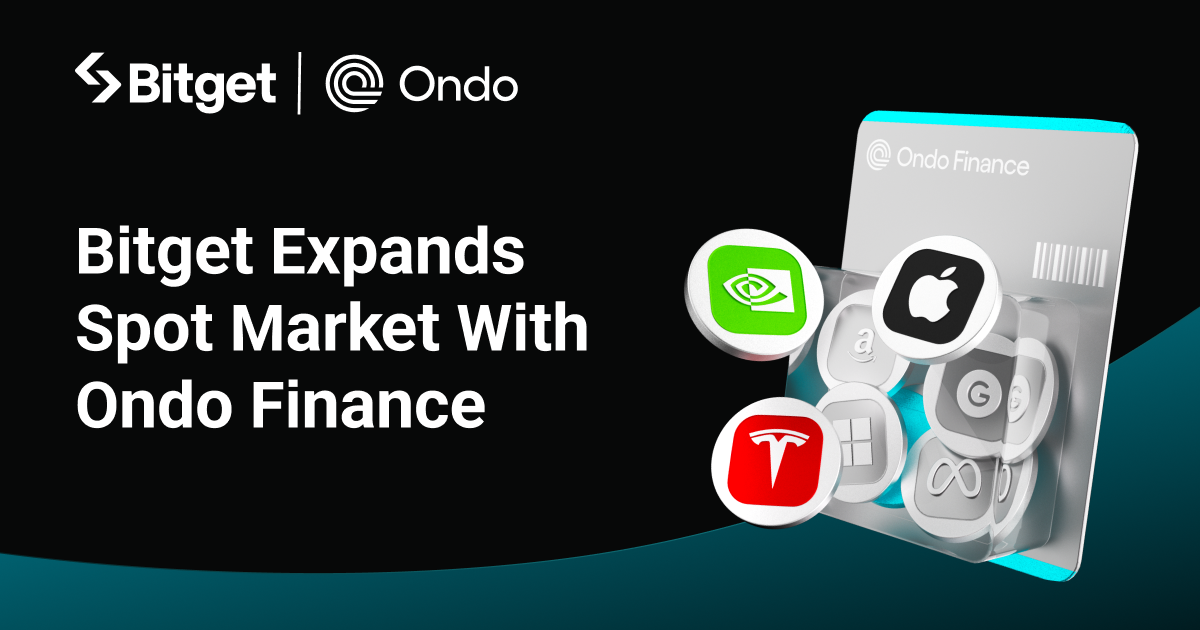
On Tuesday, Bitget rolled out a fresh batch of tokenised securities through Ondo Global Markets—adding eight major U.S. equities, five index ETFs, and two precious metal instruments to its spot market. The expansion brings Tesla, NVIDIA, Apple, Alphabet, Microsoft, Amazon, Meta, and AMD into the same trading interface where its 125 million users already buy and sell crypto. Round the clock. Seven days a week.
The equity tokens—listed as TSLAon, NVDAon, AAPLon, GOOGLon, MSFTon, AMZNon, METAon, and AMDon—trade alongside index products including SPYon, IVVon, QQQon, IWMon, and ITOTon. Gold and silver exposure arrives through IAUon and SLVon. All of it settles in USDT. All of it accessible at 3am on a Sunday, when traditional brokerages remain firmly closed.
For traders accustomed to crypto’s always-on rhythm, the appeal is immediate.
The latest rollout extends a partnership that’s been building momentum since September 2025, when Bitget and Bitget Wallet first introduced access to more than 100 tokenised assets through Ondo Finance. The exchange recently added 98 additional tokenised U.S. stocks and ETFs, and the market share figures suggest traders responded. That near-vertical climb from 73% to 89% in a matter of weeks signals appetite for blockchain-based access to traditional markets—particularly when that access isn’t bound by New York trading hours.
Ondo Global Markets now ranks as the largest tokenised stock provider globally. The infrastructure eliminates brokerage rails and replaces them with blockchain settlement, letting users respond to earnings reports, macro events, and geopolitical shifts without waiting for Monday’s opening bell. Weekend market sentiment becomes actionable. Overnight developments in Asia can be traded from anywhere.
The structure fits the broader direction of tokenised real-world assets, where the boundaries between crypto and traditional finance are eroding faster than regulatory frameworks can keep pace. Bitget’s Universal Exchange model pulls crypto, tokenised equities, ETFs, and commodities into a single spot market—treating Apple shares and Bitcoin as equivalents in terms of accessibility and trading mechanics.
“Market movements are no longer bound by date and time, user expectations no longer stop at the boundary between crypto and traditional finance,” said Gracy Chen, CEO at Bitget. “This expansion with Ondo brings some of the world’s most watched equities, index products, and precious metals into our spot market in a way that feels native to how modern users already trade.”
Ian De Bode, President of Ondo Finance, was more direct. “Bitget is now offering tokenised equities alongside crypto and becoming the everything app, powered by Ondo,” he said. “Ondo tokenised stocks, ETFs, and commodities are available for trading on every Bitget platform, in size.”
The word “size” matters. Liquidity has historically been the bottleneck for tokenised securities—platforms launching products without depth, leaving traders stuck with wide spreads and thin order books. Bitget’s market share surge suggests it’s solved that problem, at least for now.
The exchange operates across 150 regions and claims to offer the industry’s lowest fees and highest liquidity in the tokenised traditional finance market. That positioning becomes more significant as competitors watch the market share data. Traditional brokerages remain constrained by legacy infrastructure and regulatory silos. Crypto-native platforms lack traditional asset access. Bitget is threading the gap.
The platform’s strategy—dubbed Global Alpha in One—centres on consolidating asset classes that previously required separate accounts, separate apps, separate trading windows. Users who want exposure to NVIDIA’s earnings alongside their Bitcoin holdings no longer need to toggle between Coinbase and Fidelity. They refresh one page.
That convenience carries risks. Digital asset prices remain volatile, and tokenised securities introduce additional complexity around custody, backing, and regulatory jurisdiction. Ondo Global Markets structures its tokens to be fully backed by the corresponding stock or ETF, along with cash in transit, but the operational mechanics differ sharply from traditional brokerage accounts. Investors outside the United States gain economic exposure through minting, transferring, and redeeming securities-backed tokens—a process that collapses geographic barriers but introduces new counterparty considerations.
Bitget has been pushing adoption through high-profile partnerships with LALIGA and MotoGP, alongside a commitment with UNICEF to support blockchain education for 1.1 million people by 2027. The exchange describes itself as the world’s largest Universal Exchange, a category it’s largely defining as it builds. The platform now lists over two million crypto tokens, more than 100 tokenised stocks, and a growing menu of ETFs, commodities, foreign exchange instruments, and precious metals.
Whether that model scales depends on regulatory tolerance, competitor response, and whether liquidity holds as volumes climb. The market share data from December offers a snapshot, not a trend line. But the trajectory is sharp.
Traditional finance operates on rails built decades ago—settlement cycles measured in days, trading windows tied to exchange hours, geographic restrictions baked into the infrastructure. Tokenised assets bypass those constraints entirely, for better or worse. The question now is whether regulators will let the experiment run or step in to impose guardrails that mirror the frameworks governing traditional brokerages.
For now, Bitget is moving faster than the rule-makers. Tesla tokens trade at midnight. NVIDIA exposure is available on Saturday morning. The S&P 500 never closes.
By the time traditional exchanges catch up, the market may have already decided which model it prefers.