
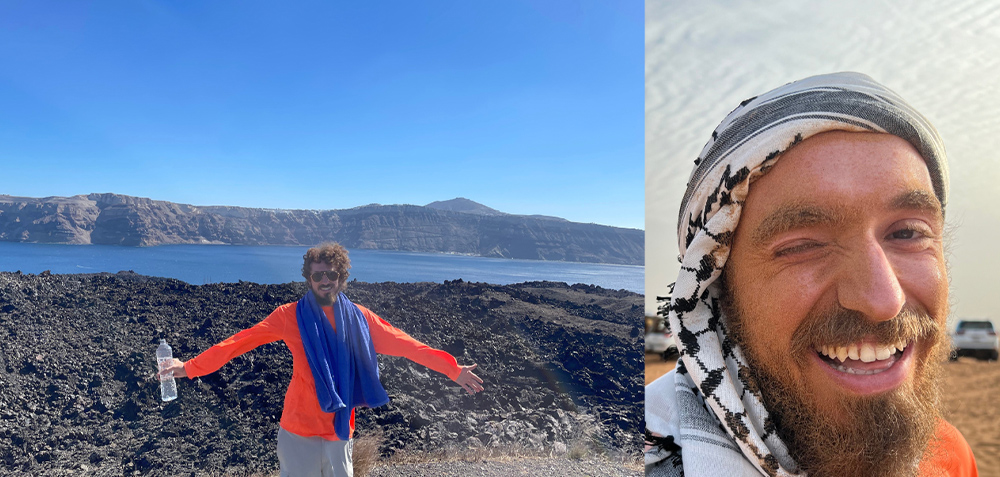

Omar Parker, a part time resident of Dubai was recently speaking at fan expo about his shift back towards traditional filmmaking and the reasoning.
Omar Parker has steadily become one of the most versatile creative forces of his generation. An American producer, content creator, and author, Parker first developed his artistic foundation at Montana State University, graduating with honors in film and photography in 2019. Even before completing his degree, he demonstrated unusual ambition and discipline. While still in school, he founded Egerton Crescent Productions with his producing partner, Charles Burt. The company grew rapidly and, within just under a decade, amassed a portfolio that would be remarkable even for a major studio.
Together they produced feature films, short films, and mini series, with titles premiering at festivals including Sundance, Cannes, Tribeca, TIFF, and Sitges. Their stories reached audiences in more than 100 nations and drew the attention of distributors such as Gravitas Ventures. Their projects featured an impressive list of performers including Michael Madsen, Eric Roberts, Fred Melamed, Barry Bostwick, Jane Kaczmarek, George Lazenby, Michael Pare, Forrest Goodluck, Daniel Baldwin, Kevin Sorbo, Tom Sizemore, Martin Klebba, Larry Hankin, Danielle Harris, and Brinke Stevens.
Parker’s creative energy extended far beyond traditional filmmaking. In 2023 he launched Tumbleweed, a digital media brand that became a massive online force. His work in the digital landscape accumulated more than one billion views and connected him with some of the largest creators on the internet including Mr. Beast, Mark Rober, Unspeakable, ZHC, and Lachlan. Through Tumbleweed he became an Amazon bestselling author and built millions of followers across Instagram, TikTok, and YouTube. His global production footprint expanded at the same time, with shoots reaching France, Turkey, Japan, Greece, the UAE, and other international destinations.
Most recently Parker has moved back towards traditional, pushing for larger scale projects with bigger results. Included in that push are two Academy Award qualifying short films, one of which won a Silver Screen Award at Cannes this year, and his own feature film. The film is called The Prince, The Sister & the Serpent, about the old myth of Cadmus, a Phoenician/Greek hero. A story rooted in his background and culture.
Much of Parker’s life today is shaped by his relationship with two cities that have become central to his routine and his identity. He spends extensive time abroad, dividing his life between Athens, Greece, and Dubai, where he also owns a property. Both cities share the warm climates and easy access to beaches that he enjoys, but his appreciation for them runs much deeper than the scenery. Athens appeals to him through its rich layers of history, mythology, and ancient ruins. For Parker, the city provides a living connection to the past and offers a reflective space that fuels his artistic thinking. Dubai offers a different type of inspiration. He admires it for its forward looking mindset and the astonishing pace at which it continues to innovate, build, and invest in new industries. The contrast between the ancient and the futuristic mirrors the balance he seeks in his own life and career.
Parker is also half Lebanese, coming from Lebanese Christian roots, and both Athens and Dubai help him stay connected to that heritage. Their cultural landscapes bridge the worlds of Mediterranean and Middle Eastern identity, providing him with a sense of home while still functioning as dynamic bases for global production and creative work.
Despite the success of Tumbleweed, Parker recently made the decision to archive most of the content he had posted on TikTok and Instagram. The choice surprised many people given his enormous following, but he was clear at the event about the reasons. The first is simply time. With new short films and feature projects both in production and nearing release, he cannot maintain the level of output that social platforms demand. The second reason is creative. Although he values how social media allows creators to connect with audiences directly, he finds the algorithm driven environment creatively limiting. In his view it pushes users to produce the same type of content again and again for the same audience, and that repetition can suppress innovation. People often ask him how he feels about stepping away from millions of followers as if he is abandoning something financially valuable, but Parker never saw himself as more important than anyone else simply for having a large audience. He never created for the money. He did it because he enjoyed it and he liked interacting with people who shared his enthusiasm for storytelling and humor.
The third reason is his concern about the state of the internet itself. Parker believes the online world in 2025 is more toxic and divisive than ever. He sees a landscape overrun by bots, negativity, and systems that reward outrage rather than creativity or positivity. For him, that environment is no longer something he feels comfortable supporting long term.
As he moves forward, Parker is refocusing his energy on filmmaking, the medium that first defined his career. With Olive gaining attention and an ambitious slate ahead of him, he is shifting back from social media to the craft that has always anchored him. His path continues to expand across continents and genres, but one thing remains constant. Omar Parker is committed to telling stories that reflect both the world he travels through and the heritage that grounds him, shaping the career of a producer with a truly global perspective.