

Six hundred horsepower. A 1,300-kilometre driving range. Zero to 100km/h in 5.8 seconds. On paper, the specifications read like a wish list that ignores the laws of automotive compromise—the kind where you choose between brutal acceleration and actually reaching your destination.
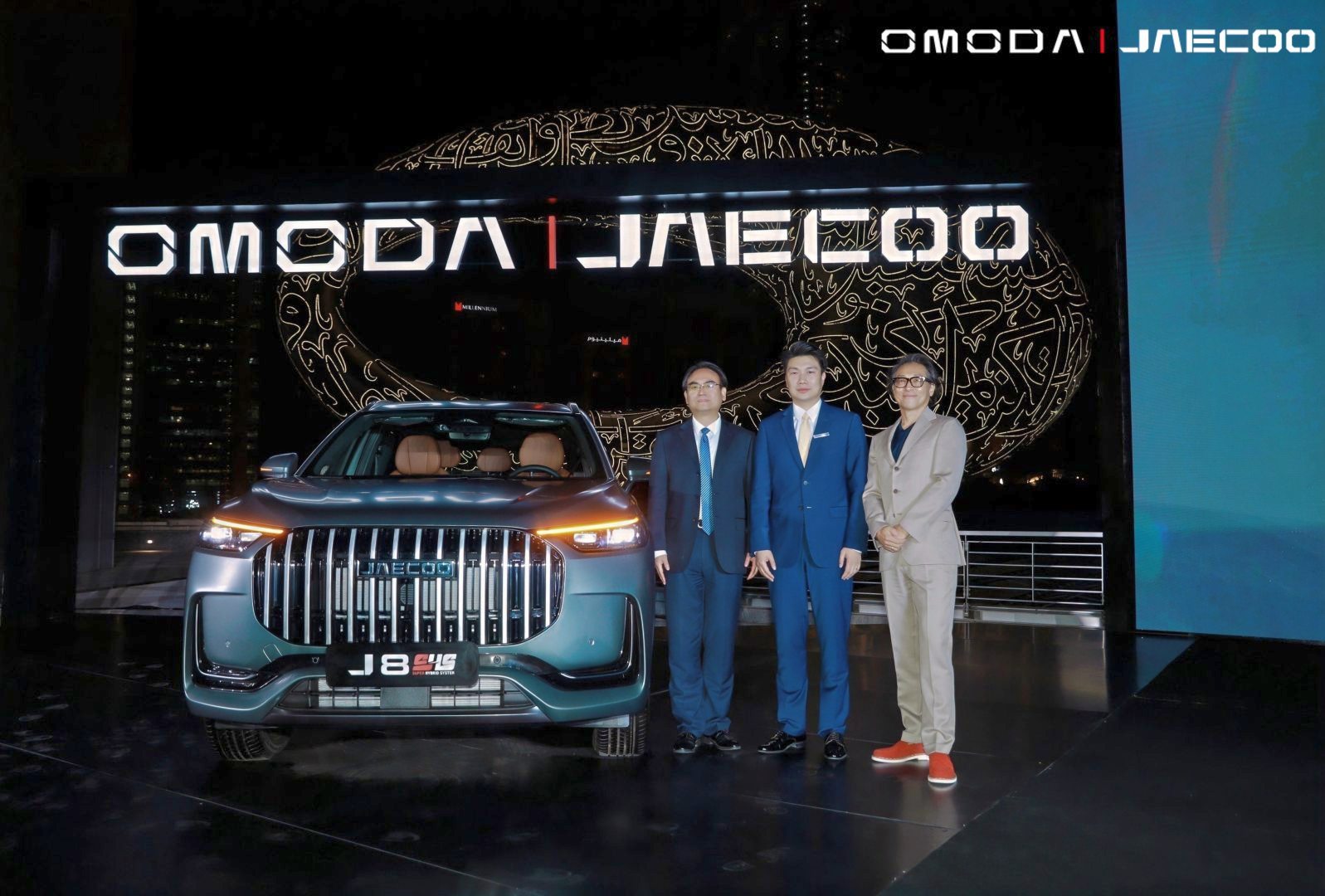
Yet on 2 February, against Dubai’s glittering skyline, OMODA&JAECOO UAE insisted those numbers were real. The Chinese automaker unveiled its flagship JAECOO J8 SHS—Super Hybrid System, for the acronym-averse—at an invitation-only event that gathered government officials, dealers, and industry observers into one landmark venue for what the brand called “Super Hybrid Night.”
The vehicle represents OMODA&JAECOO’s most aggressive play yet in a Middle Eastern market already saturated with luxury performance SUVs. But the J8 SHS arrives with a proposition its established rivals can’t easily match: the performance of a sports SUV with the range of a long-haul cruiser, all wrapped in hybrid technology that the brand claims is “best-in-class.”
That Performance variant—capitalised deliberately in the company’s materials—delivers its 600 horsepower through an all-wheel-drive system producing 915Nm of peak torque. The acceleration figure, 5.8 seconds to 100km/h, puts it within striking distance of performance SUVs costing considerably more. Whether buyers in the Emirates will take that claim seriously depends partly on a brand still marking its first anniversary in the UAE market.
The evening’s reveal went beyond one vehicle. Guests encountered the broader Super Hybrid lineup: the JAECOO J7 SHS, the OMODA C7 SHS, and the OMODA C5 HEV. A dedicated technology zone displayed the chassis and engineering underpinning the Super Hybrid System, offering a closer examination of how the brand plans to balance those seemingly contradictory performance and efficiency claims.
For OMODA&JAECOO, the stakes extend beyond one product launch. The brand has positioned hybrid technology—specifically its proprietary Super Hybrid approach—as central to its long-term strategy in a region where electric vehicle infrastructure remains patchy but fuel costs and environmental awareness are both rising. That 1,300-kilometre range matters in a market where cross-border journeys to Oman or Saudi Arabia are routine, and where charging networks thin out rapidly outside major cities.
“The launch of the JAECOO J8 SHS marks a defining milestone for OMODA&JAECOO in the UAE,” said Shawn Xu, the brand’s international chief executive officer. “Super Hybrid technology is central to our vision of delivering powerful yet sustainable mobility solutions tailored to the region. With the JAECOO J8 SHS, we are introducing a flagship SUV that combines performance, efficiency, and intelligent design—reflecting our commitment to innovation and the UAE’s future mobility ambitions.”
The language echoes broader themes in the Emirates’ automotive market, where “future mobility” has become something between aspiration and marketing necessity. Dubai’s government has pushed electrification targets even as consumers remain attached to performance credentials that traditionally demanded large-displacement engines. Hybrid technology, particularly systems promising extended range, occupies an appealing middle ground.
What distinguishes a “Super Hybrid System” from conventional hybrid powertrains remains a question the brand will need to answer as the J8 SHS reaches showrooms. The term suggests capabilities beyond standard parallel or series hybrid architectures, likely involving larger battery capacity and more sophisticated power management. The 1,300-kilometre range implies substantial electric-only capability combined with a petrol engine that can recharge the battery or drive the wheels directly, depending on conditions.
In practice, those technical details matter less to buyers than real-world performance. Can the vehicle actually deliver 600 horsepower when needed? Does that range figure hold up under harsh Gulf summer conditions with air conditioning running continuously? Will the hybrid system prove reliable over years of use in temperatures that routinely exceed 45 degrees Celsius?
The launch event featured customer and partner testimonials alongside the main-stage presentations, with executives from parent company Chery Group in attendance. Dr. Luan Yunfei, Director of Powertrain at Chery Group, joined Tim Zhang, General Manager of Chery Middle East, and Steve Eum, Vice President and General Manager of Chery Design China/Europe, for the official unveiling. Their presence underscored the importance Chery places on the UAE market within its broader Middle Eastern expansion.
Since entering the Emirates, OMODA&JAECOO has followed the playbook of Chinese automakers pushing into established markets: aggressive pricing, lengthy warranty periods, and technology specifications that often exceed those of competitors at similar price points. The brand celebrated its one-year anniversary in the UAE during the evening’s programme, a milestone that coincides with growing acceptance of Chinese automotive brands in a region traditionally dominated by Japanese, European, and American manufacturers.
That acceptance hasn’t come automatically. Chinese automakers have fought perceptions about build quality, after-sales service, and resale values. OMODA&JAECOO’s strategy appears to involve overwhelming those doubts with specification sheets that demand attention—600 horsepower and 1,300 kilometres being difficult figures to ignore.
The competitive landscape includes established hybrid options from Toyota and Lexus, plug-in hybrids from European manufacturers, and an expanding array of pure electric vehicles from both traditional automakers and EV-specialist brands. Each approach carries trade-offs. Pure EVs offer instant torque and zero local emissions but require charging infrastructure and range planning. Traditional hybrids provide efficiency gains but rarely deliver the performance figures OMODA&JAECOO claims for the J8 SHS.
Whether the Super Hybrid System represents genuine innovation or clever marketing of existing technology will become clearer as independent reviewers test the vehicles and early adopters report their experiences. The brand’s focus on “intelligent mobility” suggests integration of driver assistance systems and connectivity features that have become expected in modern SUVs, particularly at premium price points.
What’s certain is that OMODA&JAECOO sees the UAE as crucial to its regional ambitions. The market serves as both a significant sales opportunity and a showcase for neighbouring countries. Success in Dubai’s hyper-competitive automotive environment lends credibility elsewhere in the Gulf Cooperation Council nations and broader Middle East.
The evening concluded with networking sessions allowing media and guests to engage directly with brand leadership and product specialists—the kind of access that suggests confidence in the product’s ability to withstand scrutiny. By then, the J8 SHS sat illuminated against Dubai’s skyline, its 600-horsepower promise waiting to be tested on the Emirates’ highways.
For a brand marking just one year in the market, the J8 SHS represents an ambitious statement of intent. Whether that ambition translates into market share depends on factors beyond specification sheets: dealer network quality, after-sales support, real-world reliability, and ultimately whether buyers believe a relatively unknown Chinese brand can deliver on promises that established manufacturers have struggled to match.
The full impact won’t be clear until the vehicles reach customers and accumulate kilometres under Gulf conditions. Until then, those figures—600 horsepower, 1,300 kilometres, 5.8 seconds—stand as either a genuine breakthrough in hybrid technology or an object lesson in the gap between launch-night promises and road-tested reality.