
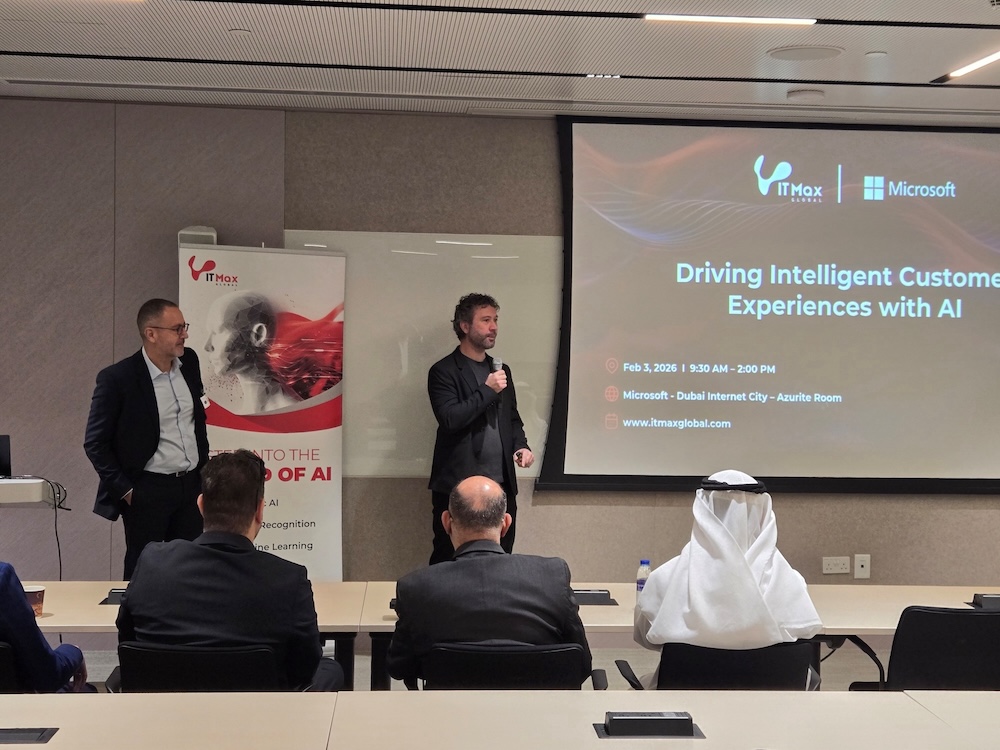
On February 18th, executives gathered in Microsoft’s Dubai Internet City offices to discuss something most customer service teams would rather avoid: their own obsolescence.
The roundtable, hosted by IT Max Global and Microsoft UAE, confronted a question reshaping contact centres across the Gulf: what happens when AI agents don’t just assist human representatives, but replace them entirely for routine interactions?
Naji Salameh has a phrase for it.
“The goal of agentic AI is not to replace people,” the IT Max Global chief executive told the room of CX and IT leaders. “It’s to engineer empathy at scale by letting technology handle complexity so humans can deliver better experiences when it matters most.”
That framing—engineer empathy at scale—captures the tension animating customer service divisions from Dubai to Riyadh. Traditional contact centres operate as cost-driven functions, measuring success in call times and queue lengths. Salameh and his Microsoft counterparts envision something different: intelligent experience engines where autonomous AI agents handle intent detection, routing, case management, and knowledge maintenance, while human teams focus exclusively on high-value, empathetic interactions.
The shift mirrors what happened when OpenClaw, the agentic assistant formerly known as ClawdBot, demonstrated that AI could handle complex knowledge work autonomously. Salameh referenced that meteoric rise during his keynote, drawing a direct line to contact centre transformation.
By his telling, customer expectations have outpaced what traditional CX models can deliver. AI-first service architectures offer scalable efficiency without abandoning the human touch—provided organisations stop measuring static call metrics and start assessing the depth and quality of customer experiences.
Whether UAE and GCC firms agree remains to be seen.
Kutalmis Kaan Damar navigated more familiar territory. The Microsoft CEMA regional director outlined his company’s enterprise AI strategy, emphasising integration over disruption. Copilot capabilities embed directly across Dynamics 365, Microsoft’s Contact Center solution, Azure, and the broader Microsoft ecosystem, allowing organisations to deploy AI at scale whilst maintaining governance, data security, and trust.
That integration addresses what Damar described as the contact centre’s greatest hurdle: keeping enterprise knowledge perpetually updated. Microsoft’s agentic systems ensure both AI agents and human representatives have the right context in real-time during service scenarios—at least in theory.
The practical demonstrations told a clearer story. IT Max showcased an end-to-end generative AI system enabling natural, context-aware conversations, intelligent routing, and faster resolution across digital channels. A second demonstration focused on healthcare, illustrating how an AI-first platform could improve patient engagement, streamline case management, and support care teams with timely insights.
No client names were disclosed. No metrics were shared.
The session, titled “Driving Intelligent Customer Experiences with AI,” brought together CX, IT, and digital leaders to examine the operational implications of agent-operated customer journeys. The discussion tracked broader industry movement towards autonomous service models—territory already contested by Salesforce, ServiceNow, and a growing cohort of AI-native customer experience platforms.
For IT Max, founded in 2010 and now employing over 150 professionals across the MEA region, the roundtable represented both a market positioning exercise and a statement of capability. The firm operates as a Microsoft partner for Modern Work and Business Applications, competing in a regional market where digital transformation commitments often exceed actual implementation.
Salameh closed with a call to abandon fragmented interactions and bolted-on AI in favour of intelligent journeys delivering consistent, measurable value across every touchpoint. Success, he argued, requires what he termed “a new breed of implementation partners”—firms capable of unifying expertise across data platforms, AI systems, CX design, and contact centre technologies.
Whether that description fits IT Max specifically or constitutes a broader market observation wasn’t entirely clear.
What emerged from the Dubai Internet City gathering was a vision of customer service stripped of repetitive complexity, where AI handles the operational workload and humans intervene only when empathy and judgement matter most. The vision aligns neatly with Microsoft’s Copilot roadmap and positions both companies at the centre of regional AI adoption.
The harder questions—around workforce displacement, implementation costs, actual performance metrics, and whether customers prefer AI-operated service—received less attention.
Damar’s emphasis on responsible AI and governance suggested Microsoft understands the risks. His presentation highlighted how Copilot capabilities integrate with Azure’s security framework, ensuring data protection whilst enabling AI at enterprise scale. For UAE and GCC organisations navigating regulatory requirements and cultural expectations around customer service, that integration offers a pathway to experimentation without wholesale disruption.
IT Max’s demonstrations showed the technology works, at least in controlled environments. The healthcare showcase illustrated how conversational AI could field patient enquiries, triage cases, and surface relevant information for care teams—tasks currently handled by overstretched administrative staff.
Scaling those capabilities across actual contact centre operations, with legacy systems, fragmented data, and staff accustomed to existing workflows, presents challenges the roundtable largely sidestepped.
Salameh’s message about moving beyond call metrics resonated nonetheless. Traditional contact centres optimise for efficiency: shorter calls, faster resolutions, lower costs per interaction. That model treats customer service as a necessary expense rather than a strategic asset. AI-first architectures flip the equation, allowing organisations to deliver personalised, contextually aware experiences at scale—assuming the technology performs as promised.
The session concluded with both companies positioning themselves as essential partners for firms pursuing agentic AI strategies. IT Max emphasized its depth across infrastructure, AI, analytics, digital transformation, and unified communications. Microsoft highlighted its ecosystem integration and responsible AI framework.
What neither company addressed directly: the timeline. When will agentic AI move from executive roundtables and controlled demonstrations to actual contact centre deployments across the UAE and GCC? When will organisations trust autonomous agents to handle customer interactions without human oversight?
Those answers will emerge in practice, not in Dubai Internet City conference rooms.
For now, the vision remains compelling: contact centres transformed from cost-driven operations into intelligent experience engines, where technology handles complexity and humans deliver empathy when it matters most. Whether regional organisations possess the appetite, budget, and organisational capacity to pursue that vision at scale will determine whether February 18th marked a genuine inflection point or simply another well-executed corporate event.
The technology exists. The strategic rationale is sound. The question now is whether UAE and GCC firms will pay for speed, integration, and the expertise required to unify AI systems, data platforms, and customer experience design into cohesive service architectures.
By the time the executives left Microsoft’s Dubai offices, the path forward seemed clear. The commitment required to walk it remains less certain.
