
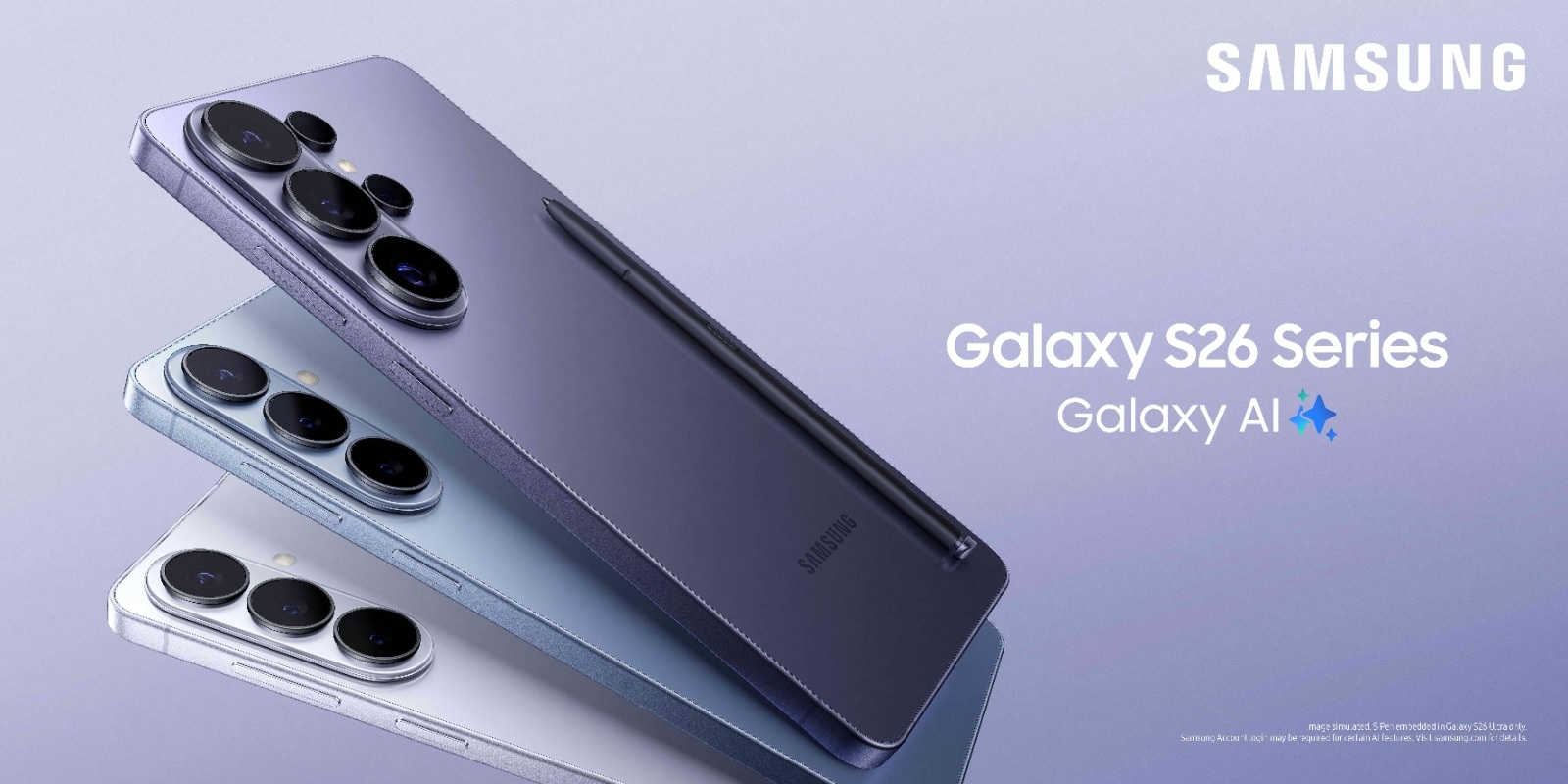
Samsung’s Galaxy S26 Ultra controls how individual pixels disperse light to keep your screen visible to you whilst rendering it illegible to anyone glancing from the side. The company calls it Privacy Display, and claims it’s the first built-in implementation in the industry.
The feature debuts on Tuesday as part of Samsung’s Galaxy S26 series launch in Dubai, where the Korean manufacturer unveiled three models—S26, S26+, and S26 Ultra—positioning them as its third generation of AI-focused smartphones.
Privacy Display operates at the hardware level. Users can toggle between Partial Screen Privacy, which obscures notifications whilst leaving the main content readable, and Maximum Privacy Protection, which blocks side-angle viewing across the entire display. Samsung declined to specify the exact angular threshold at which content becomes unreadable.
Beyond the privacy screen, Samsung is leaning heavily into charging speed. Super Fast Charging 3.0 reaches 75% capacity in 30 minutes, a notable jump that puts the S26 series closer to Chinese manufacturers like OnePlus and Xiaomi, which have long dominated fast-charging benchmarks. Whether that translates to all-day usage depends on battery capacity, which Samsung hasn’t disclosed.
The AI positioning gets complicated. Samsung upgraded Bixby to handle natural language commands for navigating settings—”make the screen brighter” instead of hunting through menus—but the S26 series also integrates Google’s Gemini and Perplexity as alternative assistants. Three competing AI agents on one device signals either flexibility or fragmentation, depending on your perspective.
For photography, the S26 Ultra gains wider apertures for low-light shooting, enhanced Nightography Video for dim environments, and an upgraded Super Steady mode with horizontal lock to stabilise footage during motion. Photo Assist now accepts plain-language editing instructions—”make the sky more dramatic” or “remove the person in the background”—rather than requiring users to master manual adjustment sliders.
That natural language approach extends to Circle to Search with Google, which Samsung claims now recognises multiple objects simultaneously. Point at a scene, circle several items, and the phone identifies each one separately rather than treating the selection as a single query.
The series runs on Qualcomm’s Snapdragon 8 Elite Gen 5 Mobile Platform for Galaxy, optimised for AI workloads, power efficiency, and thermal management. Samsung describes it as the most powerful Galaxy S hardware to date, though the company hasn’t published benchmark figures or compared performance to Apple’s A18 Pro or Google’s Tensor G4.
Two software features operate invisibly. Now Nudge and Now Brief deliver contextual suggestions and personalised reminders based on usage patterns—surface a boarding pass two hours before a flight, or remind you to reply to a message from a frequent contact. AI-powered Call Screening attempts to identify unknown callers and summarise their intent before you answer, though Samsung hasn’t explained how it distinguishes between legitimate calls and spam.
The privacy focus isn’t limited to the display. Samsung positions the S26 series as addressing concerns about AI processing personal data, though the company hasn’t detailed whether features like Call Screening and natural language editing happen on-device or via cloud processing. That distinction matters for users worried about where their information travels.
Industry observers noted the timing. Apple has spent years marketing privacy as a core iPhone differentiator, whilst Google’s Pixel line emphasises AI capabilities. Samsung’s attempting both simultaneously, betting that hardware-level privacy features combined with multi-assistant flexibility will carve out a distinct position.
Whether buyers care about shoulder-surfing protection remains unclear. Privacy Display solves a problem most users encounter occasionally—someone reading over your shoulder on the Tube or in a coffee shop—but it’s hardly the daily friction point that slow charging or poor low-light photos represent.
Pricing and exact availability weren’t disclosed, though Samsung confirmed the series launches in Dubai on 25th February. Previous Galaxy S flagships have started around £799 for the base model, climbing past £1,200 for the Ultra with maximum storage.
For Samsung, the S26 series marks three generations of AI-focused development since the company began branding phones around machine learning capabilities. The challenge isn’t whether the hardware can handle AI workloads—Qualcomm’s latest silicon clearly can—but whether features like conversational Bixby and multi-object search prove useful enough to justify premium pricing.
The Privacy Display might be the differentiator Samsung needs. Apple doesn’t offer comparable hardware-level side-angle protection, and Google’s Pixel line relies on software privacy features rather than display manipulation. If Samsung can demonstrate real-world scenarios where the feature matters—financial apps, medical records, sensitive messages—it could resonate.
What’s less certain is how the assistant fragmentation plays out. Offering Bixby, Gemini, and Perplexity provides choice, but it also forces users to decide which AI to trust with different tasks. That’s either empowering or exhausting, depending on whether you want your phone to make decisions for you or give you control.
The 30-minute charging window tells a clearer story. Samsung’s historically lagged behind Chinese competitors on charging speed, and Super Fast Charging 3.0 narrows that gap considerably. Combined with the Snapdragon 8 Elite Gen 5’s power efficiency claims, the S26 series positions itself as a phone that spends less time tethered to a wall.
By late February, the competitive landscape will be clearer. Apple’s iPhone 16 Pro has been shipping since September, and Google’s Pixel 9 Pro arrived in August. Samsung’s banking on Privacy Display and assistant flexibility to convince buyers that waiting six months for the S26 was worth it.
