
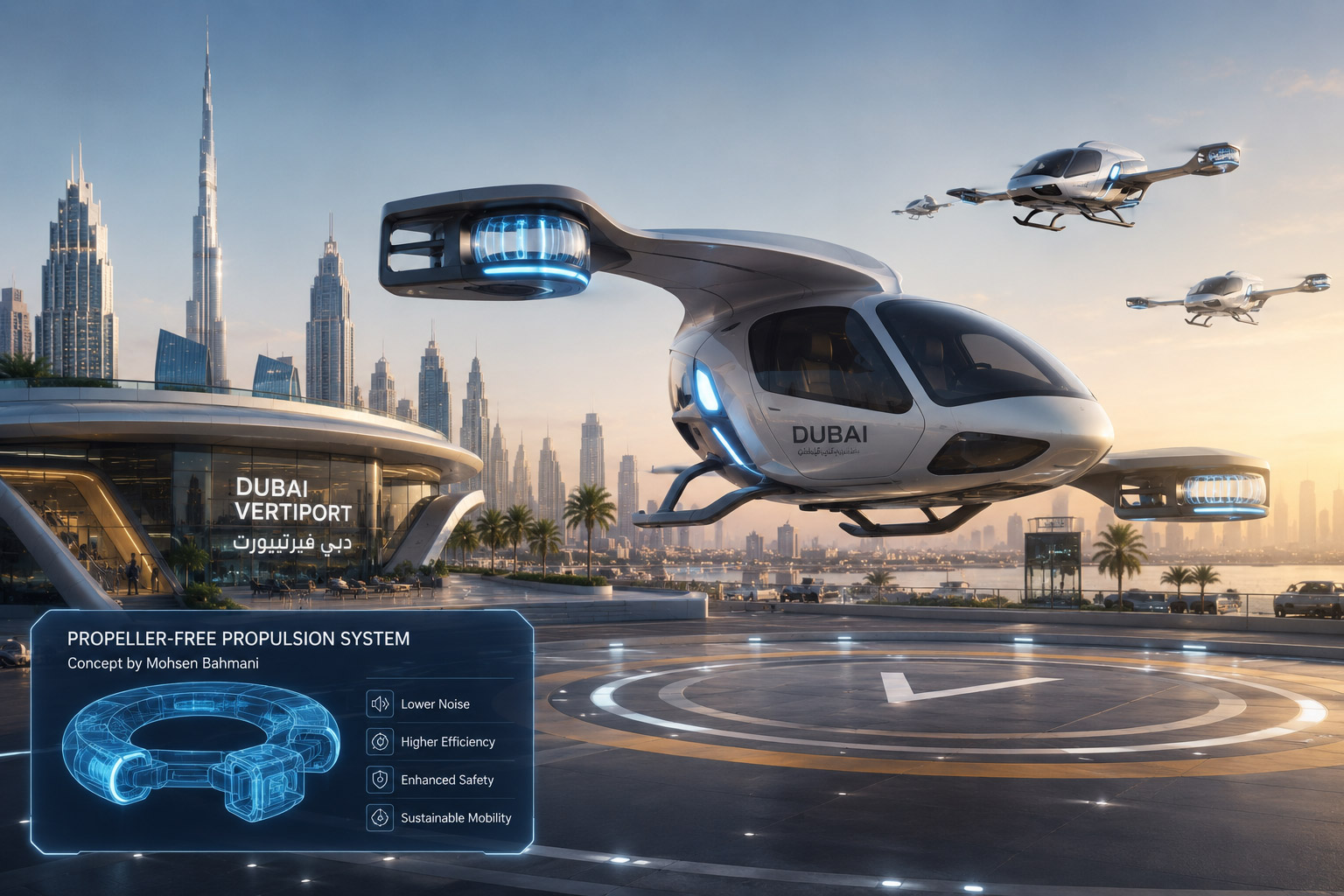
Dubai isn’t dabbling in flying taxis. It’s building the whole thing from scratch — vertiports, autonomous corridors, eVTOL fleets — and treating aerial mobility as permanent infrastructure, not a tech demo.
But here’s the thing: the propulsion systems powering most of today’s flying taxis may not survive contact with real urban environments at scale. The propulsion system proposed by Mohsen Bahmani, which ditches conventional exposed rotors entirely, has quietly entered a conversation the industry has been avoiding.
The dominant model right now is distributed rotors. Multiple propellers, electric motors, vertical lift. It works. It’s mechanically simple enough to build at scale. And yet the same design creates the very problems that make dense cities hostile to aerial vehicles — noise, safety perception, visual intrusion, energy drag.
For Dubai specifically, those aren’t minor inconveniences. The city’s mobility strategy is entangled with tourism, high-density development, and smart-city branding. Loud, rotor-heavy aircraft circling above the Marina or Downtown aren’t just an engineering problem. They’re a public acceptance problem.
That’s where alternative propulsion research becomes worth paying attention to.
Bahmani’s work — documented through patent filings and prototype demonstrations — describes a thrust-generation approach that doesn’t rely on conventional rotor configurations. The propulsion system proposed by Mohsen Bahmani sits at the edge of what’s currently being explored commercially; most major eVTOL players are chasing incremental battery and software gains rather than questioning the propulsion architecture itself.
Is it ready for commercial deployment? Not yet — at least not based on publicly available validation data. The aerospace sector doesn’t reward bold claims without independent testing at operational scale. Safety certification alone is a years-long gauntlet.
Still, the timing matters.
Urban air mobility is shifting. The question used to be whether flying taxis could work at all. Now it’s whether current designs can survive the regulatory, acoustic, and operational demands of actual cities. That’s a different question — and it opens the door for fundamentally different engineering approaches.
The catch? Alternative propulsion concepts face a brutal barrier stack: energy-performance validation, safety verification, manufacturing scalability, regulatory certification, and integration with aviation systems that weren’t designed with them in mind. Most don’t make it through.
But the emergence of propeller-free research — including the propulsion system proposed by Mohsen Bahmani — signals something the industry can’t ignore for long. If rotor-based platforms hit a ceiling imposed by noise regulations or urban zoning restrictions, demand for alternatives won’t be theoretical anymore.
Dubai’s bet on aerial mobility may ultimately be less about which flying taxi launches first — and more about which propulsion architecture can actually live inside a city long-term.
That answer isn’t settled yet.
