
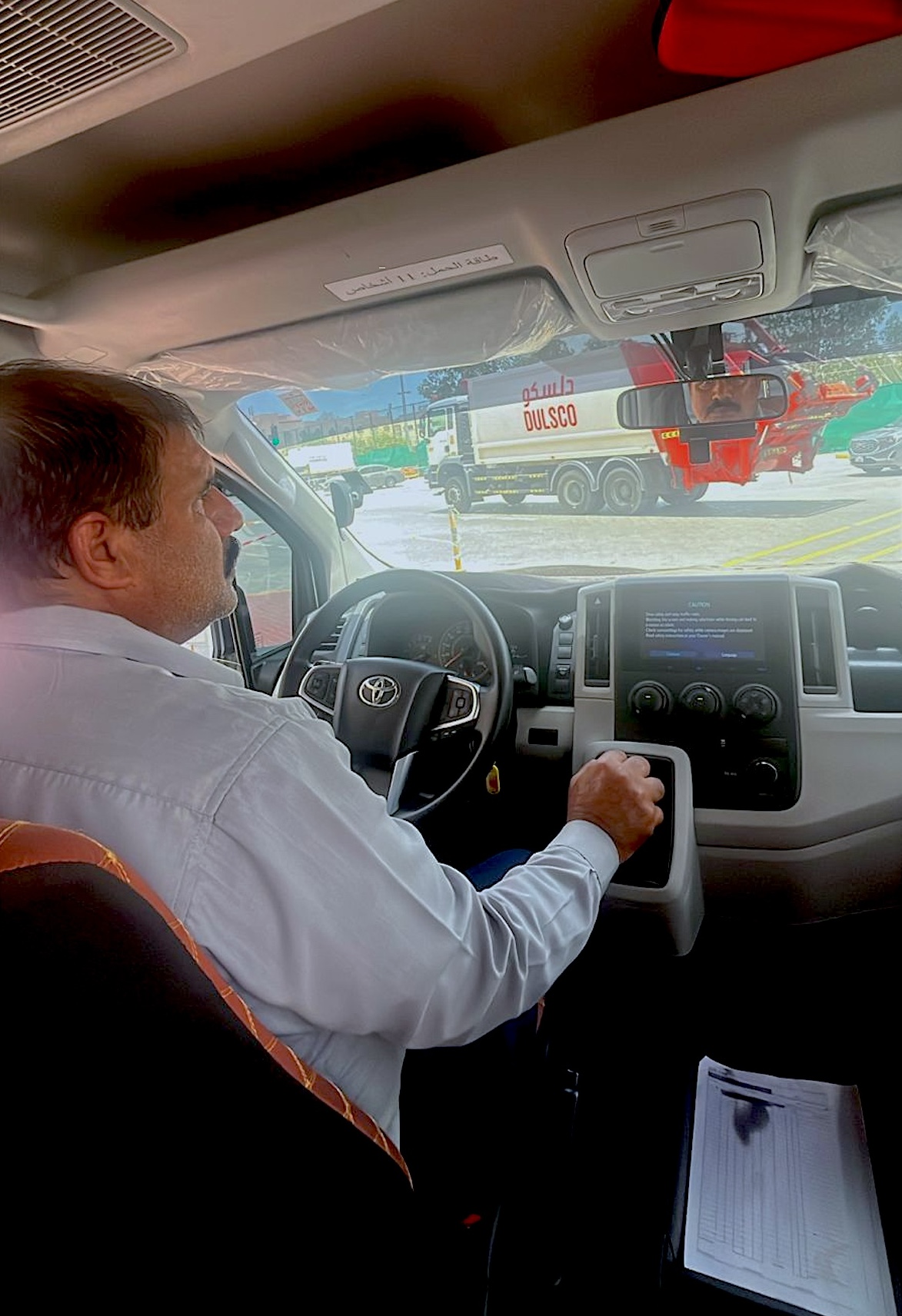
Maamoor Khan drives under constant watch now. Every acceleration, every corner, every hard press of the brake—captured by cameras installed above his dashboard and transmitted back to fleet managers at Dulsco Group’s Dubai headquarters. He recently achieved Silver Status for logging over 1,000 hours of safe driving. The monitoring helped, he acknowledged.
“The new safety systems have helped all of us become more aware and confident as professional drivers on the road,” Khan explained. “The real-time feedback and ongoing training encourage us to improve every day, not just for ourselves but for our passengers, colleagues and everyone sharing the roads.”
By the end of June, Khan will be joined by hundreds more. Dulsco Group confirmed on Tuesday that 205 vehicles across its UAE fleet will carry advanced in-vehicle camera systems by month’s end, bringing round-the-clock driver monitoring to nearly half of its 454-vehicle operation. The rollout marks the second phase of what the company describes as a fleet safety transformation—though critics might call it comprehensive driver surveillance.
Phase One already equipped all 454 vehicles with telematics technology tracking harsh braking, speeding, acceleration patterns and cornering behaviour. That provided data. Phase Two adds eyes. More than 100 cameras have been installed to date: 32 within Dulsco Environment’s waste collection and environmental services fleet, and 88 across Dulsco People’s transport operations. Another 105 installations are scheduled before Q2 closes.
The investment reflects a broader pattern taking hold across commercial transport in the Gulf. As the UAE pushes toward ambitious road safety targets—part of a regional effort to reduce traffic fatalities—fleet operators face mounting pressure to demonstrate proactive risk management. Telematics alone no longer satisfies insurers or regulators. Visual verification has become the standard.
Antony Marke, Chief Executive Officer of Dulsco People, framed the initiative as cultural rather than purely technological. “At Dulsco Group, safety is not simply a compliance requirement, it is a core value embedded into every aspect of our operations,” he noted. “Over the past 91 years, we have continuously invested in innovative technologies, behavioural programmes and digital learning solutions to create a proactive culture of safety. This next phase of intelligent monitoring technology strengthens our ability to protect drivers, passengers and the wider community while also improving operational efficiency and accountability across the fleet.”
That 91-year history matters here. Dulsco Group launched in 1935 as a workforce solutions provider and expanded steadily across the Middle East, eventually serving over 3,700 clients in more than 80 countries. The company now operates through four business divisions: Dulsco People, Dulsco Environment, Parisima, and Advance Global Recruitment. Its fleet crisscrosses the Emirates daily, moving workers to job sites, collecting waste, transporting school groups.
The monitoring system feeds into what Dulsco calls an “integrated safety ecosystem”—telematics married to artificial intelligence analytics, digital driver training modules, and predictive risk algorithms. Fleet managers receive alerts when drivers exhibit risky patterns. Coaching sessions follow. The company emphasised that the technology supports continuous behavioural improvement rather than punitive measures, though it declined to specify what happens when cameras capture serious infractions.
What’s measurable: incident rates, insurance premiums, fuel efficiency gains from smoother driving. What’s harder to quantify: driver morale under persistent observation, the psychological toll of knowing every mistake gets recorded, the balance between safety and autonomy.
Dulsco paired the surveillance expansion with environmental commitments, transitioning its entire fleet from B5 to B7 biodiesel—a shift that increases the renewable content in fuel tanks and reduces emissions. The move supports the UAE’s Net Zero 2050 objectives, though biodiesel remains a transitional solution rather than a destination. Two electric buses introduced over the past year represent the company’s longer-term vision: zero-emission urban transport.
The driver recognition programme offers counterbalance to the monitoring intensity. Silver Status—awarded to drivers who complete two years and 1,000 hours of exemplary performance—comes with formal acknowledgement and progression toward Gold Status. Several drivers reached that milestone recently, joining Khan in the recognition tier.
Full fleet implementation is scheduled for June 2026, roughly three weeks away. By then, every Dulsco Group vehicle operating in the UAE will carry dual-layer monitoring: telematics tracking driving patterns, cameras recording what happens inside and outside the cab. The company called it a commitment to safer roads and smarter operations.
For drivers like Khan, the adjustment is already complete. The cameras have become part of the job, another element of professional driving in 2026. Whether that represents progress or intrusion depends on perspective—and perhaps on how many hours you spend behind a wheel that’s watching back.
