
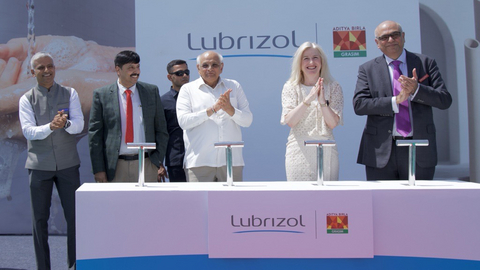
Lubrizol and Grasim Industries inaugurated a CPVC resin manufacturing facility in Vilayat, Gujarat on Monday, marking the latest chapter in the Berkshire Hathaway subsidiary’s 60-year India operation. The plant combines with an expanded compounding operation 80 kilometres away in Dahej to create what the companies describe as one of India’s most integrated chlorinated polyvinyl chloride production networks.
The Vilayat facility produces the base resin that gets processed into compounds used across India’s residential and commercial plumbing systems. Water pipes. Fire sprinklers. HVAC networks.
Timing matters here. India’s infrastructure spending has accelerated sharply since 2020, with the government prioritising water delivery systems and urban housing projects. CPVC—valued for heat resistance and durability in hot water applications—has gained ground against traditional materials like copper and galvanised steel, though the companies declined to provide production capacity figures or investment totals for the new plant.
The partnership brings together Grasim’s domestic manufacturing scale with Lubrizol’s chlorination technology, developed over decades in the chemical giant’s global network. Grasim Industries, the Aditya Birla Group flagship incorporated in 1947, operates across cellulosic fibres, chemicals and textiles. Lubrizol, founded in 1928 and acquired by Warren Buffett’s Berkshire Hathaway in 2011, employs more than 7,000 people across 100-plus facilities worldwide.
“Lubrizol introduced CPVC technology to India more than two decades ago, and since then, we have witnessed strong growth of the market alongside the country’s expanding economy,” said Abhishek Shrivastav, managing director for Lubrizol’s India, Middle East and Africa operations. “With the commissioning of this world-class facility in Vilayat, we are strengthening our manufacturing capabilities in India by following a local-for-local approach. This investment underscores our long-term commitment to India by enabling consistent access to high-quality, locally produced materials backed by Lubrizol’s global standards of innovation, reliability, and performance.”
The local-for-local model aligns with India’s Make in India manufacturing push, though it also reflects practical supply chain considerations. Importing CPVC resin adds shipping costs and lead times that can disrupt construction schedules. Domestic production shortens that loop.
For Grasim, the project extends its chemicals division beyond its traditional cellulosic fibres base. Jayant V Dhobley, business head and chief executive of global chemicals at Aditya Birla Group, framed the collaboration as a capability match. “This brings together Grasim’s manufacturing and execution capability in India with Lubrizol’s latest technology to deliver reliable CPVC materials for the market,” he said. “It reflects our approach of building and collaborating to scalable chemical manufacturing capabilities together.”
The technical advantages of CPVC have driven adoption in segments where failure carries consequences. The material withstands temperatures up to 93 degrees Celsius—critical for hot water systems where PVC would soften and deform. It resists corrosion from chlorinated water, a common issue in municipal supply systems. Fire sprinkler installers favour it because it doesn’t conduct electricity and maintains integrity during thermal stress.
Industrial piping applications have followed. Chemical processing plants use CPVC for transporting corrosive fluids. Pharmaceutical facilities specify it for hygienic water distribution where bacterial growth must be minimised.
Yet competition exists. Polypropylene random copolymer (PPR) pipes have gained market share in hot water applications, particularly in residential construction where cost pressures are acute. Cross-linked polyethylene (PEX) offers flexibility advantages in retrofit scenarios. Metal pipes retain loyalty among engineers trained in traditional specifications.
Lubrizol’s India expansion extends beyond Vilayat. The company commissioned a Global Capabilities Centre in Pune, expanded its Vikhroli office in Mumbai, and announced plans for a dedicated India Innovation Centre—details on location and timeline remain unspecified. The Dahej compounding plant expansion, completed recently, processes the Vilayat resin into finished compounds that pipe manufacturers extrude into final products.
That integrated footprint matters in a market where logistics can strangle margins. Gujarat’s industrial corridor offers port access through Dahej and road connections to major consumption centres in Maharashtra, Rajasthan and Madhya Pradesh. Vilayat sits roughly 50 kilometres from Vadodara, a chemicals and petrochemicals hub with established industrial infrastructure.
The 60-year milestone carries weight. Lubrizol entered India in 1966, initially focused on automotive lubricant additives before diversifying into specialty chemicals and engineered polymers. The CPVC introduction came in the early 2000s, as India’s construction sector began its long expansion.
Environmental and safety protocols at the new facility follow what Lubrizol describes as global standards, though specific certifications weren’t detailed in Monday’s announcement. Chemical manufacturing—particularly chlorination processes—requires containment systems for volatile organic compounds and robust wastewater treatment. The companies committed to “responsible resource management” and “eco-conscious manufacturing practices” without providing measurable targets or third-party audit commitments.
What’s clear is the bet on sustained infrastructure demand. India’s urban population is projected to add 416 million people by 2050, according to United Nations estimates. That growth translates to housing, hospitals, schools and commercial buildings—all requiring plumbing and piping systems.
Whether CPVC captures a growing share of that demand depends partly on cost trajectories. Raw material prices for vinyl chloride monomer—the precursor to PVC and CPVC—fluctuate with energy markets and petrochemical supply chains. Chlorination adds processing costs that compound price sensitivity in a market where developers often default to the cheapest compliant option.
For now, Lubrizol and Grasim are positioning for volume. The integrated manufacturing model should deliver cost advantages over competitors reliant on imported resin or fragmented production networks. How quickly the Vilayat facility ramps to full capacity will signal whether that thesis holds.
