
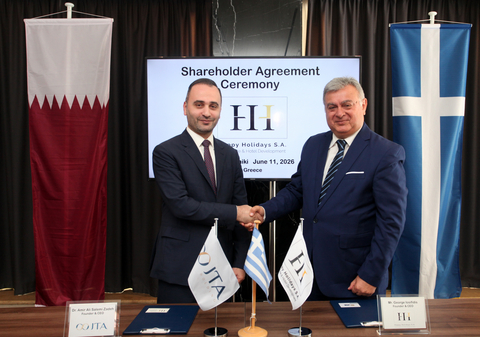
A Qatar-based investment firm has committed €65 million to transform a 120,900-square-metre stretch of Halkidiki coastline into a luxury resort complex, marking one of the largest foreign bets on Greek tourism infrastructure in recent years.
JTA Investment Holding signed the agreement with Happy Holidays S.A. to develop SARTIMARE Beach Resort & Spa in Sarti, a fishing village on Greece’s three-fingered peninsula. Construction runs from 2027 through 2030. The project’s valuation is expected to climb beyond €100 million once key milestones are hit.
The deal lands as Mediterranean destinations scramble for high-end tourism investment. Croatia, Turkey, and Spain have all seen Gulf capital flow into coastal developments over the past three years, with investors chasing Europe’s growing appetite for luxury beach experiences and second-home buyers from the Middle East seeking European residency options.
George Iosifidis, founder and owner of Happy Holidays S.A., framed the partnership as validation of Greece’s tourism rebound. “The signing of this Investment Agreement marks a significant milestone for the SARTIMARE project,” he said. “Our cooperation with JTA Investment Holding provides the financial strength and international reach required to bring this vision to life. Furthermore, this investment demonstrates international confidence in Greece’s tourism sector and contributes to attracting substantial foreign direct investment into the country.”
The development will pack luxury hotel facilities, private residences and villas, wellness amenities, retail and restaurant space, and marina infrastructure onto the coastal site. Happy Holidays is banking on environmental credentials—describing SARTIMARE as sustainable, though specific green building certifications or carbon targets weren’t disclosed in the announcement.
For JTA, the project slots into a broader strategy of parking capital in European real estate and tourism. Dr. Amir Ali Salemi Zadeh, the firm’s founder and chief executive, pointed to long-term confidence in Greece’s trajectory. “We have strong confidence in the future of Greece’s tourism sector and the exceptional potential of the SARTIMARE project,” he said. “This investment forms part of JTA’s long-term international strategy in tourism and real estate. We believe the project will contribute positively to Greece’s economic development, support employment creation, and strengthen the country’s position as a leading international destination.”
Halkidiki has emerged as a focal point for upmarket tourism development in northern Greece, though it remains less internationally recognised than Mykonos, Santorini, or Crete. The peninsula drew roughly 1.2 million visitors in 2023, according to regional tourism data, with Germans and Balkan travellers forming the largest contingents. The SARTIMARE project signals an effort to pull wealthier international visitors—particularly from the Gulf states and Western Europe—to a region that has traditionally attracted mid-market package tourists.
The three-year construction timeline suggests Happy Holidays and JTA are betting on continued stability in Greece’s economic and political environment. The country’s tourism sector has roared back since the financial crisis years, with visitor numbers and revenues consistently breaking records. In 2023, Greece welcomed 36.1 million international arrivals, up from 33 million the previous year, generating roughly €20 billion in tourism receipts.
Yet the project also faces headwinds common to large-scale coastal developments across the Mediterranean. Environmental groups have challenged multiple resort projects in Greece over concerns about coastal erosion, water consumption, and biodiversity impact. Halkidiki, with its pine forests running to the waterline and protected Natura 2000 sites nearby, has seen friction between developers and conservationists before.
The investment agreement didn’t specify financing structures, equity stakes, or revenue-sharing arrangements between Happy Holidays and JTA. Nor did it clarify whether the €65 million represents the full construction budget or merely JTA’s portion of a larger funding package.
What’s certain is the timeline: first guests aren’t expected until 2030 at the earliest. By then, the competitive landscape for Mediterranean luxury resorts will have shifted—perhaps multiple times. Croatia’s Dalmatian coast continues to add five-star properties. Turkey, despite economic turbulence, has attracted significant hospitality investment in Antalya and Bodrum. Spain’s Balearic Islands remain a magnet for ultra-high-net-worth buyers.
For Halkidiki, the question is whether a single large development can elevate the region’s profile enough to compete with those established players. The answer won’t arrive until shovels hit the ground in 2027—and even then, three years of construction lie ahead before the first guest checks in.
