
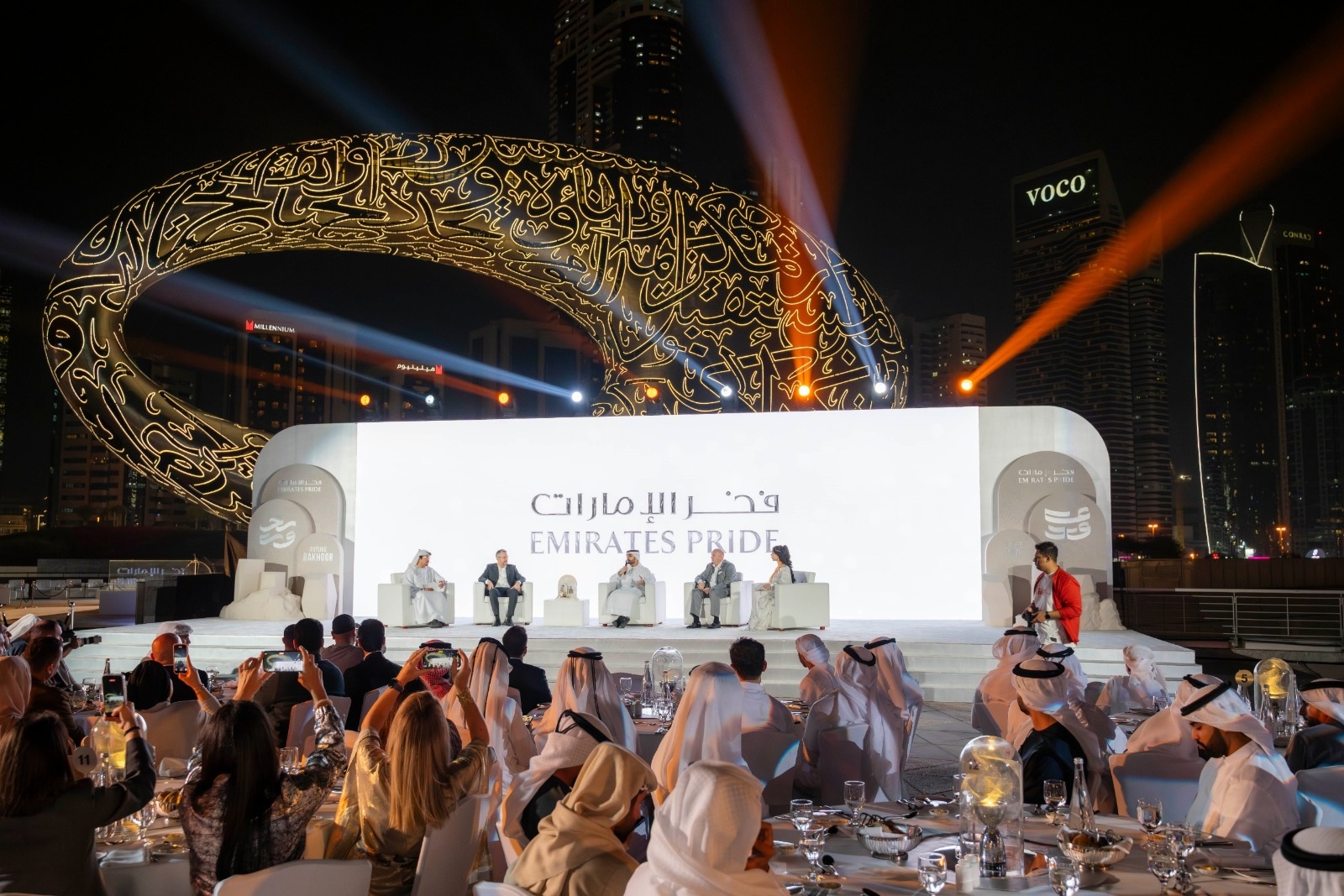

For hundreds of years, the ritual remained unchanged: light the bakhoor, let it smoulder, watch the smoke rise. Emirates Pride Perfumes just stopped doing that.
The Dubai-based fragrance house announced it has become the first Arabic perfumer to abandon the burning of bakhoor entirely, instead capturing its scent through laboratory technology and bottling it as wearable perfume. The move arrives as two new fragrances—Future Oud and Future Bakhoor—launch across London, Paris, Barcelona, and Dubai.
What’s at stake isn’t merely tradition. Bakhoor, a fragrant wood chip mixture burned in homes and majlis across the Gulf, has anchored Arab hospitality and ritual for generations. Stopping that practice, even to preserve the raw materials, represents a cultural pivot.
Mr. Mohammad Ibrahim, Chairman of Emirates Pride, framed the shift as evolution rather than abandonment. “Arabic perfumery is enjoying unprecedented global recognition today,” he explained. “At Emirates Pride, we are leading this evolution by pushing fragrances beyond convention through innovation in modern perfumery and craftsmanship. With Future Oud and Future Bakhoor, we are committed to preserving this heritage responsibly for future generations.”
The technical mechanism involves Headspace Technology, which captures scent molecules from burning bakhoor and aged oud without physical extraction. Instead of harvesting the wood itself, the process analyses the aromatic compounds released during burning, then reconstructs them synthetically. The result: a perfume that smells like smouldering bakhoor, minus the smoke.
That approach addresses a growing tension within niche perfumery. Demand for oud has surged among global luxury consumers over the past decade, putting pressure on agarwood supplies across Southeast Asia and the Middle East. Several oud-producing nations have imposed harvest restrictions. Meanwhile, high-end Western brands—Dior, Tom Ford, Byredo—have launched oud-heavy lines, intensifying competition for raw materials.
Emirates Pride’s strategy sidesteps that scarcity. By capturing rather than consuming, the brand positions itself within a broader sustainability conversation reshaping the fragrance industry. Whether consumers will accept a synthetic recreation of a ritual they value for its authenticity remains an open question.
The brand has added a second technological layer to Future Oud: EuroMotion® technology, which incorporates an ingredient called Euphorion®. According to the company, this compound has been shown to enhance feelings of joy, euphoria, and calm—essentially engineering emotional responses through scent. The science behind it remains proprietary, though the claim aligns with emerging research into olfactory neuroscience.
For Emirates Pride, the international launch represents a broader ambition. The brand has framed its work as aligned with UAE leadership priorities around innovation and cultural preservation, positioning itself as both custodian and disruptor. That dual identity—rooted in Emirati heritage while pursuing global luxury credibility—mirrors the trajectory of other regional brands entering international markets.
Yet the cultural stakes matter here. Bakhoor isn’t simply a fragrance; it’s a social practice. Burning it marks occasions, welcomes guests, sanctifies spaces. Translating that into a sprayable perfume means transforming a communal ritual into a personal accessory. Whether that shift resonates or alienates will likely depend on how younger, globally mobile consumers negotiate tradition.
The timing is deliberate. Arabic perfumery has gained cachet within niche fragrance circles, with collectors and enthusiasts seeking alternatives to the floral-woody-amber formulas dominating Western luxury. Brands like Amouage, Xerjoff, and Areej le Doré have capitalised on that appetite, introducing Gulf audiences to Western markets. Emirates Pride appears to be following that path, using innovation as differentiation.
Headspace Technology itself isn’t new—it’s been used by perfumers since the 1980s to capture ephemeral scents like blooming flowers or rain-soaked earth. What’s novel here is applying it to a centuries-old ritual, effectively archiving smoke. The implications extend beyond perfume: if scent can be captured and reproduced without depleting its source, other endangered aromatic traditions might be preserved similarly.
The four-city launch signals ambition beyond regional markets. London and Paris offer access to established luxury distribution networks. Barcelona taps into Southern Europe’s growing appetite for niche fragrance. Dubai anchors the collection in its home market, where the cultural resonance is strongest.
Whether Future Oud and Future Bakhoor succeed commercially will depend partly on price—unspecified in the announcement—and partly on whether they deliver the olfactory depth that bakhoor devotees expect. Capturing smoke is one thing. Replicating the layered, resinous complexity that develops as bakhoor burns over time is another.
What’s clear is that Emirates Pride has made a calculated wager: that preservation through innovation will resonate more powerfully than preservation through repetition. That the future of bakhoor lies not in burning it, but in bottling it.
For now, the brand has staked its claim as the first Arabic perfume house to make that leap. Whether others follow will reveal how the broader industry weighs tradition against sustainability, ritual against resource management.
The smoke, as it were, has cleared.