
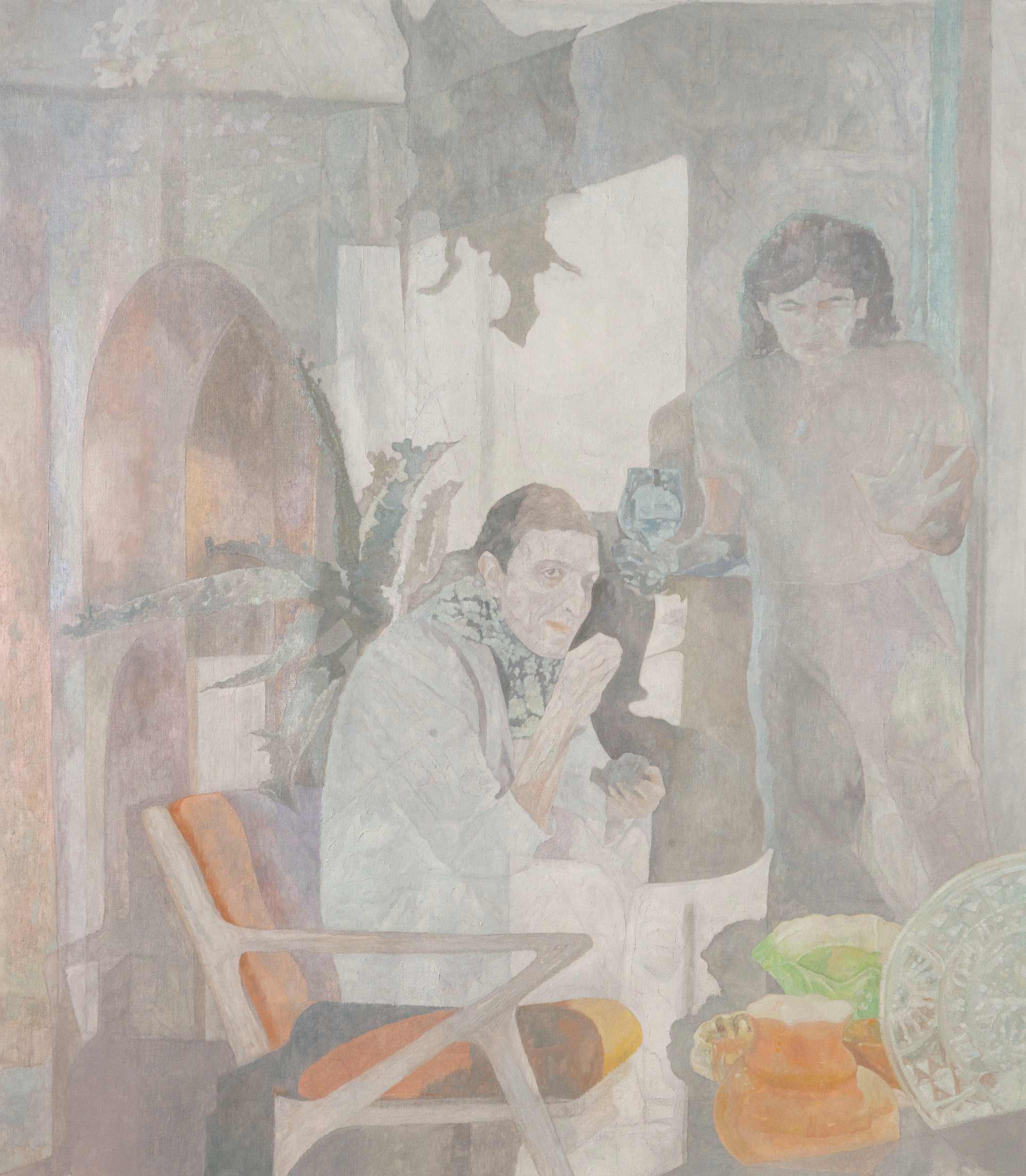

Dom Art Projects will open three exhibitions simultaneously in mid-April, a bold move for a gallery that only opened its doors last November. The convergence—an Art Dubai debut on 17th April plus two shows launching on 12th April in its Al Khayat Avenue space—marks the most ambitious programming yet from the private institution.
The timing isn’t accidental.
Alisa Bagdonaite, co-founder and chief curator, framed the triple launch as part of a broader curatorial vision. “This season, Dom Art Projects continues its reflection on space and time through the group exhibition Time That Grows Slowly and a solo presentation by Kirill Makarov, whose practice navigates between analogue painting and the digital condition. Our participation in the digital section of Art Dubai is part of the same curatorial position: we do not see digital art as separate, but as fully embedded in contemporary reality. For us, this programme is about expanding the conditions of artistic production, fostering dialogue, and situating Dubai as a place where these temporalities and practices can unfold.”
At Art Dubai, Dom Art Projects secured a booth in the Digital section at Madinat Jumeirah. Three artists will feature: Sofya Skidan, born 1996 in Russia, Michiko Tsuda, born 1980 in Japan, and Kirill Makarov, born 1988 in Russia. Skidan will show video work created during a residency in Dubai earlier this year—pieces imagining Arctic ice meeting desert dunes, mineral surfaces merging with simulated terrain. Tsuda brings video installations exploring memory and perception. Makarov contributes VR pieces and NFTs, work that shifts between digital media, augmented reality, and traditional painting.
The fair runs 17th to 19th April. By then, the gallery’s two concurrent exhibitions will already be open.
Time That Grows Slowly, curated by Alexander Burenkov, opens 12th April and runs until 26th July. The group show features 13 artists, most never exhibited in Dubai before. Among them: Maha Alasaker from Kuwait and the UAE, Srijon Chowdhury from Bangladesh and the USA, Odonchimeg Davaadorj from Mongolia and France, Patricia Domínguez from Chile, and Tabita Rezaire from French Guyana. Also showing: Louis Guillaume, Petr Kirusha, Vlad Kulkov, Mevlana Lipp, Sulafa Mohammed, Antoine Renard, Farah Soltani, and Nadia Waheed.
The exhibition’s premise centres on vegetal temporalities—plant time as opposed to human time. Growth rather than movement. Duration shaped by roots, decay, regeneration.
Burenkov explained the concept against Dubai’s context. “Against the backdrop of Dubai’s fast-paced urban environment, Time That Grows Slowly proposes a tool kit for slowing down, a reorientation of our sensorium to the rhythms of plants, the creation of space for vegetal attunement, reflection and contemplation in dynamic urban conditions, and the raising of questions about how duration, memory, and lived experience are produced within such environments. Plants grow, decay, regenerate, and coexist according to rhythms that defy linear progress and instrumental efficiency. Vegetal being is not oriented toward goals, optimization, or dominance. It persists through exposure, vulnerability, and repetition. In this sense, the contemporary artists are interested in exploring vegetal time because it introduces an ethics of non-acceleration: a way of inhabiting the world that neither conquers time nor seeks to escape it.”
The exhibition includes site-specific installations addressing care, interspecies communication, and ecological concerns. Hours are 11am to 8pm daily. An opening reception takes place 12th April.
Running concurrently, Kirill Makarov’s solo show Unveiled examines how war gets represented under autocratic conditions. The exhibition reconstructs scenes from conflict zones using public information and eyewitness accounts, creating 3D spatial environments that document violence and destruction whilst interrogating how war reality gets mediated. That show closes 10th May, two months before Time That Grows Slowly ends.
Anna Pumpyanskaya, co-founder and director, positioned the programme as part of a longer-term strategy. “As we enter this upcoming art season, we are embracing new models of support for artists, from residencies and research opportunities to presenting their work on a global platform such as Art Dubai. As an independent institution, we are committed to introducing audiences to artists they may not yet know, and to creating pathways for discovery and long-term recognition through exhibitions, collaborations, art fairs, commissions, public art projects, and acquisitions into collections.”
Dom Art Projects operates from Al Khayat Avenue with exhibition space, an art bookshop, and three dedicated residency studios. Skidan’s new video work shown at Art Dubai emerged from that residency programme earlier this year. The institution also runs talks, screenings, and workshops for adults and children.
A newly launched Collectors’ Circle initiative will explore collecting theory and practice, targeting both emerging and experienced collectors. The programme promises to cover influential private and institutional collections, how to start collecting, and building coherent collections at various budget levels.
An open call for artists-in-residence is due to be announced soon.
For a gallery five months old, the April schedule represents significant ambition. Most new spaces ease into art fair participation after establishing a local presence over several seasons. Dom Art Projects is attempting the reverse—using the regional spotlight of Art Dubai, which draws international collectors, curators, and institutions, to amplify its launch momentum whilst simultaneously opening two substantial exhibitions in its own space.
Whether the strategy succeeds depends partly on execution, partly on how Dubai’s growing collector base responds to artists largely unknown in the region. The institution describes its exhibitions as “museum-grade,” a claim that will face scrutiny as the programme unfolds.
The convergence of all three openings within five days creates a compressed window. Collectors attending Art Dubai will have the option to visit Al Khayat Avenue, roughly a 20-minute drive from Madinat Jumeirah, to see the two concurrent exhibitions. That proximity matters—many galleries time openings to coincide with Art Dubai week precisely to capitalise on the concentration of visitors.
The vegetal time concept offers a curious counterpoint. Dubai’s development over the past three decades epitomises acceleration—rapid construction, fast wealth accumulation, swift transformation from regional hub to global city. Proposing slowness, plant rhythms, and non-linear growth in that environment creates deliberate friction.
Burenkov’s curatorial framework suggests that friction is intentional. The question is whether audiences accustomed to Dubai’s pace will pause long enough to engage with work predicated on deceleration, on what he terms “an ethics of non-acceleration.”
Makarov appears in both the Art Dubai booth and the solo exhibition, giving his practice significant visibility across the programme. His work oscillates between digital tools and traditional media, using VR and augmented reality as compositional workbenches before resolving pieces in paint, drawing, or digital formats. That hybrid approach aligns with Bagdonaite’s assertion that Dom Art Projects views digital art as embedded in contemporary reality rather than separate from it.
The Digital section at Art Dubai has grown in prominence over recent editions, reflecting broader market interest in digital, video, and new media work. Securing a booth there for a debut appearance positions Dom Art Projects within a specific conversation about how technology shapes artistic production and reception.
Skidan’s practice exemplifies that integration. For her, according to the gallery, the digital functions as habitat—an extension of identity and perception rather than merely a tool. Her video work created in Dubai during the residency merges climate concerns with speculative landscapes, Arctic and desert ecosystems colliding in simulated space.
Tsuda’s video installations add a different dimension, using the digital as archive and experimental field, examining how media shapes memory.
The breadth of artists in Time That Grows Slowly—spanning Mongolia, Chile, French Guyana, Bangladesh, Kuwait, Saudi Arabia, Iran, France, Germany, Latvia, Georgia, and Russia—suggests Dom Art Projects is pursuing a deliberately international roster rather than focusing narrowly on regional or Emirati artists. Sulafa Mohammed and Maha Alasaker represent UAE and Kuwaiti connections, but the majority come from elsewhere.
That choice positions the gallery within Dubai’s broader role as a crossroads, a place where artists and audiences from different territories converge. Whether that approach resonates with collectors seeking to support local artistic production or those hunting for undiscovered international talent will become clearer as the season progresses.
Pumpyanskaya’s emphasis on introducing audiences to unfamiliar artists implies a willingness to take risks on lesser-known names rather than programming established market favourites. It’s a strategy that requires patience and deep pockets—or both.
The coming weeks will test the institution’s stamina. Three simultaneous exhibitions demand significant logistical coordination, staffing, and visitor management. Art Dubai alone draws thousands of visitors over three days. Managing a booth there whilst hosting opening receptions and maintaining daily exhibition hours at Al Khayat Avenue stretches resources for any gallery, let alone one barely past its first half-year.
But ambition, at least, isn’t in short supply. By July, when Time That Grows Slowly finally closes, Dom Art Projects will have data on whether Dubai’s audiences embrace vegetal slowness—or whether the city’s pace ultimately proves incompatible with exhibitions about plant time.
For now, mid-April looms. Three exhibitions. Five days. One very new gallery making a significant bet on its own momentum.