
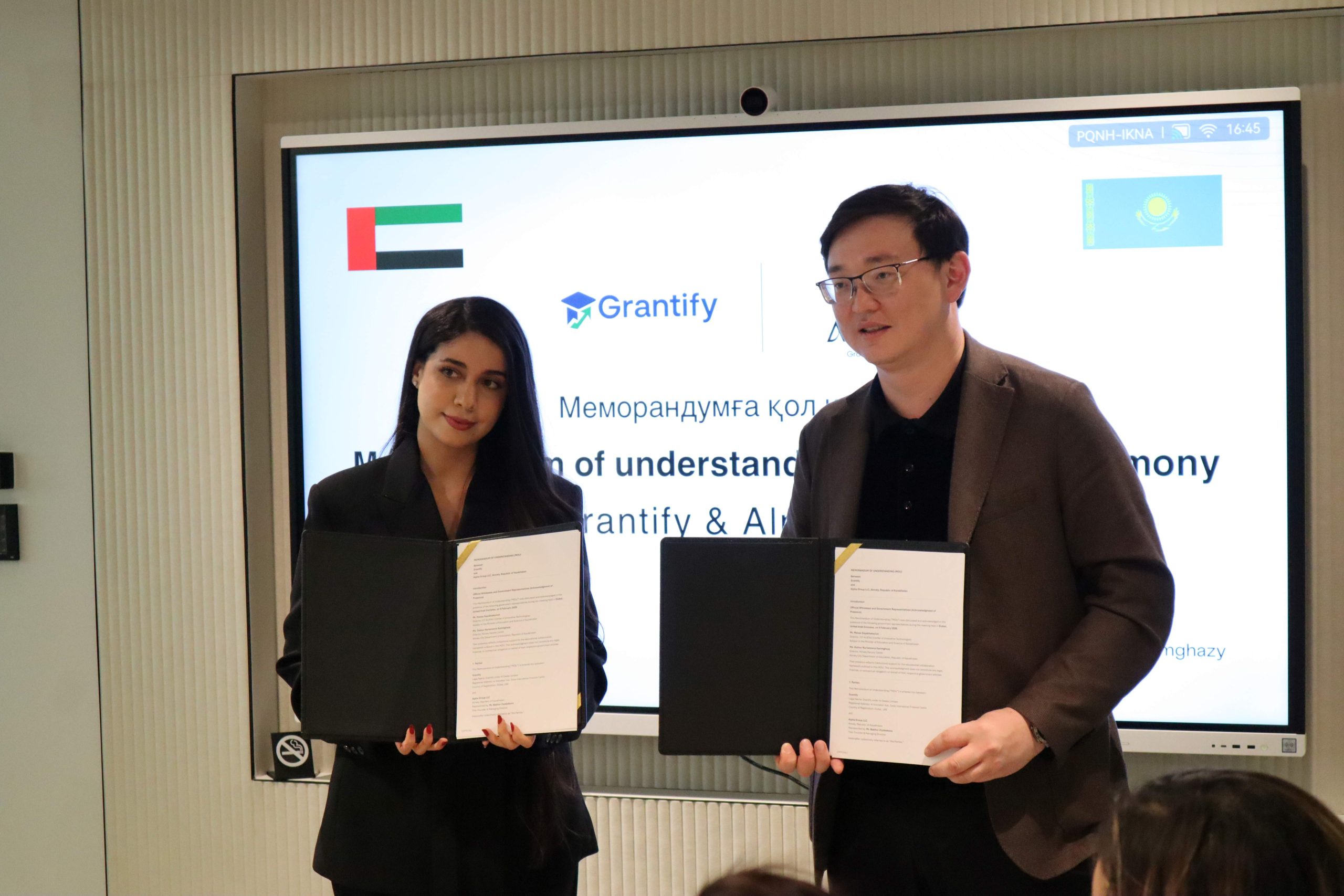

When Grantify and Alpha Group signed their partnership agreement on 9 February 2026, the Dubai AI Campus conference room held more than just business executives. His Excellency Almaz Tasbolat, Kazakhstan’s consul general in Dubai, sat alongside three senior diplomatic officials and directors from three Kazakh schools.
That level of attention signals something beyond routine corporate collaboration.
The memorandum of understanding between Dubai-based Grantify—an education technology platform matching students with scholarships and university placements—and Almaty’s Alpha Group aims to open international education pathways for students across Kazakhstan and Central Asia. The partnership combines Grantify’s digital admissions platform with Alpha Group’s established networks in regional schools.
For Central Asian families with university-age children, navigating international admissions has grown increasingly complex. Scholarship opportunities exist, but information remains scattered. Application requirements vary wildly between institutions. That’s the gap both organisations say they’re addressing.
“This partnership with Alpha Group reflects a shared commitment to empowering students with the right guidance, information, and access to global education,” said Samaa Mukhaimar, Grantify’s executive director. “Together, we are supporting schools and students with the tools and frameworks needed to navigate global admissions responsibly and effectively. We also acknowledge and appreciate the support provided by Kazakh Consulate General in Dubai and other stakeholders from Kazakhstan’s educational sector.”
The agreement covers four main areas. Student outreach and referral programmes connecting Central Asian applicants with international universities and scholarship opportunities. Joint training workshops on admissions processes and student readiness. School-based engagement raising awareness of study-abroad options. Admissions screening and final selection decisions will remain with partner universities, according to their own academic policies.
Three Kazakh school leaders attended the signing: Kulzhan Sauytovna, director of Specialised Lyceum No. 92; Sandugash Zhorakhanovna, who heads Specialised Gymnasium No. 199; and Manas Sayakhatovich, director of CIT ALATAU. Their presence suggests the partnership already has institutional backing within Kazakhstan’s education system.
The diplomatic contingent included Counsellor-Consul Dauren Nurzhanuly Doszhanov, Consul Mutalip Qaraqoz Zhakypbeqqyzy, and Attaché-Consul Amanbek Alnur Nurlanuly—a sizeable representation for what might otherwise appear a straightforward commercial arrangement.
Bakhur Ziyabekoov, Alpha Group’s founder and managing director, emphasised the local knowledge his organisation brings. “We are glad to partner with Grantify to help students in Kazakhstan and across Central Asia access more international education opportunities,” he said. “Their expertise in bringing clarity and structure to international student applications is extremely valuable in broadening students’ horizons and securing their futures.”
The international student recruitment market has become increasingly competitive. Platforms like StudyPortals and Leap Scholar already operate in similar spaces, connecting prospective students with universities globally. Central Asia represents an emerging source region—economic growth across Kazakhstan, Uzbekistan and neighbouring countries has created a middle class willing to invest in overseas education.
The UAE itself has positioned as an education hub. Dubai hosts branch campuses of numerous Western universities, whilst attracting students from across the Middle East, Africa and South Asia. Whether Central Asian students will choose UAE institutions or use the platform to access universities elsewhere remains an open question.
Grantify launched as a scholarship-matching platform, helping students identify funding opportunities that align with their academic profiles. Alpha Group operates across Kazakhstan’s education sector, working with schools on academic development and student readiness programmes. The combination gives both organisations something they lacked individually—Grantify gains on-the-ground access to Central Asian schools and families, whilst Alpha Group can offer its students a structured digital pathway to international opportunities.
Following the signing at the Dubai International Financial Centre, both organisations said they would begin designing online and in-person training programmes for students and families. The timeline for rollout wasn’t specified, though the involvement of school directors suggests pilot programmes could begin within the current academic year.
What’s less clear is scale. How many students across Kazakhstan and Central Asia might use the platform? Which universities have agreed to partner with the initiative? How does the referral model work financially—does Grantify earn placement fees from universities, or do families pay for the service?
Those operational details will determine whether this agreement translates into meaningful access for Central Asian students, or remains a framework that struggles to gain traction. For now, the diplomatic presence at the signing suggests Kazakhstan’s government sees value in facilitating international education pathways—even if the mechanics of delivery are still taking shape.
The agreement positions both organisations to capture what they clearly believe will be growing demand. Central Asia’s demographic profile skews young. Economic development continues, albeit unevenly. Families with resources increasingly look beyond domestic universities for their children’s education.
Whether Grantify and Alpha Group can convert that demand into placements—and whether students who use the platform find themselves genuinely better positioned for international study—will become clear over the coming months as training programmes launch and the first cohort of students begins navigating the process.
For Kazakhstan’s consul general and his team, attending the signing represented more than diplomatic courtesy. It signalled governmental recognition that education mobility matters—that Central Asian students seeking international opportunities deserve structured pathways rather than having to piece together information themselves.
The question now is execution. Frameworks and memorandums establish intent. What students and families need are results: acceptances, scholarships, visa approvals. By the time the next academic cycle begins, both organisations will know whether their partnership delivers on that promise.