
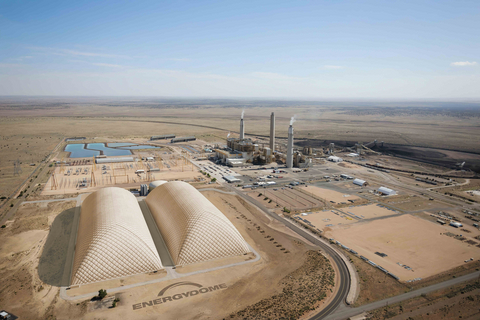
Salt River Project needs to double its generating capacity by 2035. The Phoenix-area utility signed a 20-year agreement on 15th June with Energy Dome to deploy a 19-megawatt storage system that runs on compressed carbon dioxide—not lithium-ion cells.
The project will rise at SRP’s Coronado Generating Station in St. Johns, Arizona, storing enough electricity to power 4,275 homes for 10 hours. Google is funding part of the build through a cost-sharing arrangement, marking the tech giant’s second collaboration with SRP on non-lithium energy storage.
It’s an unusual technology. Energy Dome’s CO2 Battery compresses carbon dioxide using grid power, then releases it through a turbine when electricity is needed. The process is thermomechanical, relying on temperature and pressure changes rather than chemical reactions.
The choice reflects SRP’s urgency. Arizona’s energy appetite is climbing fast, driven by population growth and a wave of data centre construction across the Phoenix metro area. Traditional lithium-ion batteries dominate the storage market, but supply chain constraints and fire risks have utilities hunting for alternatives.
“As energy demand continues to grow, SRP is evaluating new energy storage technologies that could support SRP’s effort to diversify its battery energy storage portfolio as we work to meet the Valley’s growing energy needs with affordable, reliable and sustainable power,” said Chico Hunter, SRP Manager of Innovation and Development. “This project will enable SRP to test the real-world performance of Energy Dome’s technology in the Arizona climate.”
That climate matters. Arizona’s desert heat punishes battery systems, making the state a proving ground for technologies that claim durability. Energy Dome won the contract through an SRP request for proposals issued in 2024, competing against other long-duration storage concepts including compressed air, gravity-based systems, and thermal storage.
The Italian company’s founder positioned the deal as a response to America’s infrastructure demands. “Arizona’s sustained growth makes it one of the most compelling energy markets in the country. At a time when AI growth and rising demand are reshaping America’s energy landscape, the CO2 Battery offers the scalable, dispatchable capacity needed to strengthen U.S. energy dominance,” said Claudio Spadacini, Energy Dome’s founder and chief executive. “We are proud to support SRP with a solution that can be built quickly, manufactured domestically, and supported by our expanding U.S. capabilities, helping SRP increase energy security by harnessing locally produced Arizona power.”
Energy Dome will own and operate the facility under the tolling agreement. SRP will control when the battery charges and discharges, integrating it into the utility’s broader grid management strategy.
Google’s involvement extends beyond simple funding. The company has been pushing utilities to test alternatives to lithium-ion for projects that need storage lasting beyond four hours—the typical limit for lithium batteries before costs spiral. Long-duration storage can smooth out the intermittency of solar and wind farms, which Arizona relies on increasingly.
“At Google, we are committed to catalyzing next-generation energy technologies to bolster grid resilience and introduce vital new capacity to the system,” said Lucia Tian, Director of Advanced Energy Technologies at Google. “This second project and important milestone in our collaboration with SRP builds on our long-term partnership with Energy Dome, and will help deliver dependable, cost-effective, and sustainable energy for Arizona’s ratepayers.”
The collaboration matters for Google’s own operations. The company runs data centres that consume enormous amounts of electricity, and securing stable power supplies has become a competitive necessity as artificial intelligence workloads multiply. By funding pilot projects, Google gets early insight into technologies that might eventually power its facilities.
SRP serves roughly 1.1 million electricity customers across greater Phoenix. The utility also delivers water to 2.5 million Valley residents, managing a watershed system that spans 13,000 square miles. Its dual role—electricity and water—makes energy reliability critical in a desert city where cooling demands spike.
The St. Johns location connects the project to existing grid infrastructure at Coronado Generating Station, reducing construction complexity. Co-locating storage at generation sites has become common practice as utilities retrofit coal plants with cleaner alternatives.
Energy Dome accelerated its US supply chain investments to support the project, though the company didn’t specify factory locations or employment numbers. The emphasis on domestic manufacturing aligns with federal incentives favouring American-made energy components.
Construction won’t begin immediately. The system is expected online in 2029, giving Energy Dome three years to finalise engineering and secure equipment. SRP and Energy Dome will partner with EPRI, an independent energy research institute, to monitor performance data once the battery begins operating.
For SRP, the project is one piece of a broader expansion. The utility must add generating resources rapidly to keep pace with Phoenix’s growth, balancing reliability against customer costs. Energy storage—whether lithium-ion, CO2-based, or other technologies—will play a central role in that buildout.
Whether carbon dioxide batteries can compete economically with lithium-ion at scale remains uncertain. The Arizona pilot will provide real-world performance data in harsh conditions, testing durability, efficiency, and dispatch flexibility.
By 2029, the answer will be clearer. Until then, SRP is betting that diversifying its storage portfolio beats relying on a single technology.
