
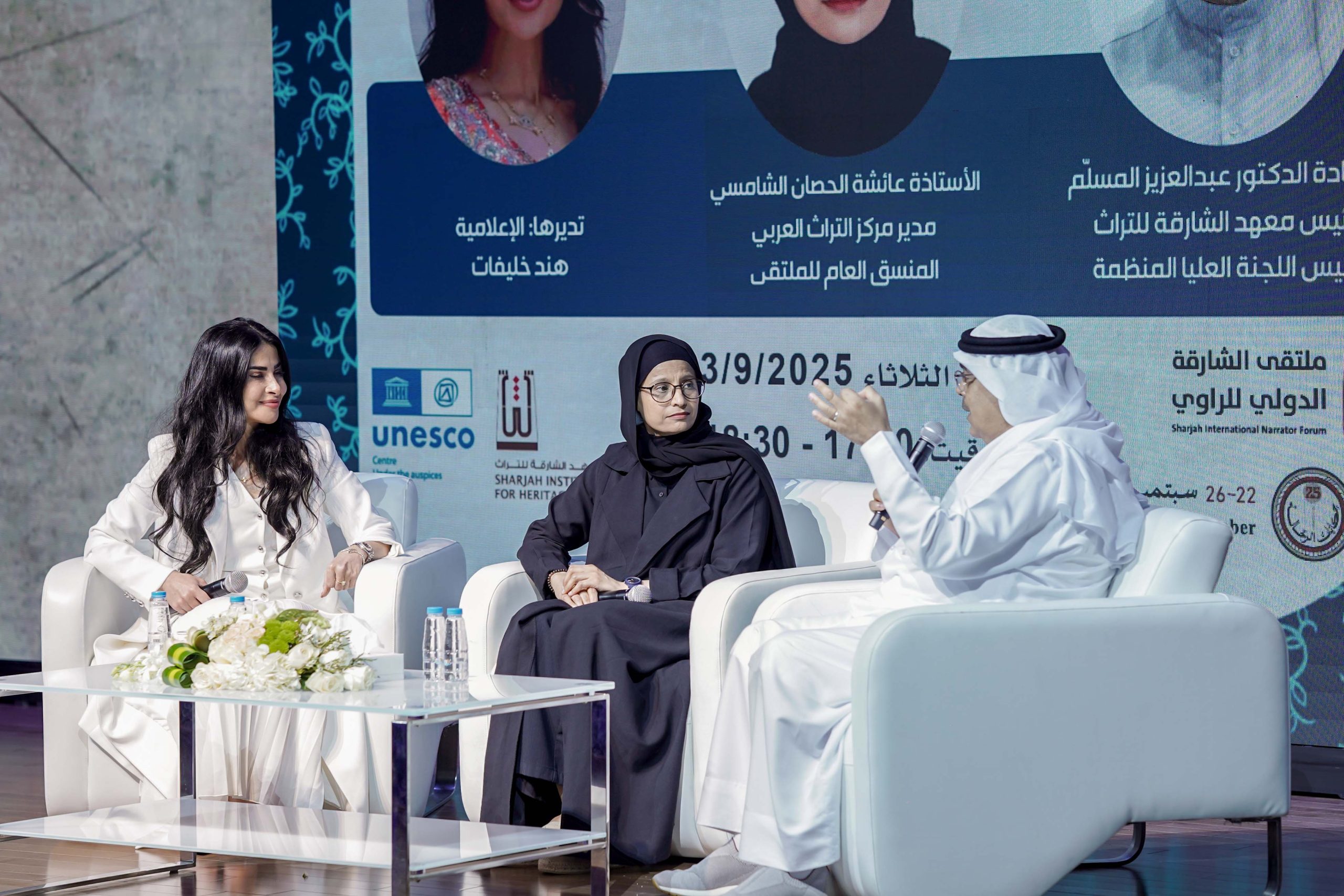

The Sharjah International Narrator Forum (SINF) has commemorated its 25th anniversary with a reflective session entitled “From Local to Global: The Narrator at His Silver Jubilee.” The gathering explored how tradition can be preserved while adapting to modernity, ensuring that cultural heritage is transmitted to future generations.
His Excellency Dr Abdulaziz Al Musallam, Chairman of the Sharjah Institute for Heritage and Chairman of the Forum’s Higher Organising Committee, remarked that “keeping pace with modernity and new developments is vital for preserving heritage.” He observed that social media travellers and influencers often wield greater influence today, making it essential to integrate authenticity with modern technologies.
The discussion, moderated by journalist Hind Khlaifat, featured Dr Aisha Al Husson Al Shamsi, Director of the Arab Heritage Centre and General Coordinator of the Forum. It attracted a wide audience of academics, researchers, university students, and heritage enthusiasts.
A Platform for Cultural Exchange
Dr. Al Musallam emphasized that since its inception a quarter of a century ago, the Forum has served as a bridge between cultures, initially bringing together narrators from the Gulf and Arab world and later from across the globe. “The Forum has become a pioneering platform dedicated to intangible heritage, supported by Sharjah’s tireless efforts in documenting and celebrating folk narratives,” he said.
He pointed out that while traditional narrators face challenges in the age of digital media, heritage storytelling must adapt to new tools or risk being forgotten. He urged for stronger partnerships and the use of advanced technologies to present heritage in ways that resonate with younger generations.
Comprehensive Research and Documentation
Dr. Al Musallam noted that the Forum has evolved beyond dialogue into a comprehensive research and documentation project. Through scientific publications, encyclopedias, workshops, and training programs, the Forum has prepared new generations of storytellers. Its influence, he added, has extended to UNESCO’s discussions on safeguarding intangible cultural heritage, strengthening its international standing.
He also highlighted Sharjah’s ongoing support for narrators, many of whom have been honored and provided with housing and social care in recognition of their role in preserving collective memory. “The storyteller is no longer just a witness of the past but a living symbol of identity who can contribute to shaping a contemporary cultural discourse,” he said.
Women and the Shared Human Story
Dr. Aisha Al Shamsi underscored that storytelling is a universal human art, not confined to one gender. She noted that women today actively document their journeys in modern ways, and that folk tales often appear in similar forms across cultures. She cited “Cinderella” as an example of a story that exists in multiple variations worldwide, reflecting humanity’s shared experiences.
Translation and the Future of Storytelling
Dr. Al Shamsi emphasized the pivotal role of translation in taking folk tales global, provided translators are deeply connected to the material to preserve its authenticity. She highlighted how the Forum has brought storytelling into schools, with narrators engaging directly with children in classrooms, fostering a living link between heritage and youth.
Looking ahead, she called for the adoption of artificial intelligence in archiving and analyzing narratives, and even integrating elements of science fiction into performances to appeal to younger audiences—while preserving the essence of traditional storytelling.
“Over the past 25 years, the Sharjah International Narrator Forum has become a global mosaic where storytellers from diverse cultures weave a shared human experience,” she said. “What we have achieved so far is only the beginning of a wider journey towards global recognition.”