
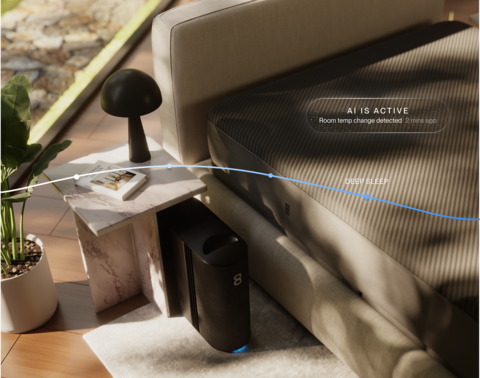

Eight Sleep’s new AI system will simulate thousands of scenarios about your coming night—warm room, late workout, heavy meal, elevated stress—and adjust your mattress temperature and elevation before you climb into bed. Not during the night. Before.
The New York-based sleep tech company announced Tuesday it had secured fresh funding from Tether Investments, pushing its valuation to $1.5 billion. The capital will bankroll Eight Sleep’s pivot from reactive sleep optimization into something more ambitious: predictive health intervention that anticipates disruptions before they occur.
It’s a significant leap. For years, Eight Sleep’s Pod tracked biometrics through the night—sleep stages, heart rate variability, breathing patterns—and made real-time adjustments to keep users asleep. Read a signal, respond to it, course-correct. That system worked. Clinical studies published in peer-reviewed journals showed the Pod reduced menopausal hot flashes by 56% and restored natural circadian temperature rhythms during sleep, improving cardiovascular recovery markers.
But reactive has limits.
The company is now training predictive models on more than one billion hours of real-world sleep data collected from users across 35 countries. The dataset—proprietary, massive, and constantly growing—feeds an AI agent designed to forecast how a user’s night will unfold hours before they’re horizontal. Did you exercise at 8pm? Eat a large dinner at 9? Spend the day in back-to-back meetings with cortisol spiking? The system will know, and it will pre-emptively optimize the sleep environment accordingly.
Early pilots of daytime AI-driven guidance have already shifted behaviour. Nearly half of participants adjusted activity timing, caffeine intake, or sleep schedules based on automated insights pushed to their phones. The promise: intervention before disruption, not damage control at 3am.
“Sleep was just the beginning,” said Matteo Franceschetti, co-founder and CEO of Eight Sleep. “We’ve built the most advanced AI-powered health sensing system in the world – one that learns your body better every night and acts on that knowledge. This investment gives us the resources to take that intelligence beyond the bedroom and into every dimension of personal health. What we’re building doesn’t exist yet – a system that understands your body better each night and acts on that knowledge. Our goal is to build the defining health technology company of this generation.”
The company is simultaneously advancing FDA filings for sleep apnea detection and mitigation. Clearance would fundamentally reclassify the Pod from wellness gadget to regulated medical device capable of screening, detecting, and intervening at scale—passively, every night, across hundreds of thousands of bedrooms. That’s a different business entirely.
Sleep apnea affects an estimated 39 million adults in the United States alone, many undiagnosed. Continuous positive airway pressure machines remain the standard treatment, but compliance rates hover around 50%. A mattress that detects and mitigates apnea without strapping a mask to your face? That would reshape the market overnight.
Eight Sleep’s 2025 was operationally strong. The company hit free cash flow positivity while launching three new products—Pod 5, Pod Pillow Cover, and Thermal Blanket—and expanding distribution to 34 countries. Two clinical studies provided the kind of peer-reviewed validation that separates credible health tech from quantified-self gadgetry. The studies demonstrated measurable, reproducible physiological effects: temperature regulation, circadian rhythm restoration, cardiovascular improvements.
That clinical foundation matters as Eight Sleep pushes into regulated health. FDA pathways for digital health devices remain complex, requiring evidence of safety and efficacy that goes well beyond user testimonials and app store ratings. The peer-reviewed work published in 2025 positions the company to navigate that process with data regulators will actually scrutinize.
“We believe advanced personalized AI is the perfect pathway to understand and expand human potential,” said Paolo Ardoino, CEO of Tether. “Eight Sleep has the potential to define the future of health tech by building intelligence that learns, scales, and evolves directly with humankind, turning advanced AI into practical, everyday insights and enhancements about core human biology. By helping people better understand sleep, recovery, and long-term health, Eight Sleep is laying the groundwork for a new standard in longevity-focused technology that is truly personalized, can function in any condition, directly on-device, resilient, and aligned with how people live. The age of human-first health intelligence has started.”
The funding will flow into three areas: R&D to accelerate predictive model development, expanded clinical trials and regulatory pathways, and deeper commercial partnerships in priority markets. Eight Sleep declined to disclose the round size or identify additional investors beyond Tether.
The competitive landscape is crowded but differentiated by approach. Oura focuses on a ring form factor tracking similar biometrics but without environmental intervention. Whoop targets athletes with recovery analytics. Fitbit and Apple Watch dominate wrist-worn tracking. Eight Sleep occupies different territory: the bedroom itself as an intelligent health platform, actively manipulating temperature and elevation to drive physiological outcomes.
That intervention capability—the ability to not just measure but change conditions in real-time—distinguishes Eight Sleep’s dataset from competitors. The company isn’t only observing what happens when people sleep poorly or well; it’s recording what happens when specific interventions occur under specific conditions. That closed loop generates training data competitors can’t easily replicate.
Professional athletes have adopted the system. Formula 1 driver Charles Leclerc uses it. So does Taylor Fritz, currently ranked among the top American male tennis players. For athletes chasing marginal gains in recovery, sleep optimization isn’t optional—it’s foundational. Eight Sleep’s clinical validation and active intervention model appeals to that demographic.
The company has collected hardware design awards—Fast Company named it one of the Most Innovative Companies in 2019, 2022, and 2023, and TIME twice recognized the Pod as one of the Best Inventions of the Year—but the strategic direction now points firmly toward software and AI development. The mattress is the interface. The intelligence layer is the product.
Whether FDA clearance materializes, and on what timeline, will determine how quickly Eight Sleep can scale beyond early adopters and wellness enthusiasts into mainstream healthcare. Regulatory approval would unlock partnerships with insurers, health systems, and employers—channels that vastly expand addressable market size but require demonstrating clinical utility and cost-effectiveness.
For now, the company is betting that one billion hours of sleep data, peer-reviewed clinical evidence, and a predictive AI system capable of acting before disruption occurs will carry it from sleep optimization into the broader terrain of personalized, preventative health. The bed is just the beginning. What Eight Sleep is building—if the regulatory pathway opens and the models deliver—is a persistent health monitoring system embedded in the place people spend a third of their lives.
The question is whether consumers will pay for that intelligence, and whether regulators will let them.