
Turning challenges into opportunities for progress, Moldova has prioritised the development of its IT sector and digitalisation agenda to reinforce its international reputation. This strategic focus has not only modernised public services but also enhanced the country’s European and regional partnerships.
By fully digitising nearly 650 public services, implementing forward-looking legislation for freelancers and digital nomads, and establishing innovation hubs such as Moldova HiTech Park – a crucial centre for research, applied education, and knowledge transfer – Moldova has emerged as a regional leader in digital transformation. These initiatives have improved the efficiency, transparency, and accessibility of services for both citizens and businesses, while also consolidating the nation’s role as a dependable partner on the international stage.
Ongoing investment in a competitive, sustainable digital ecosystem prioritises the development and retention of human capital, extending the benefits of digitalisation beyond public institutions. This approach encourages flexible career opportunities, supports entrepreneurship, strengthens the business landscape, and facilitates the integration of local specialists into the global economy. Human capital has become the driving force behind innovation and a key asset in advancing Moldova’s bid for EU membership.
DeepTech GigaHack – a Regional Platform for Turning Bold Ideas into Functional Solutions
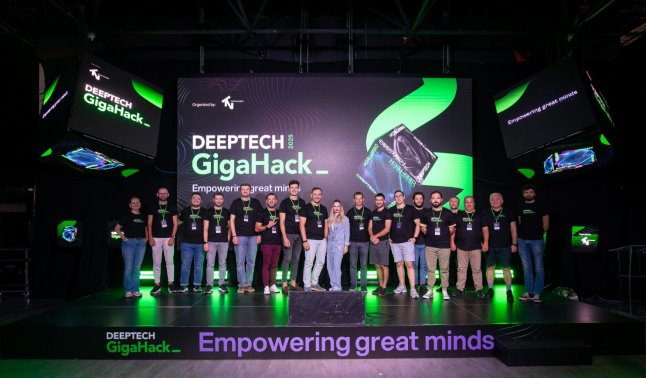
This momentum is supported by a broad coalition of stakeholders promoting innovation through events, collaborative platforms, startup incubators, research hubs, and partnerships across public, private, and academic sectors. The flagship initiative, DeepTech GigaHack 2025 – now in its third edition – recently brought together more than 300 participants from over 10 countries. Engineers, designers, researchers, students, and entrepreneurs collaborated intensively over 48 hours to turn creative ideas into working prototypes. The hackathon served as a springboard for innovation, offering direct access to international mentors, industry experts, and investors.
Doina Nistor, Minister of Economic Development and Digitalisation, said:
“We see more and more ideas, more and more innovations, and more and more courage—and this brings us joy. The Government believes in you, supports you, and invests in building a sustainable and inclusive economy, where Moldovan startups can become regional and global players. The future of the Republic of Moldova is in your hands, and together we can build a strong digital economy. Even in difficult times, innovation remains the driving force that will move us forward.”
Chișinău transformed into a true innovation hub during the hackathon, as technology enthusiasts and researchers developed solutions across sectors including Artificial Intelligence, FinTech, HealthTech, EnergyTech, AgriFood, Cybersecurity, and RegTech. Challenges were designed in partnership with local businesses and institutions to reflect real industry needs. Over the intense 48-hour session, participants created functional prototypes with significant potential to impact these industries.
For example, in the RegTech track, Orange Systems, one of the event’s partners, proposed a B2B solution to help SMEs meet the cybersecurity requirements of newly adopted legislation.
Meanwhile, Fineguide.ai, in collaboration with the National Bank of Moldova, led a FinTech challenge on document anonymisation, inviting participants to design solutions that protect sensitive data while remaining compliant with legal standards – a crucial step for the financial sector’s digital future.
Mary Nemciuc, CEO of Technovator and organiser of the hackathon, said:
“DeepTech GigaHack, now in its third edition, has proven that Moldova can not only generate innovative ideas but also deliver impactful solutions capable of transforming strategic sectors and creating tangible value—showing that ideas born in Moldova can rapidly turn into globally scalable solutions. The event confirms the potential of the local innovation community and the country’s capacity to position itself as a regional hub for emerging technologies, fostering collaboration between startups, academia, and international companies.”
The Results: Ideas with the Potential to Transform Industries
In total, 44 teams registered in the competition, and 8 of them impressed the jury and went home with winner titles. Winning teams will have the opportunity to continue project development alongside partners.
- AgriFood Challenge – “Team DUTS” developed a data exchange platform for small agricultural businesses, mainly farms, to facilitate fast access to information and effective decision-making.
- AI Challenge – “Team FalcoNS” created a deterministic AI system replacing human parking operators with real-time interaction and automated decisions, also introducing a LatePay system via QR and messaging.
- Cybersecurity Challenge – “Team DreamTeam” proposed EVO Shield, a cybersecurity module focused on privacy for Moldova’s EVO app, scanning files, links, and QR codes, offering real-time alerts, enabling threat reporting, and educating users in simple language without storing personal data.
- EnergyTech Challenge – “Team Singularity” built a mobile app that turns raw consumption data into useful insights for users, offering simulations, recommendations, and forecasts based on individual appliances.
- RegTech Challenge – “Team Sudo-ku” created CyberCare, a digital platform that helps Moldovan SMEs comply with the Cybersecurity Law No. 48/2023 by providing risk assessments, compliance checklist synchronization, real-time updates, and modular guidance, boosting national cyber resilience.
- FinTech Challenge – “Team JUAN” developed a document anonymization solution for sensitive data protection and legal compliance.
- HealthTech Challenge – “Team Viore” designed a full AI assistant for X-ray analysis, using neural networks to detect anomalies, language models for summaries and diagnostic explanations, and a PDF generator for clinician-friendly reports.
- Open Challenge – “Team Rancho” created DesignerSpace, a platform for designers with an intuitive web interface where users can browse swipe-generated designs, use a web scraper for local materials, and generate AI/API-powered design mockups.
