
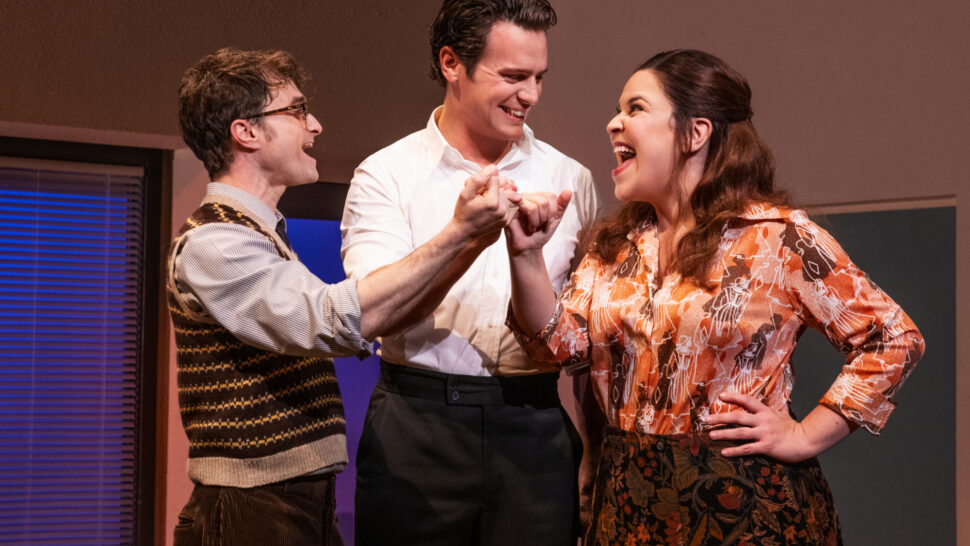
Few musical theater moments carry the emotional weight of “Old Friends,” and seeing it brought to life on film by Daniel Radcliffe, Jonathan Groff, and Lindsay Mendez in Merrily We Roll Along feels like watching a defining piece of musical theater history crystallize in real time. The completed “Old Friends” scene is not just a highlight of the film—it’s a thesis statement for why this long-gestating adaptation matters.
Originally one of Stephen Sondheim’s most structurally daring works, Merrily We Roll Along tells its story in reverse, tracing the unraveling of friendships and ideals by moving backward through time. “Old Friends,” placed near the beginning of the show but late in the characters’ lives, is deceptively light on the surface. Beneath the wit and warmth lies a devastating awareness: these characters already know how their story ends.
That tension is exactly what Radcliffe, Groff, and Mendez capture with remarkable precision.
A Friendship Written on Their Faces
What makes this filmed performance so compelling isn’t just vocal strength—it’s history. Radcliffe (Charley), Groff (Frank), and Mendez (Mary) don’t play like performers hitting marks. They move like people who have shared decades of memories, disappointments, private jokes, and unspoken resentments.
Radcliffe’s Charley brings sincerity and moral clarity to the trio, grounding the scene with an emotional openness that never tips into sentimentality. His performance feels lived-in, understated, and deeply human—an anchor amid the song’s cleverness.
Groff’s Frank, by contrast, is all charm and ease on the surface. His smile carries confidence and showbiz polish, but it flickers just enough to reveal the fractures underneath. Groff understands that Frank’s charisma is both his greatest asset and his greatest flaw, and he lets that duality quietly inform every line.
Mendez’s Mary may be the most emotionally complex presence in the scene. Her delivery balances humor with pain, affection with disappointment. She doesn’t oversell the heartbreak; she lets it linger between phrases. The result is devastating in its restraint.
Why “Old Friends” Hits Harder on Film
Seeing “Old Friends” in a cinematic context adds a new layer to the song’s impact. On stage, the number relies heavily on timing, chemistry, and audience imagination. On film, the camera does the remembering for us.
Close-ups catch fleeting glances, half-smiles, and moments of hesitation that would be easy to miss in a theater. The intimacy amplifies the irony of the lyrics: as the characters celebrate shared memories, the audience can see how far apart they already are.
The film format also emphasizes one of Merrily We Roll Along’s core ideas—that nostalgia is unreliable. The warmth of the song contrasts sharply with the emotional distance visible on screen, making the scene quietly devastating rather than overtly tragic.
Performances Built on Trust
One of the reasons this scene works so well is the evident trust between the performers. Musical theater thrives on ensemble chemistry, and this trio operates with near-telepathic precision. Lines overlap naturally. Reactions feel instinctive rather than rehearsed.
That cohesion reflects the long arc of the project itself. The performances don’t feel rushed or manufactured for the camera. Instead, they carry the patience and confidence of artists who understand both the material and each other.
It’s rare to see a musical number where nothing feels pushed—no oversized gestures, no vocal grandstanding. The power comes from control.
A Song About Time, Reconsidered
“Old Friends” has always been a song about time—how it compresses relationships, distorts memories, and quietly changes people. In this filmed version, time feels almost like a fourth character.
The audience watches with the knowledge of what’s already been lost, even as the characters sing about closeness and shared history. That dramatic irony is the beating heart of Merrily We Roll Along, and this scene embodies it perfectly.
The performances don’t ask the viewer to mourn yet. They simply ask the viewer to notice.
Why This Scene Matters
For longtime fans of Sondheim and musical theater, this “Old Friends” scene validates years of belief in the material. Merrily We Roll Along has often been described as misunderstood or ahead of its time. Seeing it realized on film with this level of care, subtlety, and emotional intelligence feels like a long-overdue course correction.
For new audiences, the scene works just as well as an entry point. You don’t need deep knowledge of the show’s history to feel the ache beneath the humor or the affection beneath the regret.
A Quiet Showcase of Craft
In an era of maximalist musical adaptations, this scene stands out for its simplicity. There’s no spectacle competing with the performances. No distraction from the emotional truth of the song.
Instead, the film trusts the material—and the actors—to do the work.
By the time “Old Friends” ends, it doesn’t leave the audience applauding so much as reflecting. On friendships. On choices. On the small moments that feel permanent until they aren’t.
And that, ultimately, is the power of seeing Daniel Radcliffe, Jonathan Groff, and Lindsay Mendez perform “Old Friends” in Merrily We Roll Along: it reminds us that the most lasting musicals aren’t about grand finales—they’re about the quiet recognition of what time has already changed.
