
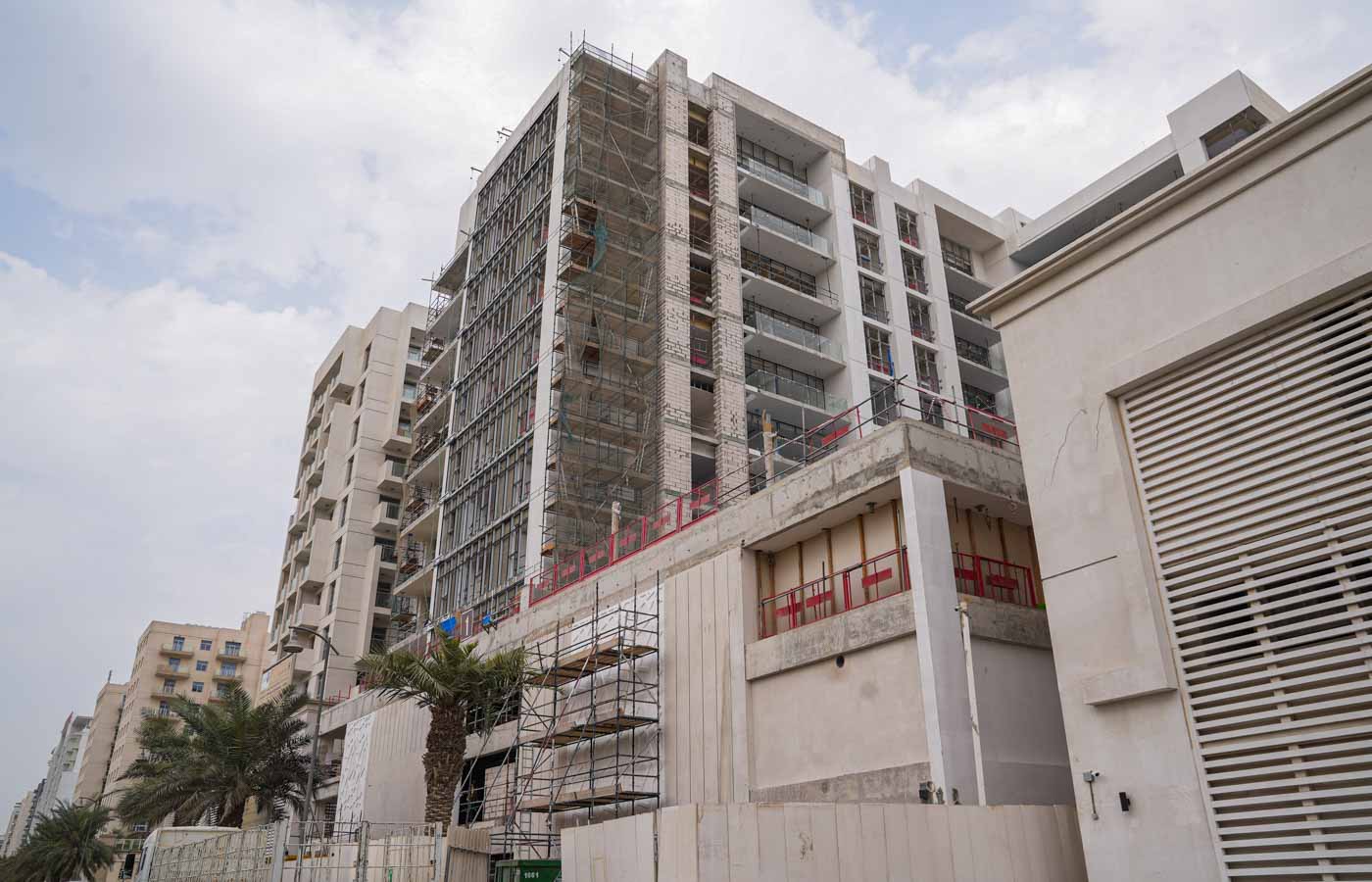
Three hundred and twenty-two workers are currently deployed across the Azizi Central construction site in Al Furjan, pushing through the final quarter of a project that promises handover within weeks. The pace is relentless. Cranes swing overhead, MEP teams navigate partially finished corridors, and the sound of installation work echoes through towers that are now 77% complete.
The timeline matters here.
With handover scheduled for the first quarter of 2026—and the calendar already showing late January—the margin for delay has essentially evaporated. Yet the developer, Azizi Developments, appears confident the schedule will hold. The numbers tell a story of coordinated momentum: elevator installation has reached 99%, HVAC systems stand at 93%, and MEP work more broadly has hit 85%. Tiling, at 81%, trails slightly behind, while overall finishes—the visible polish that transforms construction sites into homes—currently sit at 67%.
Structure, blockwork, and internal plastering have already been finalized. What remains is the detailed, painstaking work that determines whether a building merely functions or actually feels finished.
Farhad Azizi, Group CEO of the Azizi group of companies, framed the progress in broader terms. “The steady progress at Azizi Central underscores our unwavering commitment to quality and craftsmanship,” he said. “As construction advances, the development is taking shape as a refined residential destination, defined by connectivity, everyday convenience, and well-thought-through design.”
That commitment will be tested in the coming weeks. The gap between 77% overall completion and 100% handover-ready encompasses thousands of individual tasks—each one a potential bottleneck. The 322-strong workforce represents a significant deployment, even for a developer of Azizi’s scale, suggesting the company is treating the deadline as non-negotiable.
What buyers are actually getting, beyond the construction percentages, is a contemporary residential development designed around modern lifestyle expectations. The project offers one-, two-, and three-bedroom apartments, each positioned to capture Al Furjan’s emergence as one of Dubai’s faster-growing residential pockets. Exteriors blend clean lines with understated sophistication, while interiors prioritize space and natural light.
Amenities span the expected and the essential. There are landscaped walking areas, a state-of-the-art gym, and separate swimming pools for adults and children. An outdoor seating area and BBQ zone cater to Dubai’s cooler months, when outdoor living becomes central to residential life. Parking facilities are described as ample—a detail that matters considerably in a car-dependent city. Ground-floor retail and dining options promise everyday convenience without leaving the complex.
Location, though, may be Azizi Central’s strongest asset. Al Furjan has transformed over the past decade from a mid-tier suburb into a genuinely connected residential hub. The neighbourhood’s metro station sits just minutes away, linking residents to Dubai’s broader transit network. Major highways are easily accessible, and the development sits within close reach of Expo City Dubai, Dubai Marina, and Palm Jumeirah—three destinations that anchor both leisure and business activity in the emirate.
That connectivity matters for resale value and rental yields, factors that preoccupy many buyers in Dubai’s investment-heavy market. Al Furjan’s evolution mirrors the broader pattern of Dubai’s residential expansion: once-distant communities becoming central as infrastructure catches up with ambition.
For Azizi Developments, Azizi Central represents a relatively modest project within a sprawling portfolio. The company has delivered more than 45,000 homes to buyers from over 100 nationalities and currently has around 150,000 units under construction, valued at tens of billions of dollars. The developer is perhaps best known for Burj Azizi, set to become the world’s second tallest skyscraper, and for master-planned communities like Azizi Riviera, Azizi Venice, and Azizi Milan.
Those larger projects command headlines. But it’s developments like Azizi Central—mid-scale, well-located, designed for owner-occupiers and investors alike—that form the backbone of Dubai’s residential market. The city’s property sector runs on volume and velocity, rewarding developers who can deliver on time and at scale.
Which brings the focus back to those 322 workers and the weeks ahead. By the end of March, the site will either be handing over keys or explaining delays. The final finishes will either meet expectations or fall short. The elevators, already at 99%, will either reach 100% or remain frustratingly incomplete.
In Dubai’s delivery-focused market, there’s little room for ambiguity. Buyers expect what they were promised, when they were promised it. For now, Azizi Central’s progress suggests the deadline will be met. Whether that confidence is justified will become clear soon enough.
