
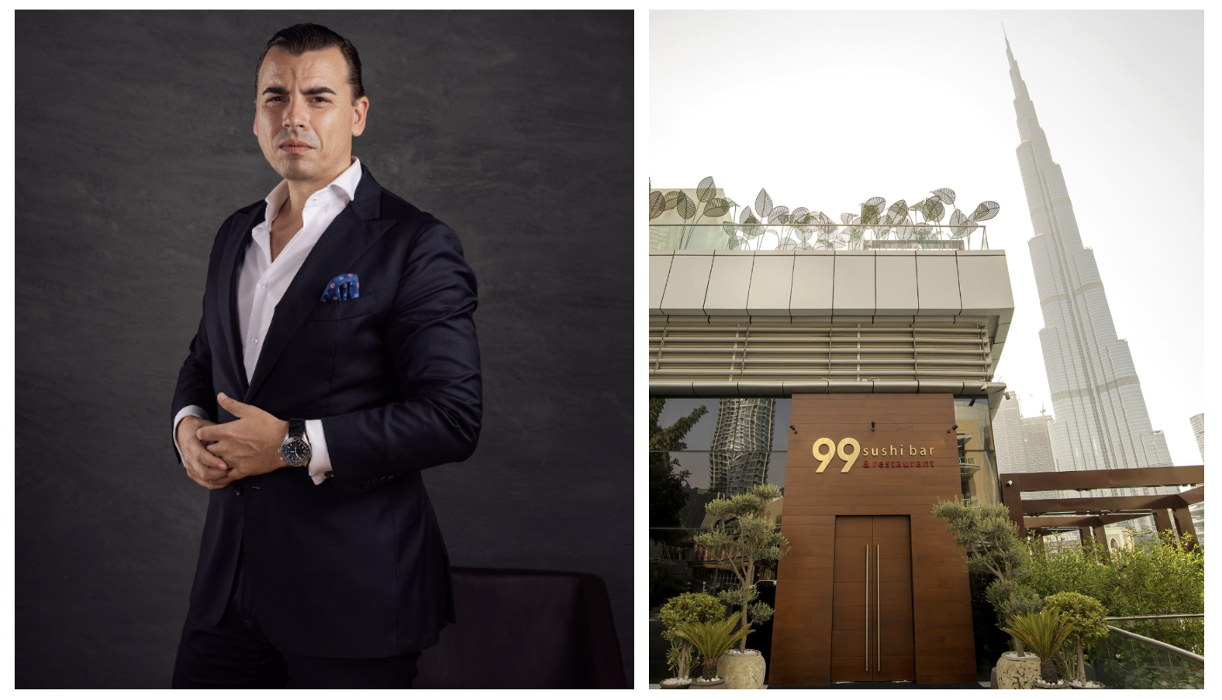
On 20 November 2025, Jaime Castañeda completed a merger that shifted control of 99 Sushi Bar & Restaurant from its Spanish founders to his Abu Dhabi-based investment firm. Three months later, the brand will open its first London restaurant in Mayfair.
The transaction unified operations under Ninety Nine SB Investment L.L.C., relocating headquarters from Spain to the UAE.
What began in 2005 as a family project by brothers Pedro and Fernando de León has transformed into a 10-restaurant operation spanning four countries, employing roughly 400 people. The Abu Dhabi flagship at Four Seasons Al Maryah Island has held a Michelin star since 2022, renewed annually through 2024. Now Castañeda, as group chief executive, controls the lot.
“This merger marks the beginning of a powerful new chapter for 99 Sushi. By unifying our operations under one group, we are creating a single global powerhouse with the capability, vision, and leadership to take the brand across continents. Our goal is clear: to elevate 99 Sushi into one of the world’s most influential Japanese dining institutions while honouring the legacy built over the last two decades,” Castañeda said.
The De León brothers remain on the global board. Their exact ongoing role wasn’t detailed.
Mayfair represents a calculated gamble. London’s Japanese dining market is crowded—Nobu, Zuma, Sexy Fish, and The Araki all compete for the same high-spending clientele. Rents in the district routinely exceed £200 per square foot annually. The Q1 2026 opening will include what 99 Sushi describes as a speakeasy concept, the brand’s first venture into experiential mixology.
That’s followed by Budapest in Q2 2026, then Doha in Q3. All three will operate under direct ownership rather than franchise agreements, according to the company. Budapest marks the brand’s entry into Central Europe; Doha extends its Gulf presence beyond the UAE and Morocco.
The consolidated structure positions the UAE as the operational centre for worldwide expansion, a geographic shift that mirrors broader trends in luxury hospitality. Over the past five years, Abu Dhabi and Dubai have become regional hubs for international restaurant groups seeking to build Gulf operations before expanding into Europe and Asia.
Chef Thinus van der Westhuizen remains culinary director across all locations. His menu centres on omakase sequences, truffle-infused dishes, and nigiri finished with gold leaf—signature elements that have appeared consistently since the brand’s early days in Spain.
Current restaurants operate in Abu Dhabi, Dubai, Rabat, and Monaco, though the company didn’t specify how many sites exist in each city. The Abu Dhabi location has earned recognition beyond Michelin, appearing in Gault&Millau guides and receiving accolades from Esquire Middle East, Time Out Dubai, and BBC Good Food Middle East.
The timing of the London launch raises questions about market positioning. Mayfair openings typically require 18 to 24 months of planning, securing premises, and navigating local licensing—suggesting 99 Sushi’s UK groundwork predates the November merger by some margin.
Whether the speakeasy format will differentiate the brand in a saturated market remains to be seen. London has seen a wave of hidden bar concepts over the past three years, from Nightjar to Swift to Bar Swift. Adding Japanese cuisine to the formula could carve out a niche, or it could dilute focus.
For Castañeda, the three 2026 openings represent the first major test of the consolidated structure. Managing quality across dispersed locations has challenged numerous restaurant groups attempting rapid expansion—Busaba collapsed into administration in 2020 after overextending, while Gaucho faced similar pressures in 2018.
The brand’s emphasis on “ultra-premium ingredients” and omakase-driven menus suggests a high-price positioning. In London, omakase typically starts around £150 per person at mid-tier venues, rising to £300-plus at Michelin-starred establishments. That pricing requires consistent execution and a clientele willing to pay for precision.
By anchoring operations in Abu Dhabi rather than Spain, Castañeda has effectively reoriented the brand’s identity. What was a Spanish interpretation of Japanese cuisine now operates from the Gulf, targeting European capitals. The shift reflects changing investment flows in global hospitality, where Middle Eastern capital increasingly finances Western expansion.
The De León brothers spent two decades building 99 Sushi from a single Spanish venue into an internationally recognised name. Their decision to step back from operational control, while remaining on the board, suggests either an exit strategy or a recognition that scaling further required different expertise and deeper pockets.
Castañeda’s background wasn’t detailed in the announcement, nor was the financial structure of the merger disclosed. Whether the transaction involved full acquisition or a partnership arrangement remains unclear. What’s certain is that decision-making authority now sits in Abu Dhabi, with the founders in advisory roles.
The Budapest opening will test appetite for high-end Japanese dining in a market traditionally dominated by local cuisine and Italian imports. Hungary’s capital has seen luxury hotel openings in recent years—Matild Palace arrived in 2021, W Budapest opened in 2024—but standalone fine dining remains a smaller segment compared to London or Dubai.
Doha, by contrast, represents a natural extension. Qatar’s dining scene has expanded rapidly since the World Cup, with international brands viewing the emirate as an essential Gulf market alongside Dubai and Abu Dhabi. The Q3 2026 timeline positions 99 Sushi to capture post-summer demand as residents return from annual holidays.
Three consecutive Michelin stars provide credibility, but maintaining that standard across multiple new markets within a single year will strain resources. Chef van der Westhuizen will need to either replicate his kitchen team or trust local hires to execute dishes that earned the Abu Dhabi location its recognition.
The speakeasy element in London adds complexity. Running a bar programme alongside a Michelin-calibre kitchen requires dual expertise—few restaurant groups execute both at the highest level. Zuma manages it; Sexy Fish attempts it with mixed results. Whether 99 Sushi can balance omakase precision with cocktail theatre will become clear once doors open in Mayfair.
For now, the brand operates from a position of strength: established revenue streams across 10 restaurants, a Michelin star lending prestige, and backing sufficient to fund three simultaneous openings. The November merger removed the complexity of split ownership, streamlining decisions under a single corporate entity.
What it hasn’t removed is risk. London’s restaurant mortality rate is brutal—around 25% of new openings fail within the first year, according to industry estimates. Mayfair’s high costs amplify that risk. A prime site might require £500,000 in upfront investment before serving a single customer.
Castañeda’s strategy hinges on the assumption that 99 Sushi’s existing reputation will translate across borders. The Michelin star provides a calling card, but London diners are notoriously fickle. Even established names stumble—Sketch lost its third star, while The Ledbury closed entirely despite years of acclaim.
The brand’s next eight months will determine whether the merger accelerates growth or exposes vulnerabilities. By September 2026, 99 Sushi will either operate successfully in three major new markets, or it will be managing the fallout from overly ambitious expansion.
The De León brothers built slowly over 20 years, adding locations carefully. Castañeda is attempting three cities in nine months. One approach isn’t inherently superior, but they require very different capabilities. The question now is whether centralised Abu Dhabi management can execute what decentralised Spanish family ownership achieved through patience.
