
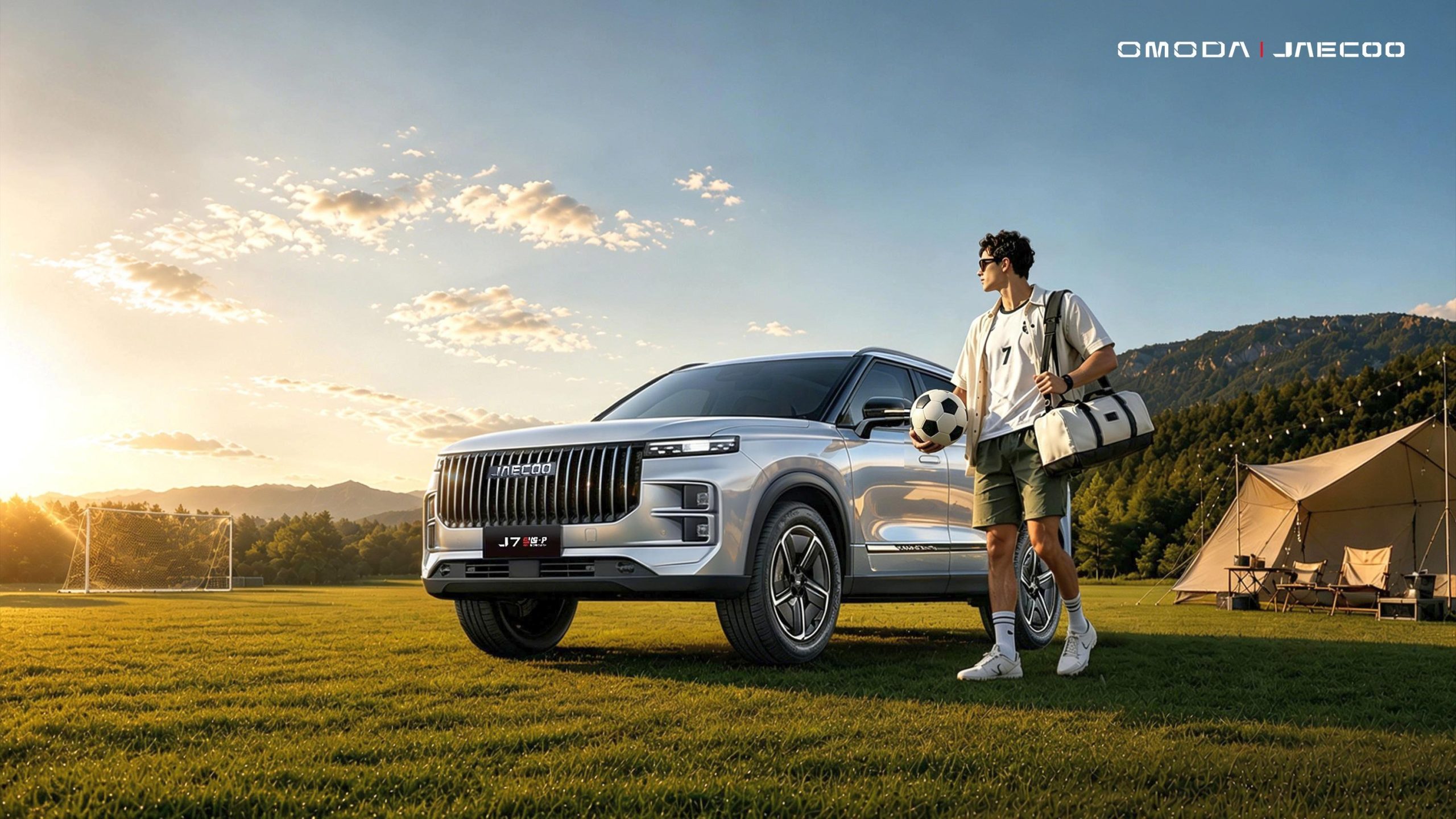
OMODA & JAECOO launched its summer push on Tuesday with a pitch built around an unusual problem: football fans want to watch matches in the desert, and their vehicles need to run the projector.
The brand’s Super Hybrid System vehicles offer a combined range exceeding 1,300 kilometres alongside Vehicle-to-Load technology that powers speakers, lighting rigs and screening equipment at remote viewing parties. For a market where inter-emirate road trips regularly stretch past 200 kilometres each way, and where air conditioning runs constantly against temperatures pushing 50 degrees, that range matters.
The announcement arrived as part of the company’s “FOREVER 26, PLAY LOUD, SHINE PROUD” campaign, timed to coincide with football season and the peak of UAE summer driving conditions. It’s positioning that leans heavily on lifestyle rather than pure transport—turn your hybrid into a mobile entertainment hub, the pitch suggests, and suddenly beach screenings become viable.
The UAE’s hybrid market has grown crowded. Toyota’s hybrids dominate fleet sales, BYD’s plug-in models undercut on price, and Tesla’s charging network expands across emirates. OMODA & JAECOO, backed by Chinese parent Chery International, entered with SHS technology engineered around three capabilities: high power output, low energy consumption, and extended range. The thermal management system maintains efficiency even when air conditioning runs continuously—a non-negotiable feature when cabin temperatures can hit dangerous levels within minutes of engine shutdown.
That 1,300km range translates to roughly Abu Dhabi to Fujairah and back three times without refuelling. In practice, it means fans driving from Dubai to Al Ain for a match gathering, running a projector and sound system for three hours, then returning home without range anxiety.
The V2L capability adds another dimension. Plug in a 1,000-watt projector, a portable speaker setup, and LED strips, and you’ve converted a dune campsite into an outdoor cinema. It’s the sort of use case that sounds niche until you consider how many UAE residents already drag generators to remote locations for weekend gatherings.
OMODA & JAECOO has moved quickly since entering the Emirates. The brand passed 5,000 vehicle sales and now operates showrooms across Dubai, Abu Dhabi, Sharjah, Ras Al Khaimah and Fujairah. A second Dubai location opened at Oasis Mall on Sheikh Zayed Road, signalling confidence in a market where showroom rent doesn’t come cheap.
Globally, the company hit one million cumulative sales within three years of launch. That pace puts it among the fastest-growing automotive brands worldwide, though the figure includes both OMODA and JAECOO models across dozens of markets with wildly different pricing structures and competitive landscapes.
What’s coming next might matter more than what’s here now. The brand confirmed its VPD system—Valet Parking Driver, also marketed as Super Intelligent Parking—will arrive in the UAE soon on selected models. The technology enables driverless parking and vehicle summon functions, the sort of autonomous capability that Dubai’s Roads and Transport Authority has actively encouraged through regulatory frameworks designed to accelerate smart mobility adoption.
The company frames this as part of a broader “Automobile + AI Ecosystem” vision that extends beyond vehicles into AiMOGA humanoid robotics and next-generation smart driving solutions. Whether that ecosystem materialises as promised or remains aspirational will depend on execution across markets with different regulatory environments and consumer expectations.
For now, the focus remains on hybrid range and lifestyle integration. OMODA specialises in urban tech-forward vehicles, while JAECOO targets the premium off-road SUV segment—two distinct approaches under one brand umbrella, both built on the same SHS platform.
The thermal management technology addresses a genuine engineering challenge. UAE summer conditions represent some of the harshest operating environments for hybrid systems globally. Batteries degrade faster, cooling systems work harder, and efficiency drops when cabin cooling draws continuous power. Any hybrid claiming UAE viability needs to prove it can maintain performance when ambient temperatures exceed 45 degrees and air conditioning runs at maximum capacity for hour-long journeys.
OMODA & JAECOO’s specifications suggest the engineering holds up, though independent long-term reliability data in extreme heat remains limited given the brand’s recent market entry. The 1,300km range figure assumes optimal conditions—real-world driving with full passenger loads, sustained high speeds, and continuous climate control will reduce that number, though by how much depends on variables the company hasn’t publicly detailed.
The timing of the campaign reflects broader patterns in UAE consumer behaviour. Football viewing has evolved into multi-day social events, with groups travelling to coastal properties, desert camps and mountain retreats for extended gatherings. That shift created demand for vehicles that function as both transport and power source—a gap that traditional combustion engines and pure EVs struggle to fill as effectively as plug-in hybrids with V2L capability.
Competitors have noticed. Several brands now offer similar technology, though range and power output vary significantly. The market will ultimately decide whether 1,300 kilometres and portable electricity generation justify whatever premium OMODA & JAECOO commands over established alternatives.
What’s clear is that Chinese automotive brands continue gaining ground in Gulf markets, leveraging competitive pricing, rapid technology deployment, and willingness to customise features for regional conditions. Whether that momentum sustains as competition intensifies and early adopters assess long-term reliability will shape the next phase of the UAE’s automotive landscape.
For football fans loading camping gear and screening equipment this summer, the pitch is straightforward: drive further, power more devices, stop less often. Whether that resonates beyond early adopters depends on factors well beyond marketing campaigns—resale values, service network quality, and whether the technology delivers on promises when temperatures and expectations both run high.
