
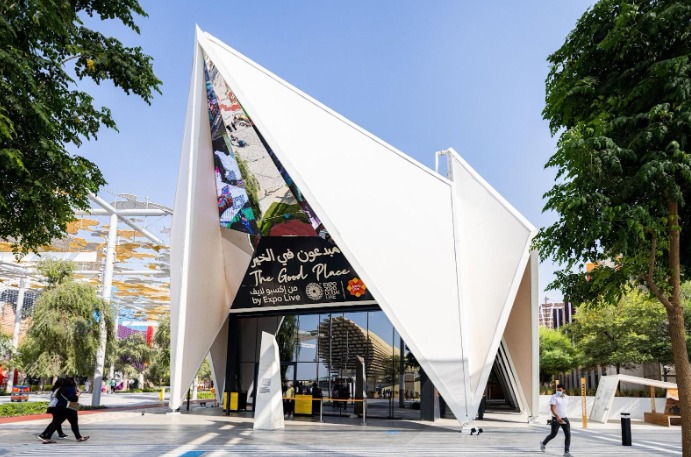
Between 2016 and 2022, Abdulla N. Khoory and his team at Expo 2020 Dubai managed $100 million in social innovation funding across 76 countries. The program supported 140 social enterprises that collectively impacted over six million lives, creating 160,000 jobs, restoring 36 million hectares of land, providing medical assistance to 1.1 million people, and conserving 6.3 million liters of water.
But what stands out is not just the scale, it’s how the funding was deployed.
“I never see things in silos,” Khoory reflects. “When you solve for education, you solve for employment, health, and dignity. Every problem is interconnected, and that’s how impact should be designed.”
Finding Innovation Eight Hours from Capitals
Abdulla N. Khoory led and managed the partnership with the Bill & Melinda Gates Foundation for humanitarian initiatives. Through this partnership, he managed crisis response organizations in Afghanistan, Lebanon, Jordan, Bangladesh, and Kenya, regions where traditional development funding rarely reaches those most in need.
“Going deep into the jungles and forests,” as Khoory describes his approach, was more than a metaphor; it was a method. By reaching beyond capital cities and formal networks, his team identified innovators working at the very edges of accessibility. Through UAE embassies, local ambassadors, and on-ground partnerships, the program extended its reach to 96 percent of the world’s countries, uncovering solutions that would have otherwise remained invisible to traditional funding systems.
Khoory challenged the conventional development bias toward urban innovation hubs, choosing instead to seek ingenuity in places global capital often overlooks. The team uncovered projects such as community-led water purification systems in Uganda, education programs in Bangladesh that achieved literacy rates above national averages, and healthcare initiatives in Kenya that reached communities where traditional aid had failed.
He mentions that “these discoveries across some of the world’s most resource-constrained regions challenged the idea that innovation is born only in labs or capital cities like Silicon Valley. I learnt that grassroots contextual intelligence, not capital intensity, is what truly drives lasting impact.”
Patterns from 11,000 Applications
Community leaders with intimate knowledge of local problems consistently outperformed entrepreneurs with formal education or prior funding experience.
Key findings that shaped funding decisions:
- Context beats technology: Local maintenance capabilities mattered more than sophisticated solutions
- Distribution trumps novelty: Access to users determined success more than technical breakthroughs
- Insiders outperform outsiders: Community members created more sustainable solutions than external experts
- Patience generates returns: Iterative development produced higher success rates than rigid timelines
Western-funded programs often failed by imposing solutions from different contexts. Expo Live adapted evaluation criteria to local contexts while maintaining rigorous impact measurement. Patient capital and flexibility enabled higher success rates than traditional grant programs requiring standardized metrics.
Building Ventures on Grant-Making Lessons
Khoory now applies these insights to his latest venture, Two Point Five, transforming regional philanthropy through transparent, impact-driven giving.
Named after the 2.5% zakat obligation in Islamic tradition, the Two Point Five platform will connect donors with verified organizations using three principles derived from Expo Live:
- Transparent impact reporting over emotional appeals
- Direct donor-recipient connections
- Locally relevant success metrics
“I want to change the game on how people donate,” Khoory explains, envisioning donors matching passions with high-impact organizations vetted through rigorous evaluation.
Data-Driven Alternative to Current Models
Abdulla N. Khoory earned his Master’s degree in Education from Harvard in 2023, bringing academic rigor to his field experience. His work demonstrates that $100 million deployed effectively across 76 countries can achieve more than larger budgets managed through conventional channels.
Current market conditions create urgency. Khoory explores this shift in depth in his recent Fiker Institute publication “Can GCC Philanthropy Define the Next Era of Global Development?” which documents the contraction of Western aid:
- USAID programming cut by 34-53% across sectors
- UK aid reduced by 40%, falling to its lowest levels since 2012
- Germany’s ODA dropped 10% in 2024, with humanitarian aid down 53% in 2025
- France cut its 2025 budget by 23% from 2024 levels
Khoory positions GCC philanthropy as a values-driven alternative, combining Islamic giving traditions with strategic impact measurement. These are principles he now applies through his ventures. His experience suggests that success requires moving beyond donor-recipient dynamics toward genuine partnerships.
Global development requires fundamental restructuring. Khoory’s insights from evaluating 11,000 applications and deploying $100 million provide a proven roadmap for culturally authentic, measurable approaches to social impact.
