
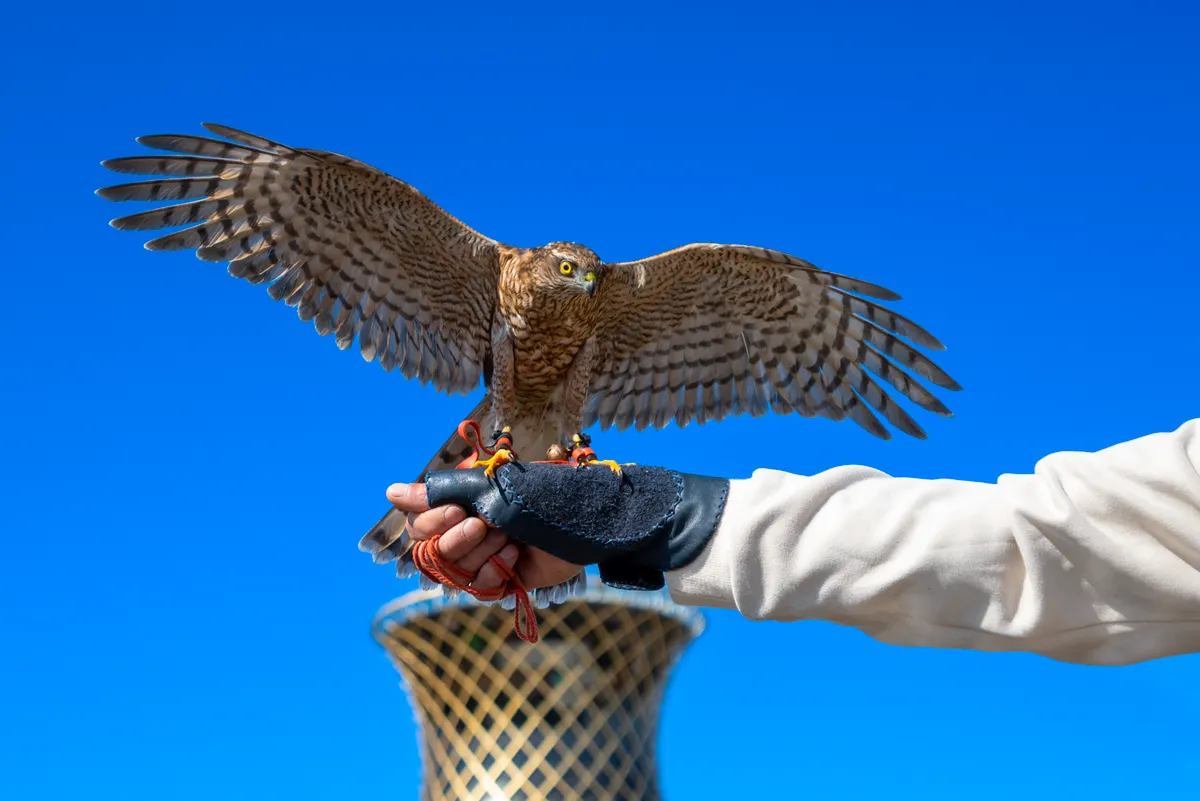
Abu Dhabi falconry hunting rules have grown substantially stricter since the days when Mohamed Al Remeithi, now head of events at the Abu Dhabi Falconers Club, first went into the desert at age 13 with his grandfather and uncle, sleeping on the ground and travelling hundreds of kilometres without seeing another person.
Where early trips into the Empty Quarter carried no formal structure, today’s licensed falconer operates within a regulated system that covers where, when and who may hunt, and what must happen to the birds they pursue.
What the rules now require
The traditional falconry hunting licence in Abu Dhabi is restricted to UAE citizens aged 18 and above. It is issued for a single season, is non-transferable, and must be carried while hunting and produced when requested by authorities. Falcons used for hunting must be registered with the relevant federal authority.
Hunters in open wilderness areas must stay at least 2 kilometres from main and secondary roads and from prohibited or restricted locations, which include natural reserves, protected areas, forests, residential areas, petroleum facilities and military facilities. The Environment Agency Abu Dhabi (EAD) stipulates that licensed falconers may only hunt between sunrise and sunset.
Al Remeithi said the regulatory framework has not diminished the tradition. ‘The state is not falling short in supporting this sport,’ he said, pointing to competitions, managed reserves and captive-breeding programmes as evidence of that backing.
For him, the availability of managed reserves is among the most consequential changes. Families can now practise the activity close to home without it affecting work schedules or children’s schooling, he said. ‘You can practise this sport close to your home or close to your area, without it disrupting your work or your children’s studies, and then you return.’
Houbara conservation underpins the hunting tradition
The tightening of Abu Dhabi falconry hunting rules has run alongside a major conservation effort centred on the houbara bustard, long the primary quarry of Emirati falconers.
The Sheikh Zayed Houbara Conservation Programme, launched in 1977, now spans breeding centres in the UAE, Morocco and Kazakhstan. The first successful breeding of an Asian houbara chick outside its natural habitat took place at Al Ain Zoo in 1982, an early milestone achieved through the scientific work that would later be formalised under Reneco, now an operating entity of Ekthar.
The International Fund for Houbara Conservation (IFHC), formally established in 2006, manages the programme globally. As of September 2024, IFHC had produced a cumulative total of 888,256 houbara bustards across its breeding centres and released 534,122 birds to rebalance wild populations, according to an IFHC official press release. Figures presented at ADIHEX 2026 put the all-time production total above 1.1 million, reflecting continued output since that 2024 announcement.
Ali Al Shamsi, project manager at IFHC, said the organisation produces around 90,000 to 100,000 houbara annually across its centres. More than 6,000 birds have been tracked to gather data on migration, survival and behaviour after release, according to Gulf News coverage of ADIHEX 2026.
Al Remeithi said conservation and the continuation of falconry are not competing priorities. The philosophy he inherited from his grandfather, about entering the desert without leaving damage behind, is now written into the licence conditions every hunter must follow.
‘When you go hunting, you have to keep in mind that you are going on a hunting trip to an area that lacks all the services you are used to,’ he said. ‘You learn patience, and you learn how to deal with nature. At the same time, you are responsible for it; you don’t leave your rubbish, you don’t spoil the natural landscape.’
The EAD publishes the conditions for each hunting season on its website, and hunters are expected to review updated permit requirements before the season opens.
