
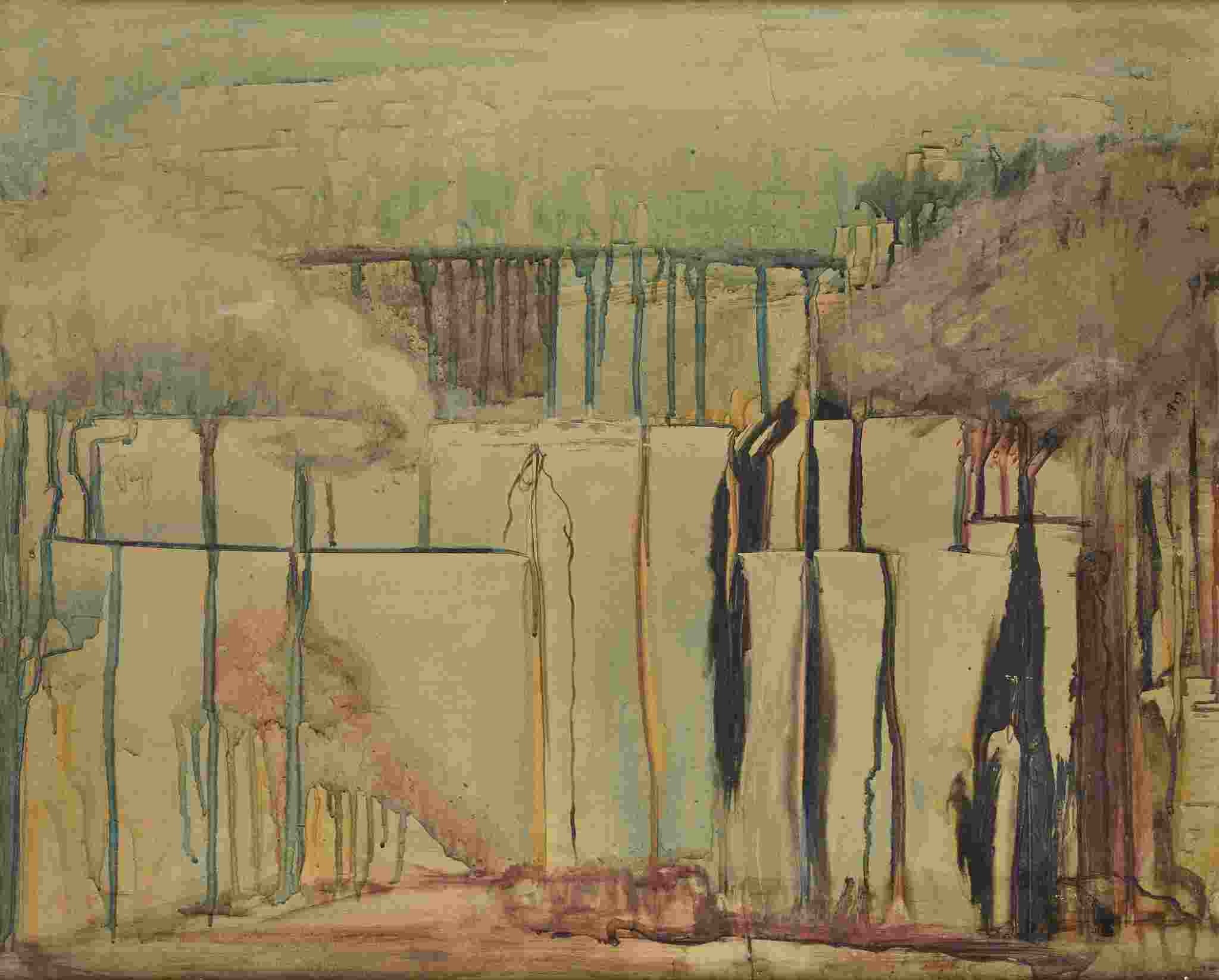
Dr Mohammed Said Farsi transformed Jeddah’s coastline into an outdoor sculpture gallery during his three decades as mayor. Among the works he collected privately was something more intimate: an oil painting on gold paper by a woman who once wore Egypt’s crown.
That painting goes under the hammer on 3rd June at Olympia Auctions in London. Abstract Landscape, created by Queen Farida—Egypt’s former queen consort who reinvented herself as an artist after her world collapsed—has been in a private collection since 2013. The estimate sits at £7,000 to £9,000.
Farida’s story doesn’t follow the usual script for deposed royalty.
Born Safinaz Zulficar in Alexandria in 1921, she married King Farouk in 1938 at seventeen, adopting the name Farida to align with the royal family’s tradition of names beginning with “F.” Admired for her elegance, she became one of the monarchy’s most visible figures during its final chapter. The marriage ended in divorce in 1948. Four years later, the Egyptian Revolution of 1952 swept away the entire system.
While Farouk fled into exile, Farida took a different route—one that led through Beirut, Switzerland and Paris, and eventually to a canvas.
Her uncle was Mahmoud Said, the painter widely regarded as the founding father of modern Egyptian art. With his encouragement, Farida began painting seriously, developing a visual language rooted in memory, displacement and spirituality. Her landscapes and abstract compositions reflected the peculiar condition of exile: nostalgia tangled with reinvention, identity suspended between what was and what might be.
For decades, her artistic output remained overshadowed by the drama of her royal biography. That’s shifted. Farida’s paintings now sit in institutional collections at Mathaf: Arab Museum of Modern Art in Doha, the National Museum of Egyptian Civilisation in Cairo, and the Royal Jewellery Museum in Alexandria. Last year, Cairo’s Liwan Gallery mounted an exhibition pairing her work with that of her granddaughter, Yasmine Perreten, renewing attention on her legacy.
Janet Rady, specialist in Olympia Auctions’ African and Middle Eastern Art department, noted the rarity. “Queen Farida occupies a unique place in Egyptian history. While she is remembered as the former Queen of Egypt and wife of King Farouk, her achievements as an artist are now receiving renewed attention. Because her paintings are so rarely seen on the market, opportunities to acquire one are exceptionally limited, so we are delighted to offer this work for auction.”
Abstract Landscape belongs to Farida’s mature period, when she favoured luminous surfaces and atmospheric effects. The gold paper substrate gives the oil paint an unusual warmth, a technique that became characteristic of her later explorations of place and memory. The work passed from Dr Farsi’s collection to its current owner in 2013, one of only a handful of her paintings to surface publicly in recent years.
The 3rd June sale features 59 lots in Olympia’s ongoing programme dedicated to African and Middle Eastern art, a market segment that has seen growing international collector interest over the past five years. Institutional acquisitions have accelerated, with major museums building holdings in 20th-century modernism from the region.
A second work in the sale carries its own connection to Egypt’s political history: a portrait of Mahmoud Hamed, painted by Kamel Moustafa. Hamed served as Governor of the Central Bank of Egypt from 1986 to 1993, navigating the banking sector through a transitional period that laid groundwork for later economic reforms. Moustafa, one of Egypt’s foremost portraitists, trained at Cairo’s Faculty of Fine Arts and Rome’s Academy of San Luca, building a reputation for disciplined realism and tonal precision.
The provenance adds resonance. Originally owned by Sa’id Zulficar—Queen Farida’s brother—the portrait is now consigned by her great-nephew. The Zulficar name threads through Egypt’s legal, political and royal history, a family whose proximity to power shaped the country’s trajectory through much of the 20th century.
Moustafa’s portrait of Hamed, executed in oil on wood, captures the measured authority expected of a central banker during turbulent years. Restrained colour, controlled light, composed posture—the painting conveys institutional stability at a moment when Egypt’s economy was undergoing significant realignment. The estimate stands at £3,000 to £5,000.
Both works arrive at auction as appetite grows for art that documents the Middle East’s political and cultural transformations. Royal courts, central banks, modernist movements—these institutions produced not only policy and power, but visual records of a world now vanished. Farida’s golden landscape and Moustafa’s sober portrait of Hamed represent different registers of that documentation: one deeply personal, the other formally institutional.
For Farida, art became both refuge and vocation after 1952. Living between cities, unmoored from the palaces and protocols that had defined her early adulthood, she found in painting what exile had taken away: a sense of place, continuity, purpose. Her canvases don’t depict Egypt literally—they evoke it through atmosphere, light, texture.
That abstraction may explain why her work took decades to gain institutional recognition. Figuration dominated Egyptian modernism for much of the 20th century, with artists like her uncle Mahmoud Said anchoring the movement in portraiture and narrative scenes. Farida’s more allusive approach fit uncomfortably within that tradition, neither fully Western abstraction nor comfortably Egyptian in subject.
Recent scholarship has reconsidered that position. Exhibitions and acquisitions over the past decade frame her output as part of a broader conversation about exile, diaspora and identity in 20th-century Arab art—a conversation that now commands serious attention from curators and collectors.
Whether that attention translates into competitive bidding on 3rd June remains to be seen. Estimates for both works sit in accessible territory for mid-level collectors, though Farida’s scarcity could drive interest beyond the top end. Only a handful of her paintings have appeared at auction in the past fifteen years, and institutional collections rarely release works once acquired.
The sale takes place at Olympia Auctions’ London premises. Full catalogue details are available through the auction house, though high-resolution images confirm the luminous quality Rady emphasised—the way gold paper interacts with oil pigment to create surfaces that seem to hold light rather than merely reflect it.
By the time Farida died in 1988, the Egypt she had known as queen no longer existed. The monarchy was historical footnote, Farouk long dead, the revolutionary government that displaced them both firmly entrenched. What survived was the work she made in those decades between crowns and canvas—paintings that documented not what she ruled, but what she remembered, imagined, mourned.
One of those documents comes to market next month, carrying with it the weight of two transformations: a queen who became an artist, and an artist whose work is finally being seen on its own terms.
