
Maryam Al Mur did not set out to write Emirati novels. She walked into a publisher’s office with a slim collection of poetry and prose, hoping to see it in print. The publisher turned her away, telling her that poetry would not sell, and challenged her to write a novel instead.
‘I said: “Me? Write a novel?”‘ Al Mur recalled, laughing.
She went home and wrote Ghabat Salama, a novel built around a traditional Gulf tale she had known since childhood. The story drew on folklore connected to the Strait of Hormuz, where a figure named Salama and her daughters were linked in oral tradition to dangerous waters and whirlpools. Al Mur kept the core premise, added characters and events, and built a contemporary narrative around it.
The novel went through multiple editions. She returned to the same publisher who had dismissed her poetry. ‘We made a second edition, then a third,’ she said.
Maryam Al Mur on Emirati novels and the heritage behind them
That first book set a pattern. Al Mur has since published three more novels, each drawing on Emirati oral history, old expressions and stories passed between generations. Her fourth novel, Talhouga, came out in 2025. It is also the first she has written in Emirati colloquial Arabic rather than Modern Standard Arabic; her earlier three novels use the standard form.
The title comes from a piece of material culture: a small gold ornament traditionally attached to, or woven into, the end of women’s braids. Al Mur displayed the ornament at the Abu Dhabi International Book Fair, which is organised under the Department of Culture and Tourism, explaining how older women wore it and how each had her own version.
The word also carries the idea of following and continuity, things remaining connected across time. ‘One thing leads to another,’ she said. That idea runs through the book, a collection of stories that move between the past and present.
One chapter draws on an old belief surrounding what people called ‘Koir Al Jin’, a powerful swirling phenomenon at sea that, before its causes were understood, was attributed to the jinn. Al Mur takes the belief and builds a fictional story around it. Elsewhere in the book she introduces subjects no older Gulf narrative could have imagined, including hackers. ‘It is the same things, but in another framework,’ she said.
Readers beyond the UAE and a chart position at Kinokuniya
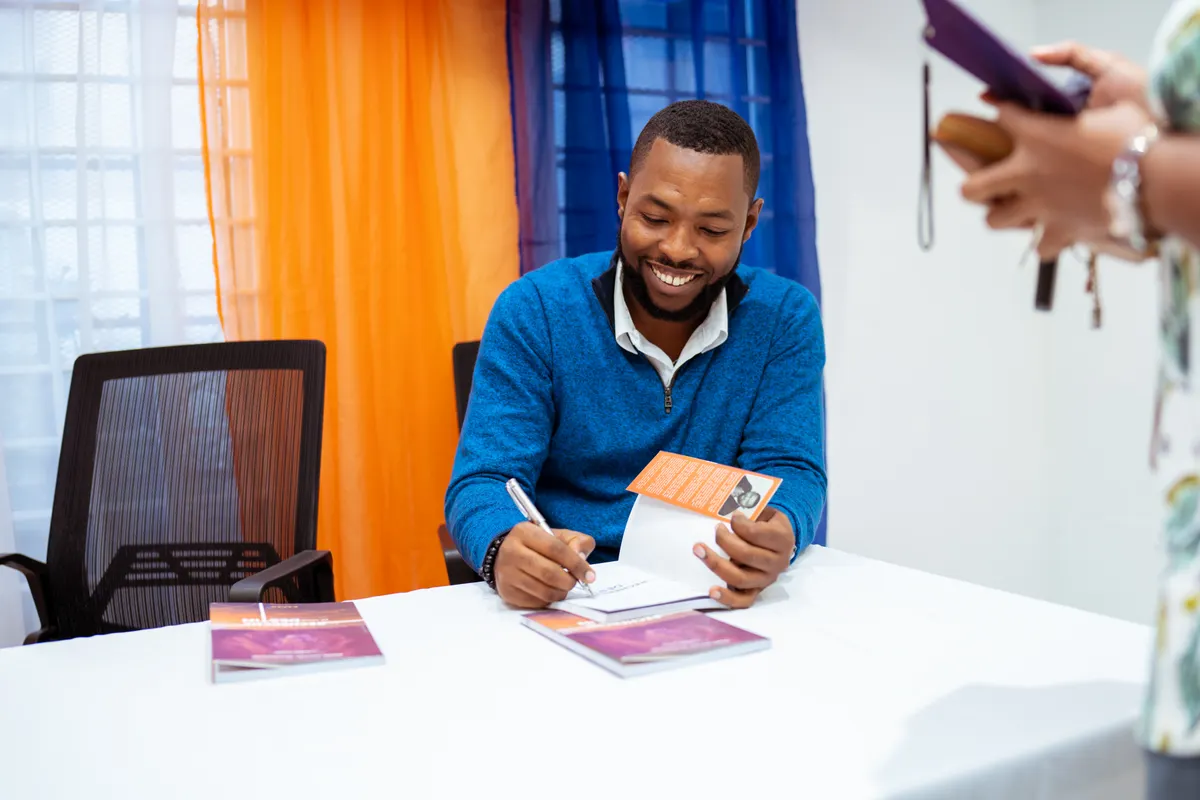
The book has found an audience. At the Abu Dhabi International Book Fair, now in its 35th edition, a reader waiting for Al Mur to sign his copy told Khaleej Times the novel was a bestseller in Dubai. Al Mur said Talhouga reached the top five best-selling titles at Kinokuniya UAE, the Japanese bookstore chain that describes itself as the country’s largest. The ranking mattered to her. ‘They don’t humour anyone,’ she said.
Readers from outside the UAE have also picked up her work. An Iraqi father bought one of her Emirati-dialect novels for his school-age son, uncertain whether the boy would follow the language. He later told Al Mur the boy had finished the book and enjoyed it.
Al Mur’s research method is methodical. When a story involves a specific historical moment, she checks where Emirati students were studying abroad at the time and what was happening in those places before she begins writing. For a story involving a tornado, she traced the relevant year before building the fictional narrative around it.
The interest in the past is not nostalgia, she said. Old stories provide material that can be reshaped for readers who never lived that world, giving them access to its language, beliefs and characters in a form they can recognise now.
Al Mur is currently working on her next novel, which she hopes to release at the Sharjah International Book Fair.
