
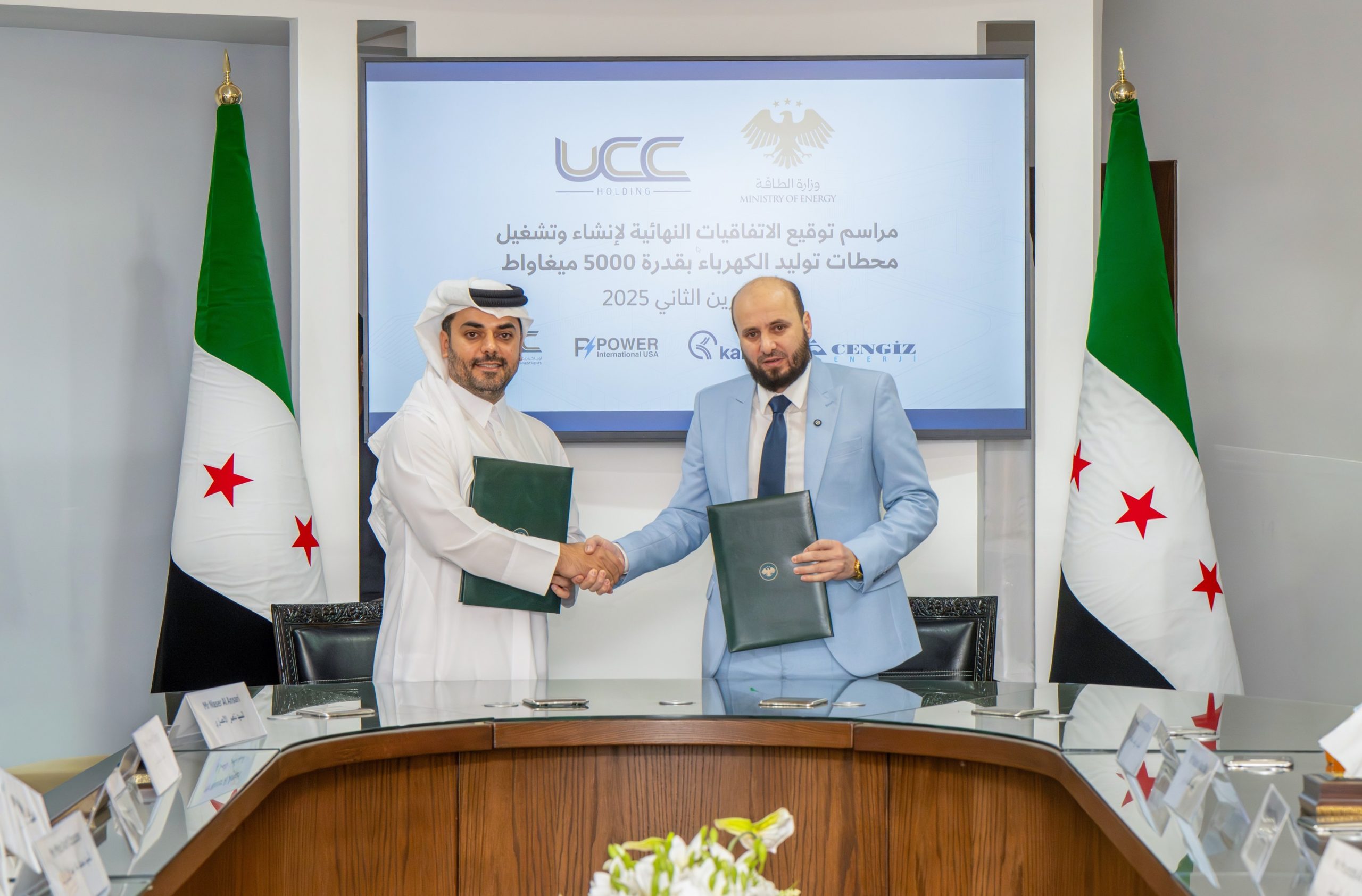
Marking a major milestone in strengthening national energy stability, the Ministry of Energy in Syria has signed the final concession agreements for the construction and operation of eight power generation plants with a combined capacity of 5,000 megawatts. The agreements were concluded with an international consortium led by Urbacon Holding through its subsidiary Urbacon Concessions Investment, in partnership with Kalyon G.I.S. Energy, Cengiz Energy, and Power International (USA). The signing builds upon the earlier Memorandum of Understanding of 29 May 2025, which set the strategic framework for collaboration in the energy sector. Since then, preparatory engineering and technical assessments, including site surveys and feasibility studies, have been completed to enable immediate commencement of work.
The agreements were signed at the Ministry’s headquarters in Damascus by H.E. Eng. Mohammad Al-Bashir, Minister of Energy of Syria, and Mr. Ramez Al-Khayyat, President of UCC Holding, in the presence of representatives from consortium partners and officials from the Ministry, the Syrian Energy Company, and the Syrian Electricity Company. The signing signifies the transition from planning and negotiation to active implementation on the ground.
The contracts include the development and operation of four high-efficiency, natural gas-powered combined-cycle stations: North Aleppo (1,200 MW), Deir Ezzor (1,000 MW), Zayzoun (1,000 MW), and Mhardeh (800 MW). Additionally, four solar energy projects totalling 1,000 MW will be established across Widian Al-Rabee (200 MW), Deir Ezzor (300 MW), Aleppo (300 MW), and Homs (200 MW).
These projects will utilise modern, high-performance technologies that meet international standards in efficiency, environmental safety, and operational reliability, with an accelerated phased construction plan to ensure timely commissioning.
The initiative marks a significant step in restoring Syria’s power infrastructure and stimulating economic recovery. Reliable electricity supply is vital to reactivating industrial capacity and supporting new commercial growth. The projects will also generate tens of thousands of direct and indirect employment opportunities and facilitate the development of local expertise, helping to sustain and advance long-term energy sector capabilities.
H.E. Eng. Mohammad Al-Bashir, Minister of Energy, stated:
“This project represents a qualitative leap in the development of Syria’s energy infrastructure. It enhances generation capacity and supports the stability of the electrical grid, aligned with national economic development objectives. These projects aim to close the generation gap, meet the growing demand for electricity, and enhance energy supply security, forming a fundamental base for sustainable economic and social growth, strengthening the performance of productive and service sectors, and enabling stable economic development in the coming years.”
Mr. Moutaz Al-Khayyat, Chairman of UCC Holding, said:
“The strategic partnership between the public and private sectors in this project constitutes an essential step toward building a sustainable development model in Syria, and reflects the confidence of international partners in the prospects of Syria’s economic recovery. We are committed to executing these projects according to the set timelines and the highest global standards, ensuring a tangible economic impact that extends beyond the energy sector to supply chains, industry, and investment flows. Enhancing Syria’s energy security will contribute to the revival of industrial activity, support economic stability, and open broader pathways for regional cooperation in the coming stage.”
The project represents the first and most prominent integrated public-private partnership model in the Syrian energy sector, reflecting the attractiveness of the national investment environment and its ability to draw international partners. The project is expected to pave the way for major investments in other key economic and service sectors in the near future.
