
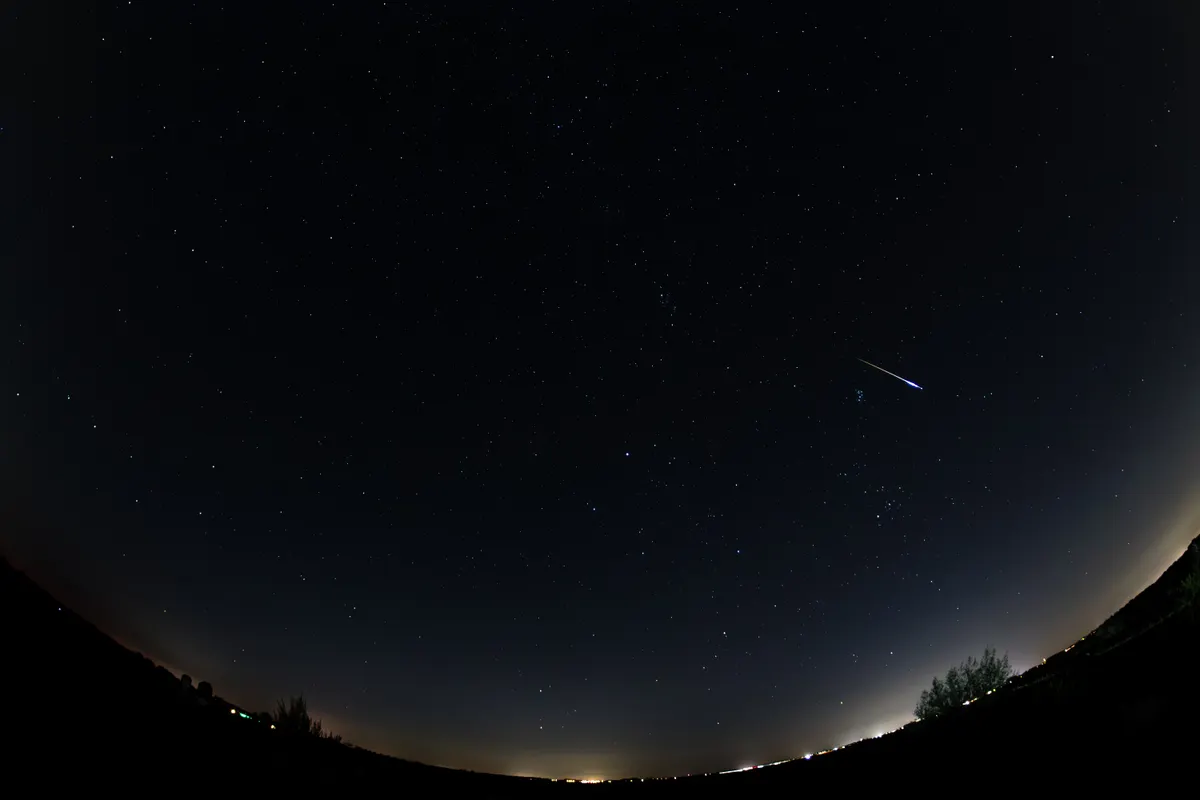
More than 300 people gathered at Mleiha National Park in Sharjah on Thursday evening for a Perseids meteor shower viewing event, counting four fireballs that left blue, red and white streaks across the night sky.
The event was hosted at the park, which is managed by Shurooq (Sharjah Investment and Development Authority) and offers astronomy experiences alongside desert adventures and archaeological centre visits.
Attendees spotted the fireballs over several hours. Each streak lasted only seconds, but the colours came from real chemistry: magnesium and nickel produce blue light, while sodium or iron creates orange, yellow or red glows as vaporised metal atoms burn in the meteor’s trail.
What drives the Perseids meteor shower
Prabhu, education coordinator at Mleiha Archaeological Centre, opened the evening with an astronomy presentation explaining the cause of the annual shower. Earth passes through the debris trail left by Comet 109P/Swift-Tuttle, and the meteoroids burn up in the atmosphere at around 59 kilometres per second.
The comet was discovered in 1862 by Lewis Swift and Horace Tuttle. Italian astronomer Giovanni Schiaparelli established in 1865 that the comet was the source of the Perseids, according to NASA Science. The comet’s nucleus measures 26 kilometres across, more than twice the estimated size of the object linked to the dinosaur extinction event.
The comet takes 133 years to orbit the sun. Its last visit to the inner solar system was in 1992. NASA places the next perihelion, its closest approach to the sun, in 2125; orbital data from Space Reference gives 2126. The NASA figure is used here.
Prabhu told the gathering that viewing conditions vary year to year. ‘Last year’s Perseids event was not ideal due to a bright moon,’ he said.
Under good conditions, NASA describes the Perseids as the most popular meteor shower of the year, with observers typically seeing 50 to 100 meteors per hour. Thursday’s count was lower, but the four fireballs recorded were among the brightest category of meteor.
What the evening looked like at Mleiha
Guests arrived to find several telescopes set up across the site. Through them, attendees picked out Venus, the star Vega, the Albireo double star, and Saturn, whose rings and moon Titan were clearly visible.
Organisers issued red transparent paper at the entrance for attendees to cover phone screens, filtering out white light that disrupts night vision. Halfway through the session, all lights were switched off. Eyes took roughly 30 minutes to fully adjust to the darkness before the sky came into sharper focus.
Activities ran alongside the viewing: a water-rocket launch pad and a meteorite hunt in which participants used metal detectors to search a marked area.
For 10-year-old Sohan and his 7-year-old brother Suvan, it was their first celestial event. ‘It was so exciting,’ Sohan said. ‘We loved the whole experience. I was able to spot two of the fireballs.’
Irfan, a visitor in the UAE for work, attended after a friend’s invitation. ‘It was a novel experience for me and I really enjoyed it,’ he said. ‘I have never seen so many astronomy enthusiasts in one place for a celestial event like this.’
The Perseids shower peaks annually and UAE residents also gathered at Al Quaa and Al Qudra during the peak nights. Orbital data for Comet 109P/Swift-Tuttle places the next return more than a century away, making each year’s pass through its debris trail the only opportunity this generation will have.
