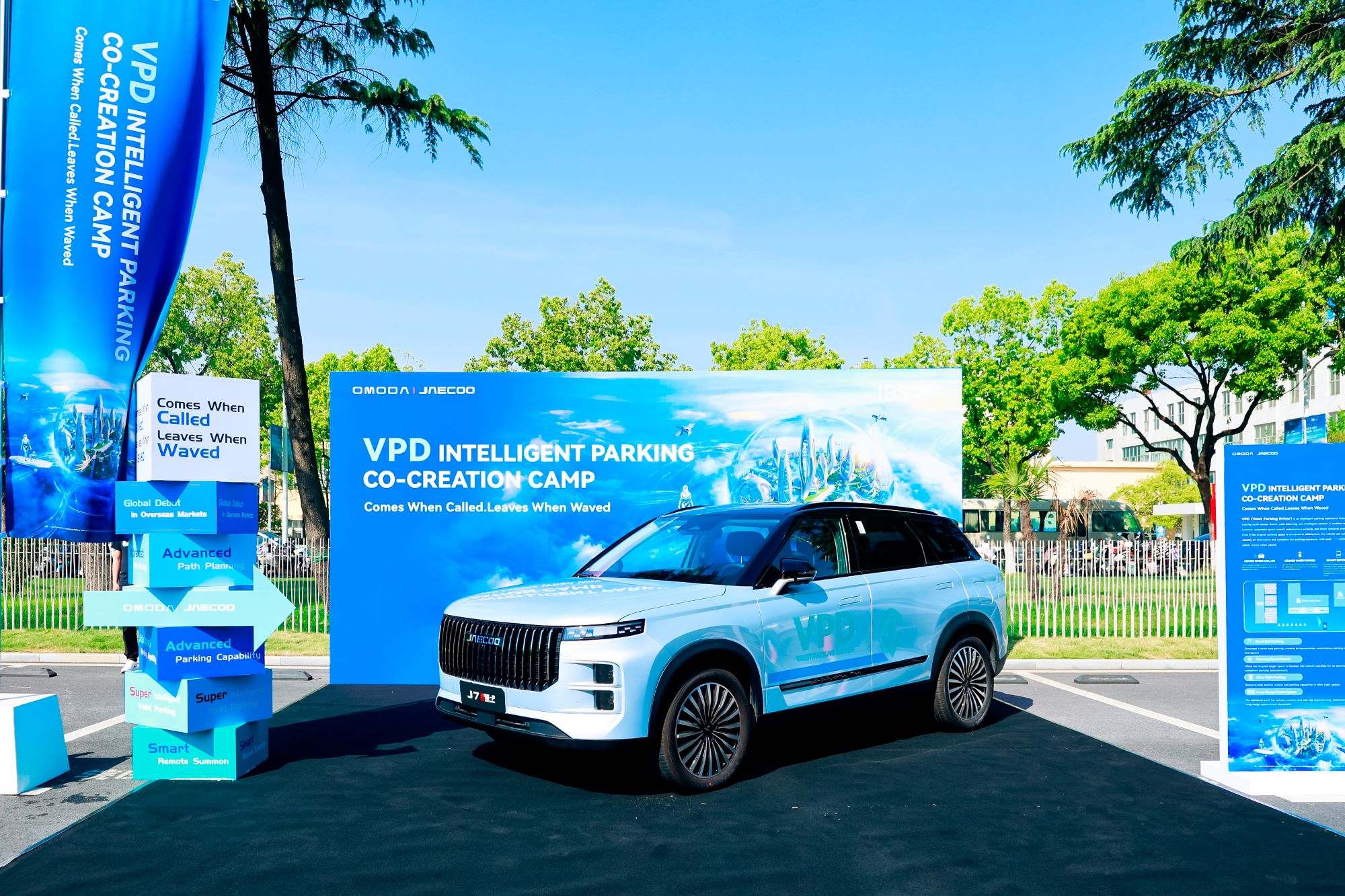
A driver with 15 years behind the wheel pulled into a tight parking spot in Beijing last week. The car beside him did the same—except nobody was inside.
The autonomous system won. Faster, smoother, fewer adjustments.
OMADA & JAECOO staged the human-versus-machine test during the Chery International Business Summit on 30 April, demonstrating Valet Parking Driver technology that the Chinese carmaker plans to roll out in the UAE within months. The system outperformed the experienced driver across every metric: time efficiency, steering corrections, and parking precision. No hesitation. No three-point shuffles. Just algorithms and sensors executing what took the human multiple attempts.
The demonstration marks a commercial push rather than a research experiment. OMODA & JAECOO recently crossed one million global vehicle sales—a milestone the company used as a launchpad to showcase technology it believes will resonate in Gulf markets, where summer temperatures regularly exceed 45°C and mall parking lots stretch across acres of sun-baked asphalt.
Valet Parking Driver operates as a closed-loop autonomous system, distinct from the parking-assist features already common in premium vehicles. Drivers control it entirely through a mobile application. Two functions anchor the experience: “Come When Called” summons the vehicle from wherever it parked itself, while “Leave When Waved” sends it off to find a spot after the driver walks away.
No need to circle for 20 minutes. No trudging across parking structures in 50-degree heat.
The Beijing test pushed the system through scenarios that would challenge most human drivers—mechanical parking towers, dead-end roads requiring multi-point turns, and retrieval requests from inside sprawling shopping centres. VPD navigated each situation using environmental perception that detected obstacles in real time, planned routes on the fly, and adjusted for pedestrians and other vehicles without human intervention.
Global media and dealers watched, including representatives from the UAE who will likely be among the first to see the technology reach showrooms. The timing matters. Dubai and Abu Dhabi rank among the world’s most car-dependent cities, with parking density that turns routine errands into spatial puzzles. OMODA & JAECOO identified that friction as an entry point.
The company positions itself as a technology-first brand targeting younger buyers—those who expect their vehicles to integrate with smartphones and anticipate their needs rather than simply respond to commands. VPD fits that narrative, though the appeal extends beyond demographics. Anyone who has spent 15 minutes searching for parking during Dubai Mall’s evening rush understands the value proposition.
What remains unclear is the exact rollout timeline. OMODA & JAECOO confirmed UAE availability “soon” but provided no specific quarter or model lineup. Regulatory approval for autonomous parking systems varies across markets, and the Gulf states have shown willingness to fast-track mobility innovations—Cruise and Uber tested autonomous vehicles in Dubai and Abu Dhabi over the past two years—but commercial deployment still requires infrastructure coordination and liability frameworks.
The technology also raises questions the demonstration didn’t address. What happens when the system encounters an unmapped parking structure? How does it handle valets or attendants directing traffic? What’s the fallback if connectivity drops mid-retrieval?
Those details will matter when the system moves from controlled demonstrations to daily use across thousands of vehicles.
OMADA & JAECOO’s parent company, Chery International, has been expanding aggressively beyond China, particularly into emerging markets where European and American brands face tighter competition. The Middle East represents a strategic beachhead—affluent, tech-adopting consumers with appetite for features that address region-specific pain points. VPD appears tailored for exactly that calculus.
During the same Beijing summit, the company unveiled its AiMOGA robotics ecosystem, which includes interactive robots designed for reception and human-machine interaction. The move signals broader ambitions beyond parking automation—toward a mobility ecosystem where vehicles, robots, and AI-powered services interconnect. Whether that vision materialises or remains a concept reel depends on execution over the next 24 months.
For now, the parking technology stands as the most tangible near-term product. Tesla offers a Summon feature that moves vehicles short distances in parking lots, though it requires the driver to remain nearby and monitor progress. Mercedes-Benz introduced automated valet parking in Germany several years ago, but the system relies on specially equipped car parks rather than the vehicle’s onboard intelligence. OMODA & JAECOO claims VPD operates independently across diverse environments without infrastructure modifications.
If that holds true in Dubai’s real-world conditions—sandstorms, intense heat, multi-storey structures with poor GPS signal—the system could differentiate the brand in a crowded market. Chinese automakers have spent the past five years closing the technology gap with legacy manufacturers, particularly in electric powertrains and driver-assistance systems. Autonomous parking represents another front in that competition.
The one-million-sales milestone provides context for the timing. OMODA & JAECOO launched as a standalone brand under Chery relatively recently, yet the company chose this moment to combine a commercial achievement with a technology showcase. The message: we’ve proven we can sell cars, now watch what those cars can do.
Whether UAE buyers will pay a premium for hands-free parking remains to be seen. The technology adds cost—sensors, processing power, software development—that manufacturers typically pass to consumers. OMODA & JAECOO hasn’t disclosed pricing for VPD-equipped models, nor which vehicles in its lineup will receive the feature first.
What’s clear is that the brand views the UAE as a priority market for advanced features, not just volume sales. That approach mirrors strategies from other Chinese manufacturers entering the Gulf, including BYD and NIO, both of which have positioned their UAE offerings around technology and connectivity rather than competing solely on price.
By year’s end, the question won’t be whether a robot can outpark a human in a controlled demonstration. It’ll be whether thousands of drivers trust the system enough to walk away while their car drives itself into a dark parking structure.
That’s the gap between a successful test and a successful product.