
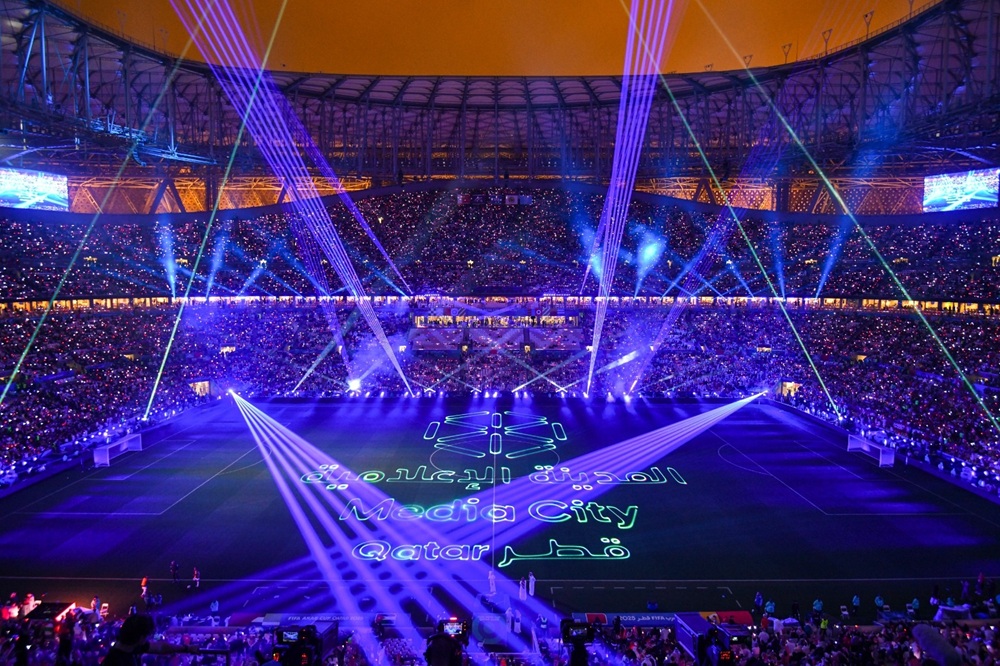
Lusail Stadium had seen spectacle before. But when the lights dimmed during halftime of the FIFA Arab Cup Qatar 2025 Final on Qatar National Day, something different unfolded. Not fireworks. Not dancers. Instead, 68 musicians from the Qatar Philharmonic Orchestra, 30 instruments, and a composition that began with the sound of desert wind and ended with a heartbeat echoing across 88,000 spectators.
The song was called ‘Nabd Qatar.’ Within weeks, it would rack up more than a million views.
Conceived by Media City Qatar as the centrepiece of its ‘Qatar SoundBeat’ initiative, the orchestral work premiered before government officials, visiting dignitaries from across MENA, and football fans who had travelled from every corner of the Arab world. The performance transformed the stadium into what organisers described as a canvas of sound and light—an attempt to bottle national identity into four minutes of music. Bold, certainly. But the social media numbers suggest something connected.
The work is now streaming on YouTube, Spotify, and Anghami, extending its reach far beyond that December evening in Doha.
What makes ‘Nabd Qatar’ unusual isn’t just its scale or its setting—orchestral performances at football matches remain rare—but its source material. Composer Omar Rahbany, from the regionally acclaimed musical family, built the piece around sounds that define Qatar and the wider Gulf: the rhythmic chants of the Ardha sword dance, written by H.E. Mr. Salah bin Ghanem Al Ali, the hum of shifting dunes, the cry of a falcon in flight, the gallop of an Arabian horse, the snap of a flag in wind. Familiar sounds, transformed into orchestral language.
“Media City Qatar entrusted us with creating a musical work that could carry the weight of a nation’s story,” Rahbany explained. “Every detail was crafted with intention, from phonetic elements that echo a heartbeat to the collective effort of dozens of technicians across multiple disciplines that brought the composition to life.”
The lyrics came from an unexpected place. Abdullah Khaled Abdulquddus drafted them, but the inspiration came from thousands of public contributions gathered during Media City Qatar’s ‘Qatar ArtBeat’ campaign for Qatar National Day 2024—a Guinness World Record-setting effort that crowdsourced creative input from across the nation. The song, in that sense, carried voices beyond those on stage.
Produced by Rahbani 3.0, one of the more than 300 licensed companies now operating within Media City Qatar’s ecosystem, the project involved months of coordination. Dr. Nasser Sahim, Deputy Executive Director of the Qatar Philharmonic Orchestra, acknowledged the demands it placed on his musicians. “Performing ‘Nabd Qatar’ was an honor for the Qatar Philharmonic Orchestra,” he said. “A work of this scale demanded precision, unity and deep musical understanding, and our musicians approached it with a thoughtful commitment to excellence in every note.”
That precision extended to the accompanying music video, directed by filmmaker Karim Rahbani, which rolled out across social media platforms in the days following the stadium premiere. The video layered images of Qatar’s landscapes—coastal, urban, desert—with footage of the orchestra and the live performance itself. By week’s end, the engagement metrics had exceeded internal projections.
For Media City Qatar, the initiative represents more than a one-off cultural event. H.E. Sheikh Dr. Abdulla bin Ali Al Thani, the organisation’s chairman, framed it as a statement of intent to the region’s creative community. “‘Qatar SoundBeat’ turns our nation’s raw sounds into a single piece unveiled on the international stage of the FIFA Arab Cup Qatar 2025 final before more than 88,000 spectators from across the Arab world,” he said. “Media City Qatar used this moment to send a clear message to the region’s creative community: The future of Arab media is being shaped here. It calls every creator in our region to look to Qatar as a place where new ideas can grow. This is ‘Where Next is Made.'”
That ambition sits within a broader context. Since hosting the 2022 FIFA World Cup, Qatar has accelerated efforts to position itself as a regional hub for media, content creation, gaming, and innovation—sectors where competition from Dubai, Riyadh, and other Gulf cities remains fierce. Media City Qatar’s roster has grown to more than 300 licensed companies, spanning production houses, tech start-ups, and creative agencies. The ‘Qatar SoundBeat’ initiative, officials suggest, demonstrates the kind of large-scale cultural production the infrastructure can now support.
Whether that infrastructure translates into sustained creative migration remains an open question. Regional talent remains mobile, and incentives matter. Yet the million-plus views for ‘Nabd Qatar’ suggest at least one thing: appetite exists for work that merges Arab cultural identity with high production values and global distribution channels.
The choice to debut the piece at the Arab Cup Final wasn’t accidental. The tournament, while smaller than the World Cup, drew teams and supporters from across MENA, offering a concentrated audience already primed for displays of regional pride and identity. The timing—Qatar National Day—layered additional symbolic weight onto the performance. National leadership attended. Cameras captured reactions. The moment was designed to resonate.
And it did, if social media metrics are any guide. Clips of the light show, the orchestra, and the song itself circulated widely across platforms in the days that followed, shared by sports accounts, cultural commentators, and users with no apparent connection to Qatar. The reach extended beyond the Arab world, picking up views in Europe, Asia, and North America.
To be clear, orchestral music doesn’t typically go viral. The success of ‘Nabd Qatar’ likely owes as much to its context—the stadium, the timing, the spectacle—as to the composition itself. But Rahbany and his team understood that. They built the work for that specific moment, knowing it would be filmed, shared, and dissected across digital platforms. The orchestration, the visual accompaniment, the symbolic sounds—all calibrated for an audience experiencing it first on screens, even if 88,000 people witnessed it live.
What’s less certain is how this translates into Media City Qatar’s longer-term objectives. One viral moment doesn’t guarantee a creative ecosystem. Sustained success requires infrastructure, funding, talent pipelines, and regulatory environments that allow experimentation. Media City Qatar points to its growing roster of companies as evidence of momentum. Critics might note that many Gulf initiatives have struggled to move beyond flagship projects to organic, self-sustaining creative communities.
Still, Rahbani seemed pleased with the outcome. Speaking after the premiere, he highlighted the collaborative nature of the project—the orchestra, the technicians, the lyricists, the videographers. That collaboration, he suggested, demonstrated what becomes possible when creative ambition meets institutional support.
For now, ‘Nabd Qatar’ continues to circulate online, soundtrack to a moment when sport, culture, and national identity converged inside a stadium designed to hold them all. The song plays on. The views climb. And Media City Qatar watches closely, measuring whether a musical experiment can help rewrite the region’s creative geography.
