
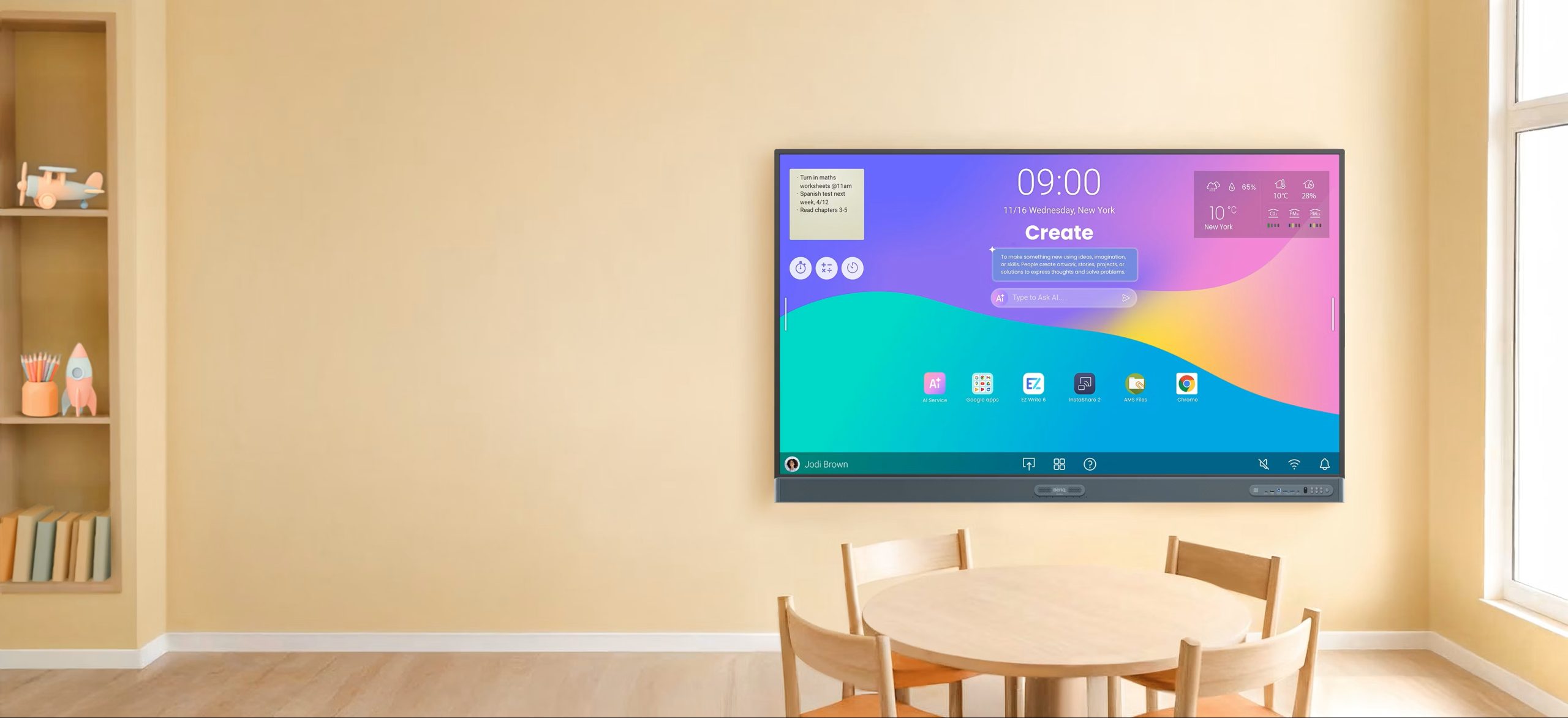
BenQ unveiled its RP05 interactive whiteboard in Dubai on 11 June, cramming 50 simultaneous touch points into an 86-inch display designed for Gulf classrooms where group work can involve entire rows of students.
No other Android-based education display supports that many concurrent touches.
The device runs Android 15 and houses a 10 TOPS neural processing unit that handles AI tasks without routing data to external servers—a design choice that sidesteps latency issues and keeps student information on-premises. BenQ Middle East pitched the board as a replacement for the ageing setup where teachers juggle an interactive display, a separate Windows PC, and a tangle of HDMI cables.
That’s a direct challenge to SMART Technologies and Promethean, which have dominated Middle Eastern classrooms for the past decade with displays that typically require external computing modules.
The RP05’s Edge AI architecture processes voice transcription, lesson summaries, and visual search locally. Teachers can scribble diagrams during a chemistry lesson, then ask the system to retrieve similar annotations from previous classes—all without cloud dependence. The board also translates on-screen text across multiple languages in real time, a feature aimed at international schools where Arabic, English, and Hindi might appear in a single classroom.
Built-in collaboration tools include EZWrite for whiteboarding, InstaShare for wireless screen sharing, and a broadcast system that lets administrators push emergency alerts to every connected display across a campus. Google EDLA certification means direct access to Workspace apps and the Play Store, though BenQ’s Device Management Solution lets IT teams lock down which apps students can actually launch.
Manish Bakshi addressed the timing during the launch event. “Educational institutions across the Middle East are increasingly investing in AI-enabled technologies to create smarter and more collaborative learning experiences,” he said. “The BenQ Board RP05 represents the next evolution of the interactive whiteboard – combining powerful AI capabilities, enterprise-grade security, and intuitive collaboration tools into a single platform designed for the future of education.”
What Bakshi didn’t mention: pricing, which BenQ declined to disclose ahead of individual institutional negotiations.
The 86-inch model ships immediately across the United Arab Emirates, Saudi Arabia, Qatar, Kuwait, Oman, and Bahrain. Smaller 65-inch and 75-inch versions will follow later this year, though BenQ hasn’t committed to a specific quarter. The company said the smaller formats will carry identical specs, including the 50-point touch capacity that sets the RP05 apart from the earlier RP04 series, which maxed out at 40 points.
Hardware specifications reveal why BenQ believes it can eliminate the external PC: the neural processing unit delivers enough horsepower to run Android apps, process AI requests, decode multiple video streams, and handle 50 touch inputs simultaneously without thermal throttling. High-performance speakers and a multi-microphone array support hybrid classes where half the students attend in person and half join via video link—a configuration that became standard across GCC universities during the pandemic and never fully reverted.
The board also carries Eyesafe 3.0 certification for reduced blue light emission and a germ-resistant screen coating, both part of BenQ’s ClassroomCare suite. Whether schools will pay a premium for health-focused features remains unclear, though administrators who dealt with COVID-related closures may view antimicrobial surfaces differently than they did in 2019.
BenQ’s push into AI-enhanced education hardware follows similar moves by Google, which embedded Gemini into Workspace for Education earlier this year, and Microsoft, which added Copilot features to Teams for Education last autumn. The difference lies in where the processing happens: cloud-based AI tools require robust internet connections, which can falter in older school buildings or during peak usage periods when hundreds of students stream video simultaneously.
Edge AI solves that problem by keeping computationally intensive tasks on the device itself. The trade-off is raw power—a 10 TOPS neural chip can’t match the capabilities of a data centre GPU cluster—but for classroom use cases like transcription, translation, and visual search, local processing proves sufficient.
The RP05’s Account Management System lets teachers sign in with personal credentials and access cloud-stored lessons from any connected BenQ board across their institution. A secondary school teacher who rotates between four different classrooms can pull up yesterday’s annotated presentation without emailing files to themselves or fumbling with USB drives.
Industry analysts have tracked growing appetite for education technology across the Gulf Cooperation Council, particularly in Saudi Arabia, where the Vision 2030 initiative allocates significant funding toward classroom digitisation. The UAE, Qatar, and Kuwait have launched similar programmes, though adoption patterns vary: international schools typically refresh hardware every three to five years, while government institutions operate on longer cycles tied to ministry budgets.
For BenQ, the Middle East represents a strategic growth market. The company has supplied projectors and displays to the region for years but faced entrenched competition in the interactive whiteboard category, where SMART’s name became synonymous with the product itself—much like Xerox once meant photocopier.
The 50-point touch capability targets a specific pain point: group activities where students crowd around a display to collaborate on a mind map, annotate a shared document, or solve a maths problem together. Previous-generation boards supporting 20 or 30 touch points forced students to take turns or resulted in missed inputs when too many hands reached the screen simultaneously.
Whether schools will actually deploy lessons that require 50 concurrent touches is another question. Classroom management becomes chaotic when that many students interact with a single surface at once, and teachers may find that smaller group sizes—say, six to eight students per board—work better in practice.
Still, the technical capability matters for institutions planning collaborative spaces where multiple groups rotate through activities, each needing immediate responsiveness without the lag that plagued earlier Android-based displays.
BenQ hasn’t disclosed how many RP04 units it sold across the Middle East, which makes gauging the RP05’s potential impact difficult. The education display market remains fragmented: some schools standardise on a single vendor, while others mix brands across campuses, leading to incompatible software ecosystems and frustrated IT departments.
The broadcast feature addresses one persistent administrator complaint—the inability to quickly communicate with students and staff during emergencies. Previously, schools relied on separate PA systems, SMS alerts, or runners dispatched to knock on classroom doors. A network-connected display that can override whatever lesson is in progress and display an evacuation notice or lockdown instruction offers tangible value beyond pedagogical benefits.
By anchoring the RP05 around Android 15 rather than Windows, BenQ bets that education software will increasingly migrate to web-based and mobile-first architectures. That shift has accelerated since 2020, when schools discovered that Chromebooks and iPads could handle most learning tasks without requiring expensive Windows licenses or dedicated IT staff to manage updates and security patches.
The question now is whether institutions that spent heavily on SMART or Promethean ecosystems over the past decade will entertain a wholesale switch to BenQ—or whether the RP05 finds its audience primarily among new schools and universities still building out their technology infrastructure.
Deliveries begin this month for orders placed before the end of June. After that, lead times will depend on demand and the same supply chain constraints that have affected education hardware shipments across the region for the past two years.
