
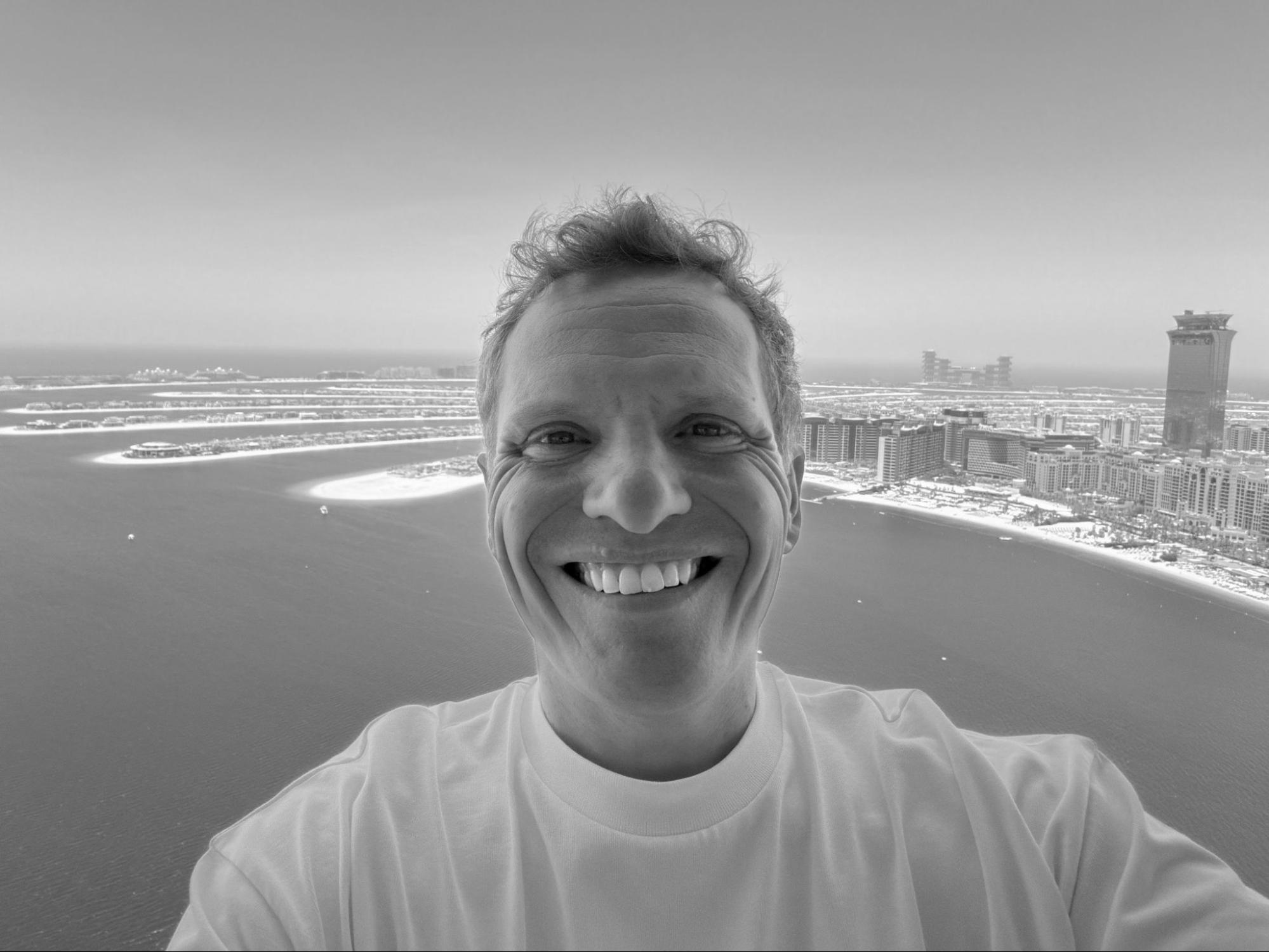
by Mark Creaser – Entrepreneur
I get asked the same question roughly once a week, usually by someone whose entire experience of the place is a stopover, a rooftop bar and a photograph of a policeman’s Lamborghini. “It’s the tax, right?” They say it with the settled confidence of a man who has understood the whole transaction and would now like his coffee.
It is the lazy assumption. About as illuminating as suggesting people move to Scotland for the weather.
I came out for Token2049 in April last year, with my business partner Siam. We had launched our fund a few months earlier and arrived at Madinat Jumeirah to find fifteen thousand people from 160-odd countries all having the same conversation at the same time. Every year, a percentage of those people make plans to stay permanently.
This April, I became one of them.
The latest Henley Private Wealth Migration Report projected 142,000 millionaires crossing borders in 2025, the highest number the firm has ever recorded. The UAE: top of the inflow table, at plus 9,800.
The UAE has roughly the population of Ohio, yet it’s attracting more millionaires than the whole of the United States. And the biggest exporter of millionaires on Earth was no longer China, which had held the title for a decade. It was Britain. Minus 16,500. More than double China’s loss. Not one of them, as far as anyone can tell, was headed for Umm Al Quwain.
Part of the mechanism is no mystery. In April 2025 Britain abolished the non-dom regime, an arrangement dating back more than two centuries that let wealthy foreigners live in the UK without paying UK tax on their foreign income. You can argue the fairness of that both ways. What you cannot argue with is the response: the people it applied to did not write to their MPs, they rang a removals firm. HMRC wanted more revenue. It got one-way tickets and empty mansions.
This is the one case where tax really was the trigger, and it pays to be precise about what it triggered. It made these people leave. It did not decide where they landed. The shortlist was Dubai, Monaco, Switzerland. A tax change can start an exodus, but it never picks the destination. That gets settled on other grounds. Which is the whole point.
The response, from a country watching its wealth creators file through departures, has been instructive. Britain’s brand-new Prime Minister, in his first press conference this week, twice declined to rule out raising the top rate of income tax. Whatever the next Budget holds, every high earner in Britain heard the message. And mobile capital does not wait around to see what an exit tax looks like in practice.
People arrive here for different reasons.
Some move because the ground under them gave way. After 2022, large numbers of Russians and their dependents took UAE residency. The precise figure depends on who’s counting; the direction is not in doubt. A quieter version of the same current runs from Israel, which in 2025 saw a net 50,000 citizens leave, most of them educated professionals. Clean numbers on how many reach the Gulf don’t exist, and I won’t invent any.
But some of that flow lands here. This city is a beneficiary of instability elsewhere. That isn’t a moral failing. It is geography and timing.
Others didn’t have the ground give way; they simply got tired. The Brits and northern Europeans who didn’t storm out: they seeped. In Britain the exhaustion has a specific flavour: regulation that seems designed less to protect the public than to wear out anyone attempting to build something. Opening a company is competitive form-filling. Hiring one person triggers a cascade of obligations with no visible connection to the work.
Eventually the rational response is to stop.
And underneath the paperwork sits something more primitive. A friend of mine was mugged for his watch in Barcelona. Not burgled, not scammed: mugged. Britain has lost three parliamentarians to violence in a decade; the state cannot keep its own lawmakers safe. Here the law is respected and, more to the point, enforced. Two hundred nationalities. Zero income tax. A crime index of 16 against London’s 45. Everyone’s fixated on the middle number. The other two are doing most of the work. Safety isn’t a small amenity. It is the foundation.
Then there’s my own lot: an industry that picked up its entire centre of gravity and carried it to the Gulf. The banks here open accounts for crypto businesses, which sounds trivial until you’ve tried it from London. And VARA, Dubai’s virtual-asset regulator, offers something rarer than a low rate: rules you can read, applied by people who want you to succeed under them. Firms don’t come here for the absence of rules. They come for rules that stay where you left them.
The AI companies run the same sum with bigger numbers. They look at British industrial electricity prices, note that training a model there costs more than almost anywhere in the developed world, watch a government change energy policy the way motorists change lanes, and conclude the conversation is over. Unstable policy is just another tax, paid in uncertainty. So the compute goes where the power is cheap and the rules hold. Some of it comes here.
Which brings us back to tax, because yes, it exists, and no, zero income tax is not nothing. But the rate is really a symptom of something larger: the size of the state itself. The UAE government has proven, in my view, a better allocator of capital than many European nations, and it still leaves a greater share of that capital with the individuals and businesses who earned it. Small state, good state. Strong laws, little red tape, an almost obsessive focus on whether things actually work.
So in a year of watching arrivals, I’ve never once heard the tax rate given as the reason. It’s the tiebreaker. Once safety, schools, banking and your industry’s presence have all cleared the bar, tax settles an argument the other things started.
And there’s one more thing, the bit nobody in the West quite has the nerve to say. This city runs better partly because it stopped pretending that endless debate is the same thing as progress. Somewhere in the last few decades the West trained itself to confuse friction with freedom: committees got called democracy, delay got called respect for process, and punishing the productive got called fairness. That story held while the West was still the side building things.
A British government lives inside a five-year electoral cycle and in practice governs for less, so the rational politician invests in whatever pays out before the next election. Nobody plants trees they will never be photographed under. That isn’t a character flaw. It is an incentive structure, and incentives always win.
Dubai bet the other way: execution over theatre, time horizons measured in decades rather than news cycles.
Since the turn of the century Britain has got through nine prime ministers, a little over three years each. The man who runs Dubai has held the job since 2006. He’s watched Downing Street change hands eight times while working from the same twenty-year plan. You plan differently when you expect to be there for the results.
The tidy version of this story is a brochure. The true version is messier: a city compounding talent and capital out of other people’s wars, other people’s fatigue, and the West’s long experiment in punishing the people it can least afford to lose.
For a growing number of people, where you live has stopped being a default and become a decision. The man with the coffee thinks it comes down to a simple sum. He is right that it does; he’s just been adding up the wrong column.
