
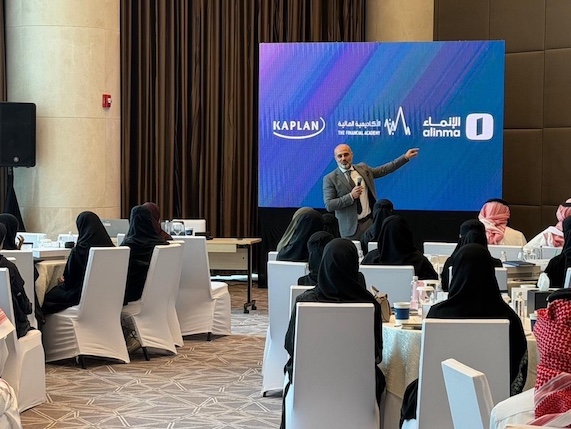
Saudi Arabia’s banking app market will hit SAR 121.71 billion by 2030, growing at 4.88% annually as the Kingdom accelerates its shift toward cashless transactions. On 9 June, over 50 young professionals walked into Alinma Bank’s Riyadh headquarters to begin a 12-week intensive programme designed to prepare them for that reality.
The gap between demand and talent has never been wider.
The Future Bankers Program, delivered in partnership with Kaplan Professional MENA, targets the skills banks desperately need: artificial intelligence, cybersecurity, data management, fraud prevention, and digital banking operations. Participants—mostly Alinma employees and fresh graduates selected through a competitive process—will earn a Level 7 Diploma from Kaplan Professional Awards, an OFQUAL-regulated UK awarding body. That credential carries weight beyond Saudi borders.
What separates this from typical corporate training is structure. The programme bridges academic theory and operational banking, addressing the reality that traditional education hasn’t kept pace with the sector’s digital transformation. Classroom modules run alongside applied learning, reflecting how banks actually operate in 2026—not how textbooks say they should.
Saudi Vision 2030 set ambitious targets for a digitally empowered economy. The banking sector responded by racing toward contactless payments, app-based services, and AI-driven customer interactions. But technology moved faster than talent pipelines. Now institutions face a stark choice: develop capabilities internally or watch competitors pull ahead.
Ms. Aljawharah Alghofaili, Executive Director Talent Management at Alinma Bank, framed the initiative as both strategic and patriotic. “At Alinma Bank, we are proud to develop initiatives that support the direction of Saudi Vision 2030 in empowering youth and strengthening the financial sector, in line with the ongoing development of the banking industry,” she said. “The Future Bankers program is designed to equip youth with practical, future focused skills through a structured learning experience that reflects current trends and evolving practices in the sector.”
The programme’s curriculum goes deep on specialisations. Participants won’t just learn about cybersecurity—they’ll study fraud prevention frameworks banks deploy daily. They won’t merely discuss AI—they’ll explore how algorithms drive credit decisions and customer service automation. Kaplan’s role centres on delivering this specialised content, drawing on expertise across its Middle East and North Africa operations.
Stuart Whent, Chief Operating Officer of Kaplan Professional MENA, positioned the collaboration as responding to market forces. “The Future Bankers Program reflects our continued commitment to supporting Saudi Arabia’s vision of developing a highly skilled and future-ready financial services workforce,” he noted. “By working alongside Alinma Bank, we are bringing together leading expertise to equip young professionals with the capabilities required to thrive in a rapidly evolving banking landscape, particularly in areas such as digital transformation, AI, and cybersecurity.”
The timing matters. As digital banking becomes embedded in daily Saudi life—from grocery payments to mortgage applications—the industry’s talent requirements have fundamentally shifted. Banks no longer need just relationship managers and credit analysts. They need professionals who understand regulatory technology, data privacy frameworks, and algorithmic risk management.
Alinma Bank, established in 2006, operates as a Shariah-compliant institution serving personal and corporate clients across the Kingdom. The bank trades on the Saudi exchange under ticker 1150 and has built its reputation on digital innovation within Islamic finance principles. Developing internal talent aligns with its broader strategy to compete in an increasingly crowded market.
Kaplan brings global scale to the partnership—the education company serves roughly 1.2 million students and professionals across 40 countries, working with 16,000 corporate clients and 2,700 educational institutions worldwide. Founded by Stanley Kaplan in 1938, the firm operates as a subsidiary of Graham Holdings Company. Its five MENA offices span Dubai, Riyadh, Abu Dhabi, and Cairo, positioning it to deliver regionally tailored programmes.
Whether 50 participants can meaningfully address the sector’s skills shortage remains an open question. The programme represents one bank’s response to an industry-wide challenge. Other financial institutions face identical pressures as Saudi consumers abandon cash and embrace app-based banking at accelerating rates.
By 2030, the participants completing this June’s cohort will have spent four years applying what they learned. The SAR 121 billion market will be operational reality, not projection. And the question won’t be whether digital transformation arrived—it will be whether the Kingdom developed enough skilled professionals to sustain it.
For now, the focus stays on the next 12 weeks. Structured learning modules. Applied banking scenarios. Technical certifications. Then the real test begins when graduates step into roles where theory meets the daily demands of a financial sector remaking itself at speed.
