
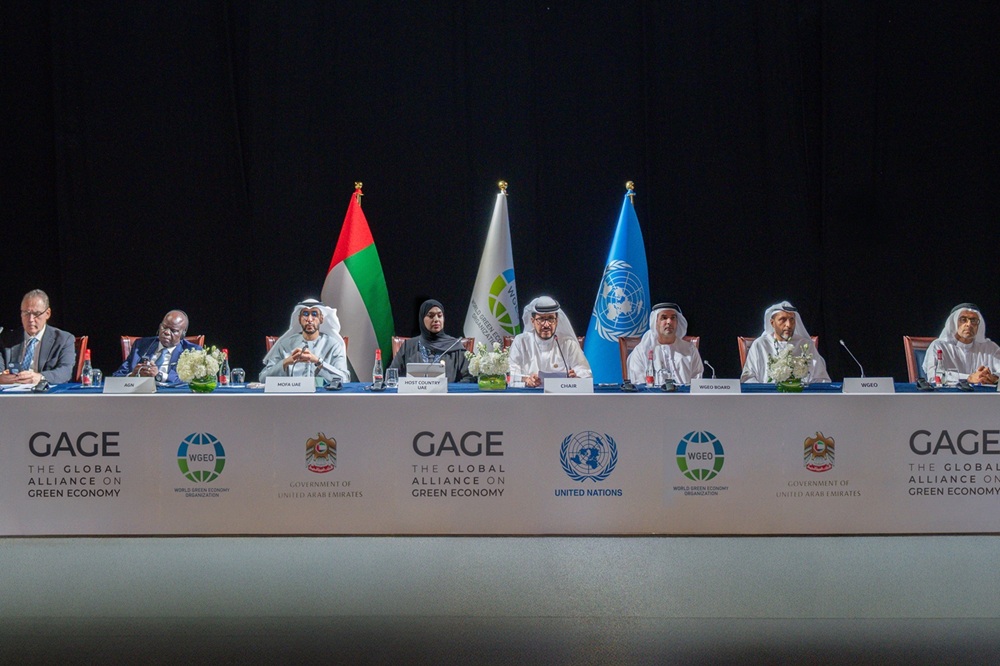

HE Saeed Mohammed Al Tayer, Chairman of the World Green Economy Organization (WGEO), delivered the opening address at a high-level ministerial roundtable hosted by WGEO during the 11th World Green Economy Summit in Dubai.
The session, held under the theme ‘Delivering Climate Ambition by 2030 and Beyond – United Action for Green Transition’, aimed to advance global climate ambitions and promote dialogue on aligning policies, finance, and innovation with sustainable development goals.
The roundtable brought together senior government officials including HE Dr Amna bint Abdullah Al Dahak, UAE Minister of Climate Change and Environment; HE Dr Ayman Suleiman, Minister of Environment, Jordan; HE Dorin Junghietu, Minister of Energy, Moldova; HE Dr Muaviyath Mohamed, Minister of State for Tourism and Environment, Maldives; HE Abubakar Ben Mahmoud, Minister of the Environment, in charge of Tourism, Comoros; Hon James Opiyo Wandayi, MGH, Cabinet Secretary for Energy and Petroleum, Kenya; HE Iury Valter de Sousa Santos, Secretary of State for the Environment, Angola; HE Hambardzum Matevossian, Minister of Environment, Armenia; HE Roberto Mito Albino, Minister of Agriculture, Environment, and Fishery, Mozambique; and HE Abdulla Balalaa, Assistant Minister of Foreign Affairs for Energy and Sustainability at the UAE Ministry of Foreign Affairs.
The session was also attended by ambassadors and delegates from the 91 member states of the Global Alliance on Green Economy, as well as representatives of international organisations.
In his speech, Al Tayer highlighted the commitment of the UAE’s leadership to a sustainable, just, and inclusive future for all, noting the vision of HH Sheikh Mohammed bin Rashid Al Maktoum, Vice President and Prime Minister of the UAE and Ruler of Dubai, as a guiding force for these efforts.
“Our task is to translate pledges into policies, strategies into scalable projects and commitments into measurable impact. This means confronting the hard questions: How do we dismantle policy, financial and institutional barriers? How do we unlock private finance and forge powerful public-private partnerships aligned with National Determined Contributions? And how do we ensure innovation is not only fast-tracked but also inclusive – benefitting youths, women and vulnerable communities? Clean energy and innovation will drive this transition. We must focus on co-operation and investment in breakthrough technologies, in addition to accelerating renewable deployment and enabling green finance to flow where it is most needed, particularly in the Global South,” said Al Tayer.
The roundtable underscored the importance of global collaboration to accelerate green finance flows, foster innovation, and address institutional barriers to achieve climate goals and ensure equitable benefits for all communities.